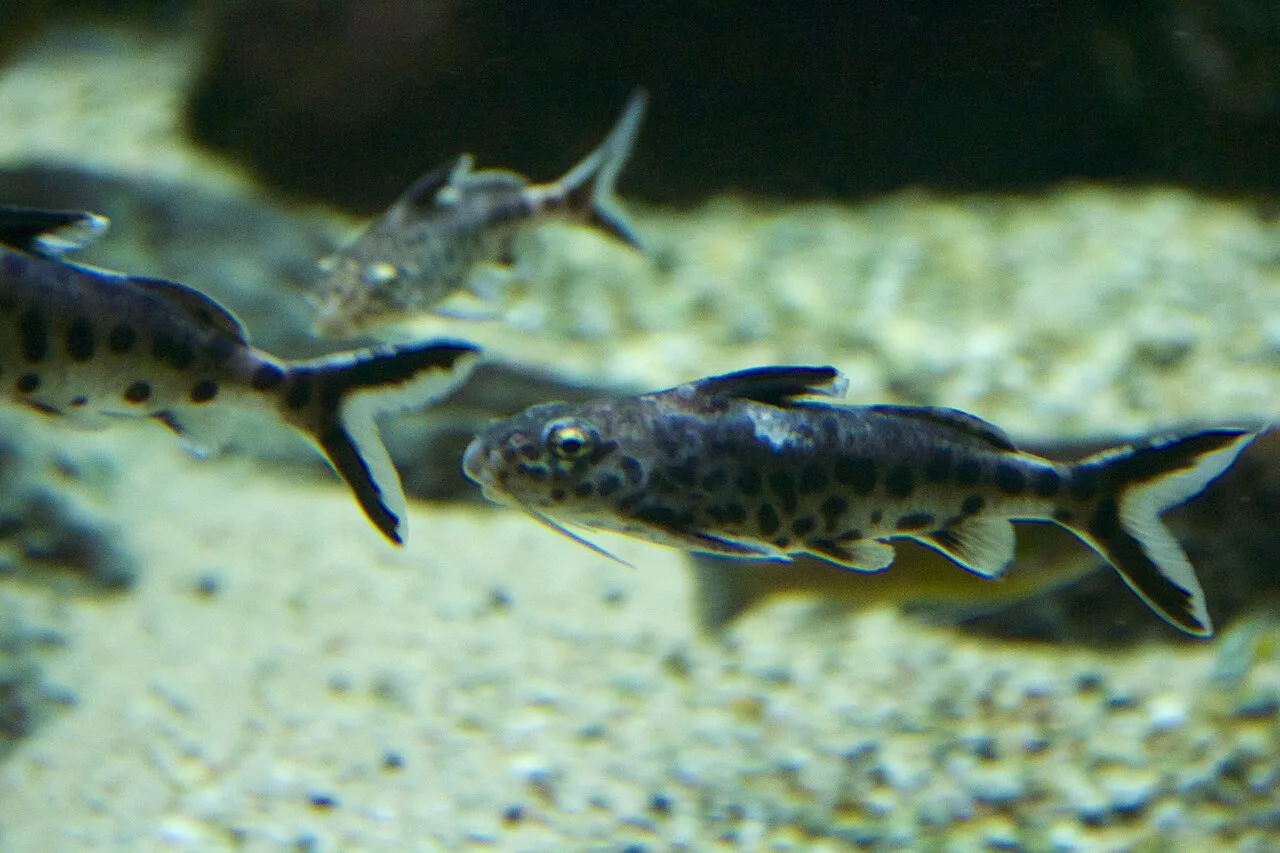
Compressiceps cichlid
Altolamprologus compressiceps
26 views
A strongly compressed cichlid from Lake Tanganyika. It hunts in rock cracks and needs hard water and caves of its own.
- Temperature
- 24 – 28 °C
- pH
- 8 – 9 pH
- General hardness
- 10 – 20 °dH
- Maximum size
- 12 cm
- Minimum tank size
- 200 L
5 min read · 702 words
Fresh water
Quick facts
Place in the aquarium
Highlighted are the water layer and the spots where the species usually stays in the tank.
- Near the bottom Mostly stays just above the bottom. Food has to reach the substrate.
- Rocks and caves Needs caves, crevices or rockwork as hiding place, territory or spawning site.
Shrimp in the tank
Not shrimp safe
- Not shrimp safe
- Dwarf shrimp at risk
- Shrimplets at risk
- Shrimp safe
- Adult dwarf shrimp
- At risk
- Shrimplets
- Get eaten
- Safe from shrimp size
- No size is safe
The compressiceps is a dedicated shrimp hunter. It eats very small fish and small freshwater shrimp and follows them with its extremely narrow body even into tight rock crevices. Hiding places that protect against other fish do not help here. At up to 13 cm and with an extensible mouth it also overpowers larger shrimp. Shrimp therefore do not belong in its tank. The species does best in a Tanganyika tank with plenty of rock and tankmates that use other zones.
Home & range
Overview
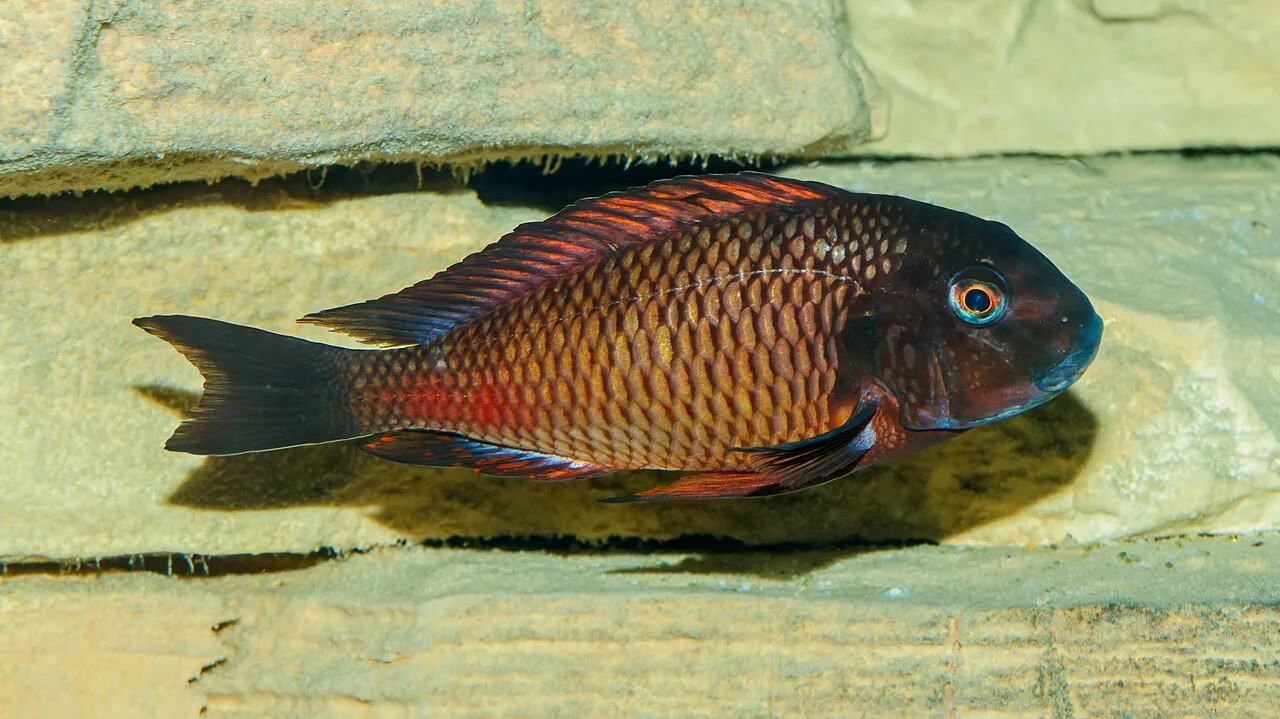
Altolamprologus compressiceps reaches about 12 cm, females stay smaller. The body is so flat that it enters cracks that are too tight for other cichlids. The ground colour is beige to gold-brown with dark bars. There are several shore populations. They should not be bred on as random mixes.
The species eats mainly small animals that it takes from crevices. It is not an aufwuchs feeder and not a Malawi mbuna, even though both stand in hard water.
Body shape
The strongly compressed, deep body reaches a depth of up to 40 percent of standard length. The species can grow to 13 cm but usually stays smaller. No external sex difference is known. The strikingly tall dorsal fin carries 20 to 21 spines, the anal fin 9 to 12. The mouth is densely toothed and very extensible. Depending on the population the base colour is brownish beige, olive green or yellowish. Six to seven dark vertical bars pattern the flanks, more clearly in young fish than in old ones. The pectoral fins are yellow to reddish orange.
Telling it apart from Altolamprologus calvus
In A. compressiceps the nape is scaled, in A. calvus it is not. It also has shorter jaws and an upturned snout. A. calvus has a long sloping face, less distinct bars and more distinct spots. Numerous local forms are traded, such as Fire Fin, Gold, Gold Head Kasanga, Kigoma, Mutondwe, Red Fin, Yellow Chaitika and Zaire Gold. Some of them may prove to be separate species or subspecies. Locally the fish is called lupapa.
Classification
George Albert Boulenger described the species in 1898 as Lamprologus compressiceps. Since 1986 it has been the type species of the genus Altolamprologus, introduced by Max Poll. The genus also contains A. calvus and an undescribed small species, Altolamprologus sp. „shell“. Genetically the haplotypes of calvus and compressiceps form a disordered network. This is explained by hybridisation when fluctuating lake levels brought separated populations together.
Origin & habitat
This describes the origin, not how to furnish the aquarium.
Rocky coasts of Lake Tanganyika. Clear, alkaline, oxygen-rich water, cracks and overhangs. The lake is the origin. Individual stretches of shore are not a reviewed point map here.
In the rock the fish hunts sideways into the crevice. A smooth rock tank without tight cracks takes away exactly that hunt.
The species lives at depths of two to ten, at most 30 metres in the rocky zone of the lake. The IUCN does not consider it threatened. Lake Tanganyika holds at least 250 cichlid species, almost all of them endemic.
Care
Layout
24 to 28 °C, pH 8 to 9, hard. From about 200 litres and 100 cm for a pair, with a layout of flat stones that form real cracks. Sand in front. Several pairs need clearly more length and separate territories. A single fish is possible.
Company
Other Tanganyika species that use other zones, such as shell dwellers on the sand, if the tank offers both. Soft-water fish and mbuna do not belong. Shrimp and very small fish are prey. The compressiceps digs little and is more likely to leave tough epiphytes standing.
Diet
Animal food that falls into the cracks and onto the sand. Brine shrimp, mosquito larvae, small pieces of frozen food, a granule. The fish do not feed hurriedly at the surface. A feeding only there misses them.
Pieces that are too large are ignored or spat out. The mouth is built for small bites from the crevice.
Altolamprologus compressiceps eats very small fish and small freshwater shrimp. Thanks to its narrow body it follows them even when they flee into narrow rock crevices.
Behavior
Quiet, until another fish wants the same crack. Then the body itself is the weapon: it turns sideways and blocks the entrance. Losing fish need a second crack out of sight.
The species is active by day, but not hectic. It often stands for minutes sideways in a crevice and watches the tank.
Reproduction
Cave spawner. The female, clearly smaller, fits into tighter cracks than the male and guards the clutch there. The young stay nearby for a long time. In a species tank with enough cracks a brood can remain. Constantly taking the layout apart destroys it.
Maturity takes time. A juvenile of 4 cm is not a breeding pair.
The species breeds in caves and forms a parental family in which both parents take part.
Gallery
More species in this group


Similar water needs
Species with a similar temperature, a similar pH and a comparable adult size. Whether their behaviour fits as well is what the compatibility check is for.