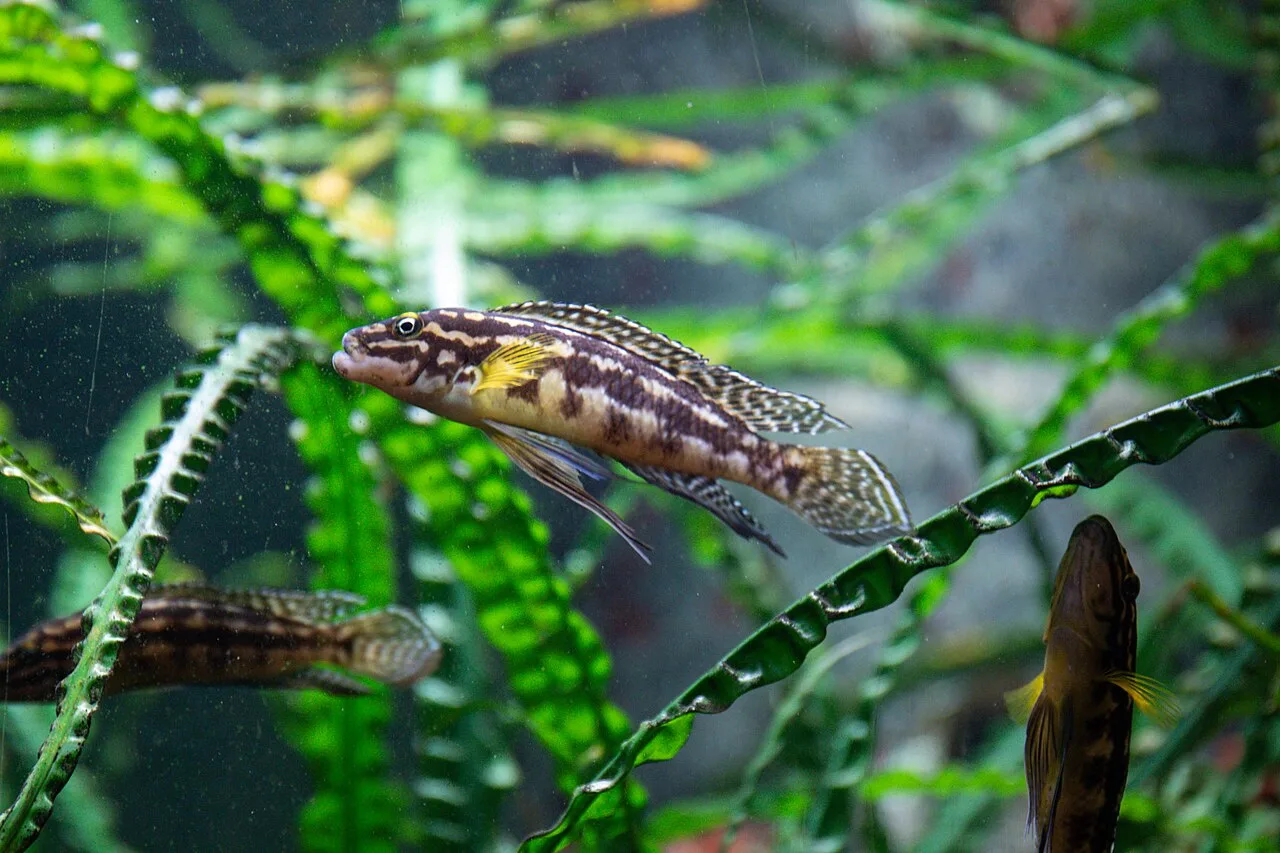
Giant river prawn
Macrobrachium rosenbergii
26 views
A very large freshwater prawn. Adults live in fresh water, the larvae need brackish water. Not a community animal for a small tank.
- Temperature
- 22 – 32 °C
- pH
- 7 – 8.5 pH
- General hardness
- 8 – 20 °dH
- Maximum size
- 32 cm
- Social behavior
- Territorial
- Diet
- Omnivore
3 min read · 371 words
Fresh water, larvae in salt or brackish water
Quick facts
Further published values
- Lifespan
- 3 a
- Minimum tank size
- 400 L
Place in the aquarium
Highlighted are the water layer and the spots where the species usually stays in the tank.
- Near the bottom Mostly stays just above the bottom. Food has to reach the substrate.
- Wood and roots Uses roots as shelter or grazes biofilm from them.
- Rocks and caves Needs caves, crevices or rockwork as hiding place, territory or spawning site.
Home & range
Hatched countries are where the species occurs. It lives in particular waters there, not across the whole country. The points name known waters for orientation, not collection sites.
- Country of origin
- Water for orientation
Native
Overview
Macrobrachium rosenbergii is one of about 270 species in the genus. Figures for female body length range up to 25 or 26 cm; males grow to 32 cm. The claws of the males reach up to 50 cm, longer than the body. Juveniles are transparent, adults greenish, brownish or grey, large males bluish. Sexual maturity depends not on age but on a weight between 15 and 35 g. After that males keep growing, females hardly do. Males occur in three forms: dominant ones with blue claws that can become twice as long as the body, smaller ones with yellow to orange claws about as long as the body, and small adult males with still shorter claws.
Range and habitat
This describes the origin, not how to furnish the aquarium.
Originally the Indo-Pacific, down to 2 m, in Sri Lanka, Indonesia on Java and Borneo, and in southern China. Rivers, streams, lakes and ponds, near brackish water. Escaped from aquaculture in the United States in Mississippi and Hawaii, in Puerto Rico, Guam, Venezuela, Brazil and Dominica. Sri Lanka, Indonesia and China stay coarse. The introductions are not filled as a natural range.
Keeping
They tolerate 16 to 42 °C. Successful reproduction needs 22 to 32 °C. The wide span is a tolerance, not a care optimum. The fact sheet therefore keeps only the breeding window. Large males are dominant and territorial. After a moult, smaller animals are eaten.
Diet
Omnivore: fruit, seeds, algae, worms, molluscs, insects and carrion. Cannibalism is not rare.
Behaviour and moulting
In wet weather they walk over land. A tightly closed tank is therefore sensible.
Reproduction and larvae
Possible all year, with the main season at the start of the rains. After a courtship dance the large male passes a sperm packet to the gonopore of the freshly moulted female. Up to 100,000 eggs are carried between the first and fourth pairs of swimming legs. Hatching after 17 to 23 days, depending on temperature. The larvae must reach brackish water within a few days. In 16 to 35 days they pass eleven stages and then live on the bottom. In aquaculture since the 1960s, after larval rearing was documented in Malaysia. Twelve animals went to Hawaii. Production was 237,124 tonnes in 2018 and, according to the FAO, 294,018 tonnes in 2022. White tail disease, caused by nodaviruses, lightens the body. Poor keeping can cause bacterial necrosis in larvae. It must not be released from the aquarium into natural waters.
Gallery
More species in this group
Similar water needs
Species with a similar temperature, a similar pH and a comparable adult size. Whether their behaviour fits as well is what the compatibility check is for.