Assam river prawn
Macrobrachium assamense
1 view
A long-armed prawn from the Indian subcontinent with banded claws. It develops in fresh water but eats small shrimp and sleeping fish.
- Temperature
- 20 – 27 °C
- pH
- 6.5 – 8 pH
- General hardness
- 5 – 15 °dH
- Maximum size
- 8 cm
- Social behavior
- Territorial
- Diet
- Omnivore
2 min read · 316 words
Fresh water
Quick facts
Further published values
- Minimum tank size
- 60 L
Place in the aquarium
Highlighted are the water layer and the spots where the species usually stays in the tank.
- Near the bottom Mostly stays just above the bottom. Food has to reach the substrate.
- Dense plants Looks for dense planting as cover, retreat or grazing ground.
- Rocks and caves Needs caves, crevices or rockwork as hiding place, territory or spawning site.
Home & range
Hatched countries are where the species occurs. It lives in particular waters there, not across the whole country. The points name known waters for orientation, not collection sites.
- Country of origin
- Water for orientation
Native
- Western Thailand
- The animals from western Thailand fit neither subspecies clearly.
Overview
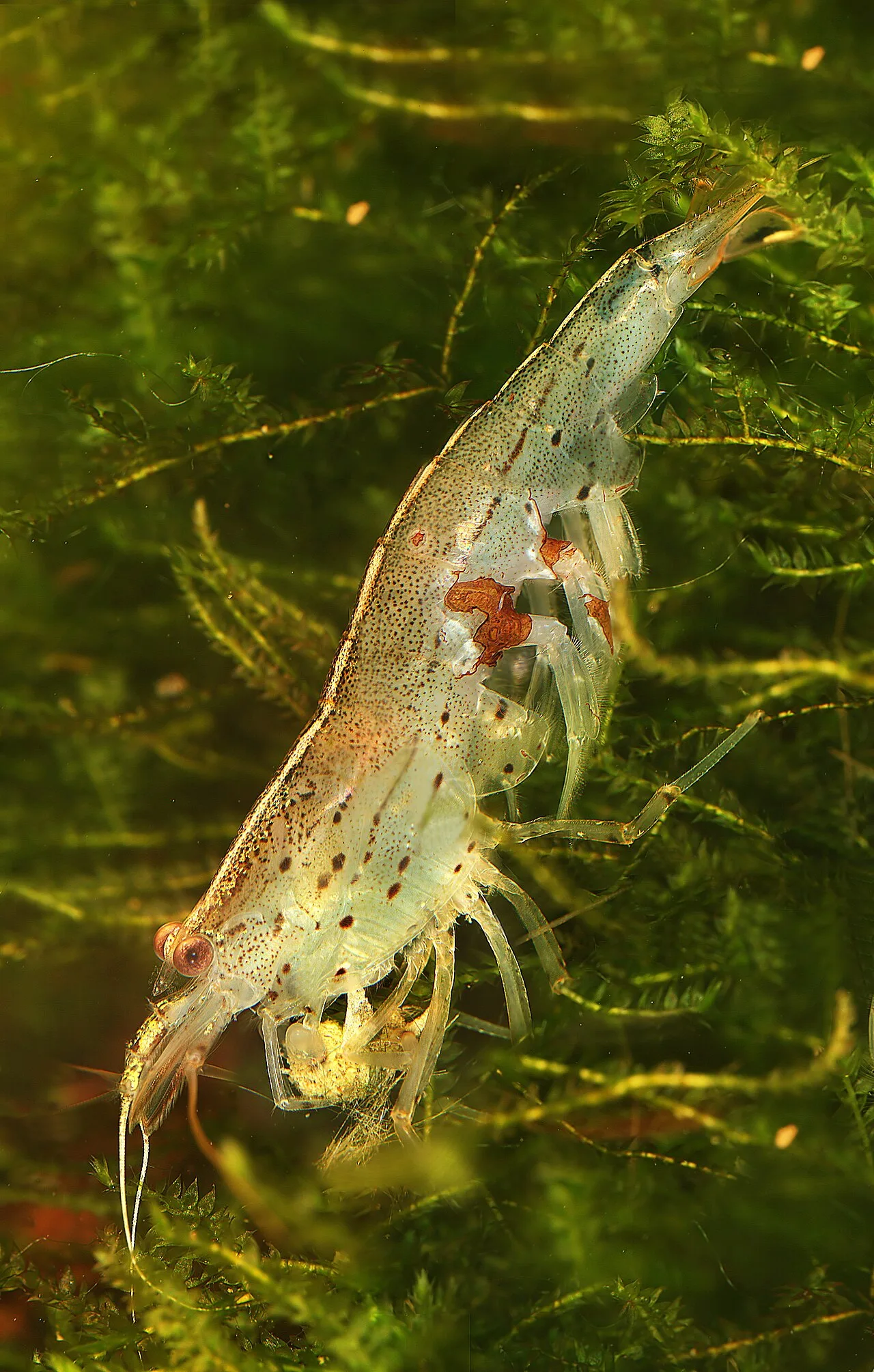
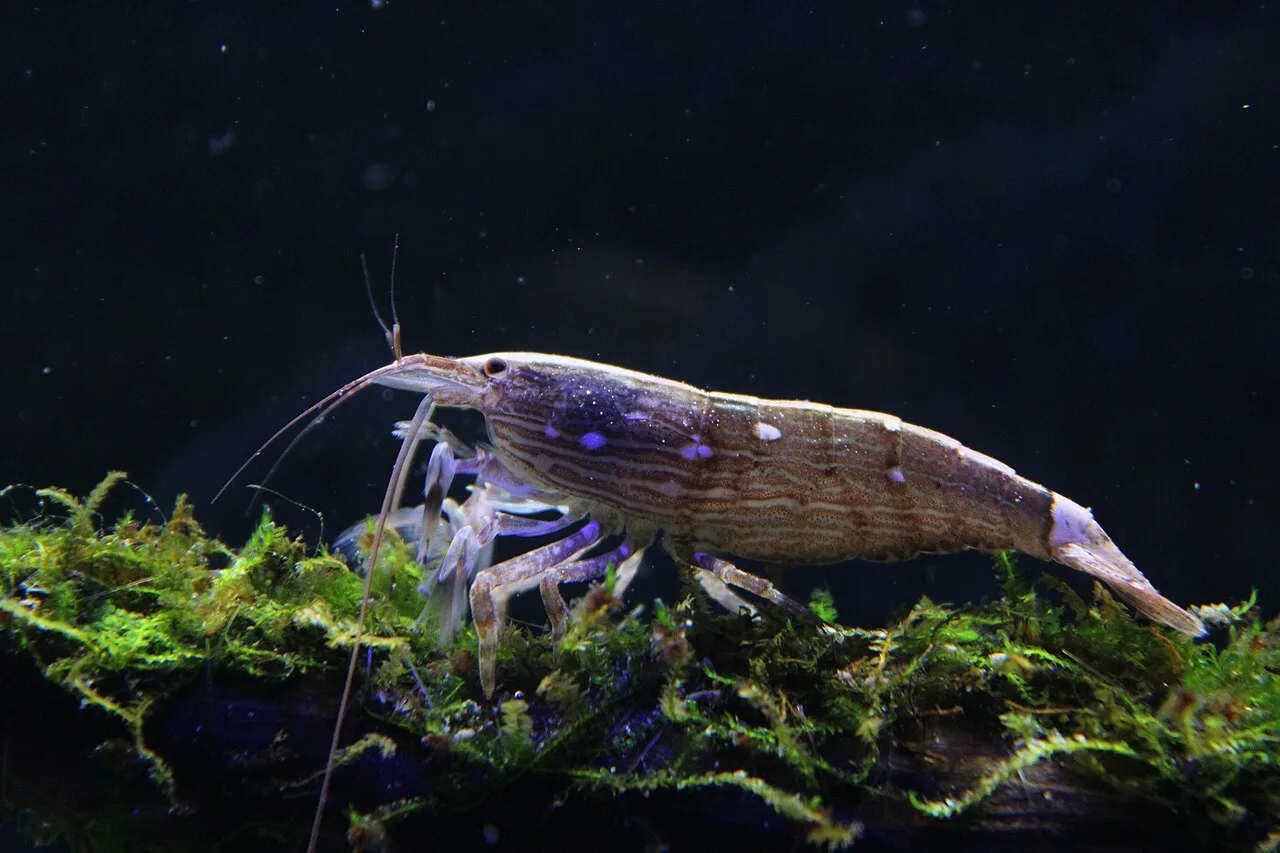
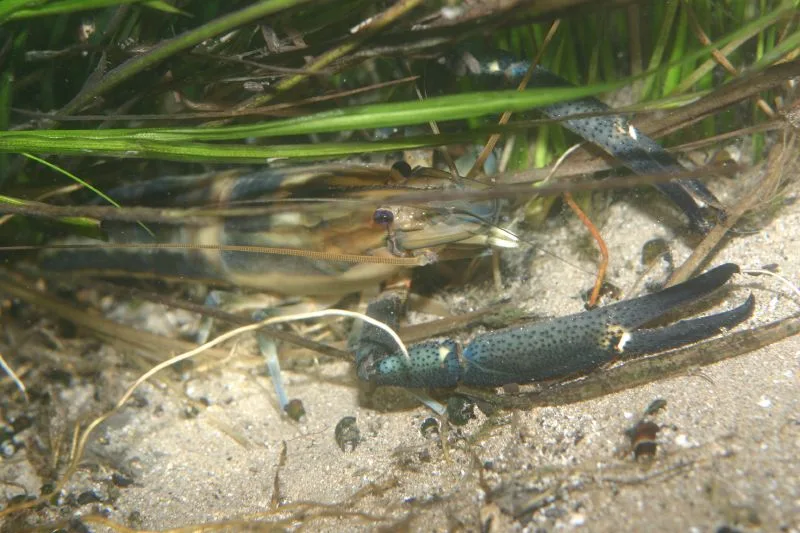
The largest known male measures 8 cm; animals of the subspecies peninsulare reached 7 cm. The second pair of legs carries long claws that reach three quarters to four fifths of body length in adult males. Adults are brown or cream with pink spots; the body is banded with red and white lines and the leg tips are red. The colouring adapts to the substrate.
Name
Macrobrachium dayanum is also sold as a ringhand shrimp. The two look alike; the name on the label does not separate them reliably.
Subspecies
The nominate form comes from Assam and Myanmar, the subspecies peninsulare from the Indian peninsula. Animals from western Thailand fit neither clearly.
Range and habitat
This describes the origin, not how to furnish the aquarium.
Larger rivers, as well as mountain streams and small rivers in Uttarakhand. The animals live in calm stretches under stones and wood, in leaves and plants. India, Myanmar and Thailand remain the coarse origin.
Keeping
Tank
From about 60 litres for a small group, with many caves, stones, wood and leaves. More hiding places than animals. Males fight over territories.
Water
20 to 27 °C, pH 6.5 to 8, GH 5 to 15 °dH. A cover is needed; the animals like to climb.
Companions
Not with dwarf shrimp. Small fish that sleep on the bottom at night are grabbed. Fast, medium-sized fish in the upper water fit.
Diet
Omnivore with a large meaty share. In the wild zooplankton on the bottom and carrion. In the tank frozen food, tablets, granules and vegetables.
Behaviour and moulting
Nocturnal and territorial. Males threaten with their long claws and chase each other off. Juveniles are more tolerant.
Reproduction and larvae
The eggs are large and few, between 13 and just over 100 depending on the size of the female. They are light green at first, then yellow, and later a dark eye is visible. At 26 to 28 °C development took 14 to 18 days. Well-developed larvae hatch that need no salt water. Breeding therefore succeeds in fresh water if the young find enough hiding places from the adults.
Gallery
More species in this group
Similar water needs
Species with a similar temperature, a similar pH and a comparable adult size. Whether their behaviour fits as well is what the compatibility check is for.