Bleeding-heart tetra
Megalamphodus erythrostigma
21 views
A tetra from the black water of the upper Amazon, about 6 cm. Hyphessobrycon erythrostigma is the synonym. The German name Kirschflecksalmler is used in the catalogue for Hyphessobrycon pulchripinnis. This profile is therefore the Perez tetra.
- Temperature
- 23 – 28 °C
- pH
- 5.5 – 7.5 pH
- General hardness
- 2 – 12 °dH
- Maximum size
- 6 cm
- Minimum group size
- 10
- Minimum tank size
- 100 L
3 min read · 463 words
Fresh water
Quick facts
Place in the aquarium
Highlighted are the water layer and the spots where the species usually stays in the tank.
- Middle water Usually stays in the middle of the tank, between bottom and surface.
- Dense plants Looks for dense planting as cover, retreat or grazing ground.
Shrimp in the tank
Shrimplets at risk
- Not shrimp safe
- Dwarf shrimp at risk
- Shrimplets at risk
- Shrimp safe
- Adult dwarf shrimp
- Safe
- Shrimplets
- Get eaten
- Safe from shrimp size
- about 2 cm
Adult dwarf shrimp are usually safe with the bleeding heart tetra. It grows to about 6 cm, is peaceful and eats dry and live food mainly in the middle water layer. Shrimp from about 2 cm are usually not taken.
Baby shrimp that drift into open water are eaten, though. With moss, leaf litter and dense planting on the bottom a shrimp colony can persist. For productive breeding a separate tank is better. The more fine structure lies on the bottom, the more young grow up, and food given in the evening distracts the fish as well.
Home & range
Hatched countries are where the species occurs. It lives in particular waters there, not across the whole country. The points name known waters for orientation, not collection sites.
- Country of origin
- Water for orientation
Native
Overview
An elongated diamond, very flat, a long anal fin, a sickle-shaped dorsal. Grey-brown with reddish shading, yellowish belly, a bright red round spot in the middle of the body. Males smaller, more colourful and longer-finned. Megalamphodus socolofi and Hyphessobrycon pyrrhonotus are other species. socolofi stays smaller, pyrrhonotus has a red dorsal stripe.
Features
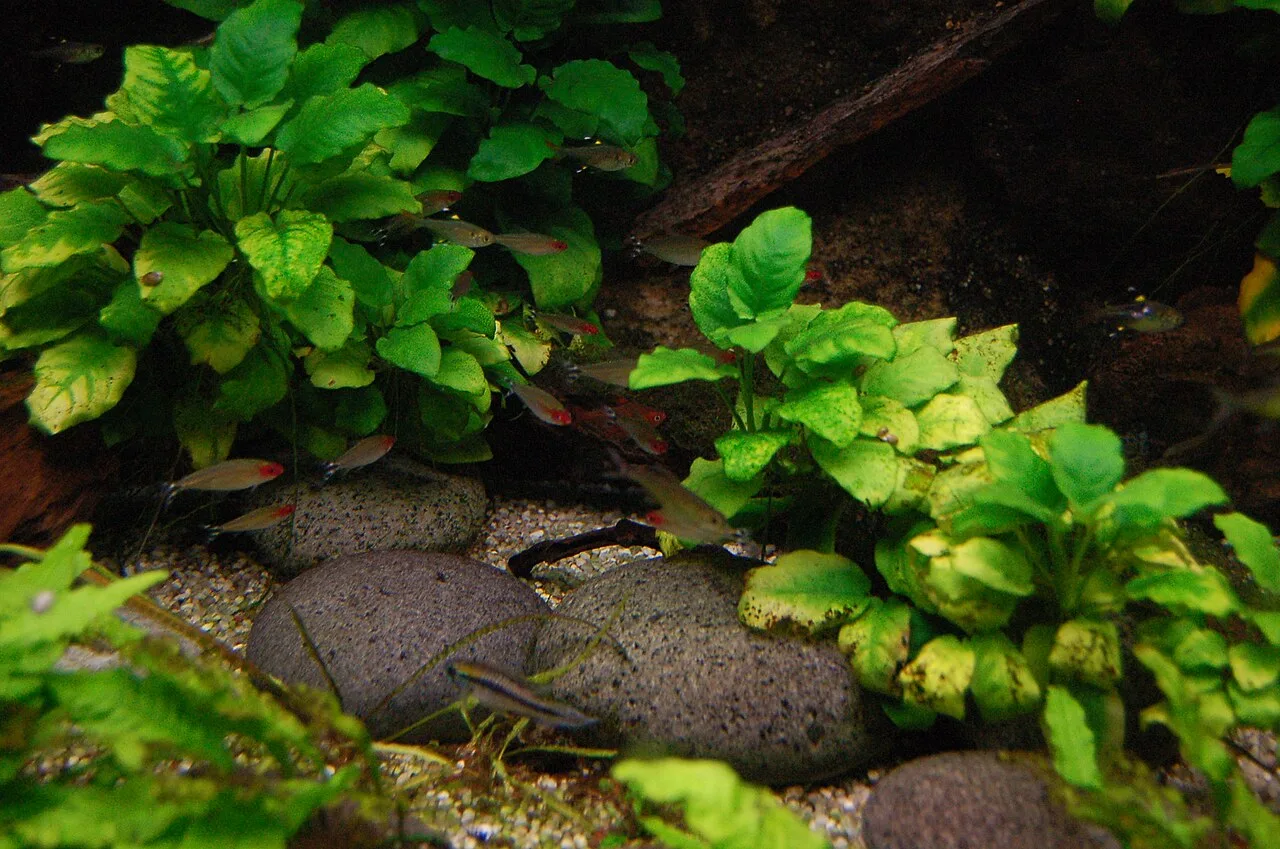
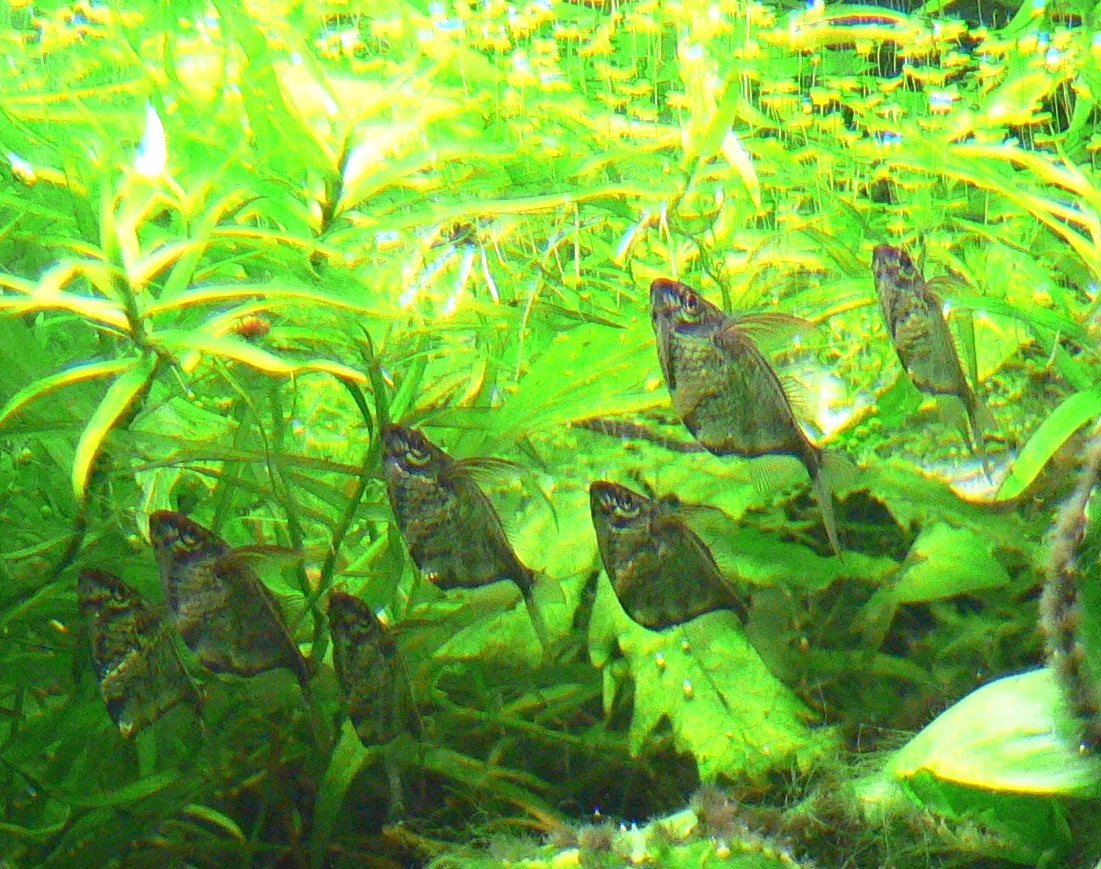
The bleeding heart tetra grows to about 6 cm. The body is an elongated diamond shape and strongly compressed. In the middle of the flank sits a bright red round spot, to which the name erythrostigma (red mark) also refers. The upper body is greyish brown with a reddish tinge, the belly yellowish, and the sheen of the scales changes with the light. The sickle-shaped dorsal fin is reddish grey with a dark base and tip. A white stripe runs along the front of the anal fin and forms a hook in adults.
Males are smaller but more colourful and have long, drawn-out dorsal and anal fins. Females stay fuller.
Confusion
The most similar species is Socolof's bleeding heart tetra from the Rio Negro area, which stays smaller. The most reliable mark is the hook-shaped white anal-fin stripe. The red-backed bleeding heart tetra instead has a strong red dorsal stripe.
Taxonomy
Fowler described the species in 1943 as Hemigrammus erythrostigma. It long stood in Hyphessobrycon and since 2024 in the genus Megalamphodus, set up by Eigenmann in 1915. The IUCN lists it as least concern.
Origin & habitat
This describes the origin, not how to furnish the aquarium.
Upper Amazon basin, black water.
The species comes from the western Amazon basin in Brazil, Colombia and Peru. It lives in floodplains and large tributaries with clear to slightly stained water, and also in black water. It stays mainly in the middle water layer.
The type locality probably lies in the border area of Brazil and Peru. A further synonym is Hyphessobrycon rubrostigma Hoedeman, 1956. Megalamphodus is Greek and means roughly with spacious ways, and Eigenmann did not explain the name, perhaps meaning large fontanels. The genus is the type genus of the subfamily Megalamphodinae, the red tetras.
Care
Groups from ten, tanks from 80 cm long, not converted to litres, 23 to 28 °C, soft water, pH 5.5 to 7.5. A dark substrate and peat make the colours stronger. Midwater. The group breaks up and closes again when danger threatens.
Groups from ten fish, tanks from 80 cm in length, 23 to 28 °C and soft water at pH 5.5 to 7.5 are recommended. A dark bottom and peat filtration make the water slightly acidic and strengthen the colours. The fish are peaceful and sociable. When danger threatens, the group breaks up and gathers again afterwards. Feed a varied diet of dry and live food. Almost all fish in the trade are captive-bred, but deliberate breeding in home tanks rarely succeeds.
Diet
Dry and live food. Captive breeding is still rare.
More species in this group






Similar water needs
Species with a similar temperature, a similar pH and a comparable adult size. Whether their behaviour fits as well is what the compatibility check is for.