Harlequin rasbora
Trigonostigma heteromorpha
17 views
A deep-bodied cyprinid from the Malay Peninsula and southeastern Thailand. Total length is two to two and a half centimetres.
- Temperature
- 22 – 27 °C
- pH
- 6 – 7.8 pH
- General hardness
- 0 – 15 °dH
- Maximum size
- 2.5 cm
- Minimum group size
- 6
- Minimum tank size
- 54 L
5 min read · 810 words
Fresh water
Quick facts
Further published values
- Lifespan
- 5 – 8 a
Place in the aquarium
Highlighted are the water layer and the spots where the species usually stays in the tank.
- Middle water Usually stays in the middle of the tank, between bottom and surface.
- Dense plants Looks for dense planting as cover, retreat or grazing ground.
Shrimp in the tank
Shrimplets at risk
- Not shrimp safe
- Dwarf shrimp at risk
- Shrimplets at risk
- Shrimp safe
- Adult dwarf shrimp
- Safe
- Shrimplets
- Get eaten
- Safe from shrimp size
- about 1.5 cm
Adult dwarf shrimp are safe from the harlequin rasbora. It stays small, eats insect larvae, copepods and other zooplankton and has a small, upturned mouth. It cannot handle shrimp from about 1.5 cm. Young shrimp swimming freely, however, are eaten. The calm rasboras stay in midwater among plants and hardly search the bottom. In a densely planted tank with moss and leaf litter enough young therefore survive, and both species go well together.
Home & range
Hatched countries are where the species occurs. It lives in particular waters there, not across the whole country. The points name known waters for orientation, not collection sites.
- Country of origin
- Water for orientation
Native
Overview
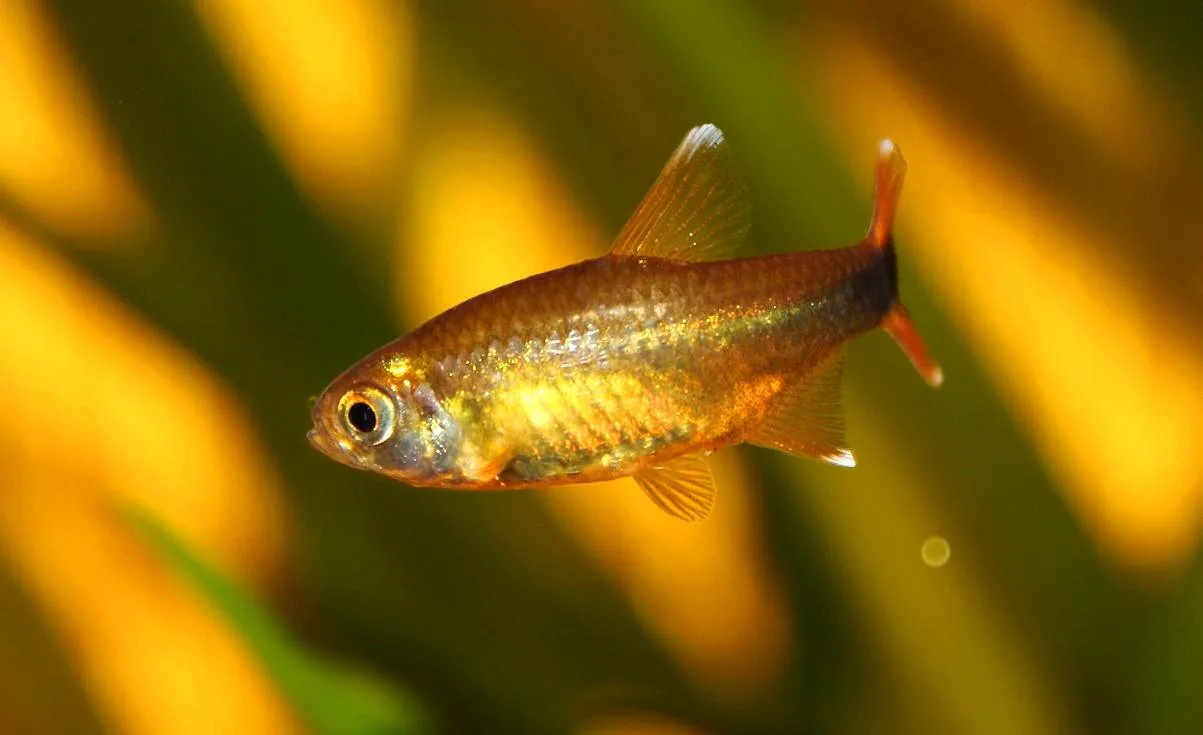
Trigonostigma heteromorpha is deep-bodied, broadest between the first rays of the dorsal and pelvic fins. The scales are relatively large. The ground colour runs from pale pink to copper red and is stronger on the head, back and caudal peduncle. Toward the belly it becomes silvery to white. The wedge starts below the dorsal origin. In females it ends at the caudal base. In males it continues as a dark point through the caudal fin. The male anal fin carries a dark streak that is hardly visible or absent in females. The mouth is upturned and the lateral line is incomplete. Kottelat and Witte erected the genus in 1999 because of the different spawning behaviour. Tang and colleagues in 2010 synonymised it, on mitochondrial DNA, with Rasbora in the broad sense. Kullander and colleagues argued on morphology for keeping the genus. FishBase and the Catalog of Fishes still list the species as Trigonostigma. The catalogue name here remains Trigonostigma heteromorpha.
Size and confusion
Size figures differ widely: from 2 to 2.5 cm total length up to 4 to 4.5 cm standard length and at most about 5 cm. The specific name heteromorpha means differently shaped and alludes to the body shape that differs from other Rasbora. The name harlequin rasbora refers to the triangular black patch reminiscent of a harlequin costume. The dorsal, anal, tail and pelvic fins are tinted red. Males have a slightly larger black patch that ends more rounded towards the anal fin. Ripe females are noticeably fuller.
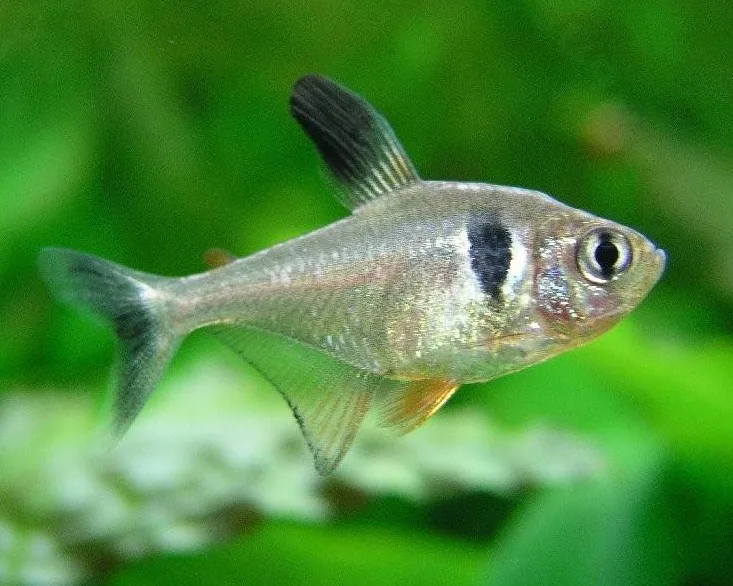
The species is confused with Trigonostigma espei and Trigonostigma hengeli, formerly regarded as subspecies. Both are slimmer, and their marking is not a triangle but a horizontal band that widens strongly downwards below the dorsal fin. Because of this shape they are called lamb chop rasboras. From 1935 an image of three harlequin rasboras stamped in gold graced the cover of every edition of William T. Innes's book Exotic Aquarium Fishes.
Origin & habitat
This describes the origin, not how to furnish the aquarium.
Duncker described the species in 1904 from fish in a pond of the Singapore botanic garden. The range extends across the Malay Peninsula and southeastern Thailand. Ladiges named shaded, weedy streams. Total hardness there was below 3 °dGH. That is a measurement from the home streams.
The species lives on the Malay Peninsula, in Singapore, on Sumatra and Borneo. According to it, populations in southern Thailand have belonged to the related species Trigonostigma truncata since 2020. The native waters are low in minerals and rich in dissolved humic acids, because they flow through peat swamp forests.
Care
Soft water is described as decisive for the development of the eggs. The first breeding anywhere succeeded only more than twenty years after the first import, because soft water was available. Fish sold today come from large farms in Thailand, Malaysia, Poland and the Czech Republic. There is a melanistic, a xanthoristic and a veil-finned form. The first live import to Europe was made in 1906 by Julius Reichelt in Berlin.
Water values and setup
In the aquarium the species is adaptable as long as moves are done carefully. It is kept at pH 6.0 to 7.8 and a hardness of 0 to 15 °dH. Usually 22 to 27 °C are cited, and 21 to 28 °C are tolerated. The species is kept in groups of six or more, and larger groups are better. Peaceful, similar-sized fish such as many small characins suit it. Live plants with open swimming areas are recommended, such as Cryptocoryne and Asian Aponogeton, which like the fish prefer subdued light. With good care the fish live five to eight years.
Diet
Insect larvae, copepods, other zooplankton and food taken from the surface.
Prepared foods are taken eagerly, best in variety and supplemented with live foods such as daphnia. Mosquito larvae are particularly suitable for conditioning before breeding.
Behavior
Harlequin rasboras are not schooling fish. They live in simply structured social groups. For spawning, males separate from the group.
Reproduction
Males court with spread fins, intense colour and jerky to dancing movements. Pairs form briefly. Females stick the eggs to the undersides of leaves, and only then does the male fertilise them. There is no further brood care, and the spawning site is not guarded. The other species of the genus share this spawning behaviour.
Breeding
The female swims upside down beneath a leaf and rubs against it. The male turns over beside her, curls his tail fin around the female and releases sperm with a trembling motion. Six to 12 eggs are attached per embrace, over two hours or more. Breeding water should have at most 4 °dH and about pH 6.4, at 28 °C. In hard, alkaline water the fish hardly spawn, and fertilisation suffers. After spawning the parents are removed.
At 28 °C the larvae hatch after about 18 hours. They are translucent, 3 to 4 mm long and stay attached to the leaf for another 12 to 24 hours. Then they need infusoria for seven to 14 days, followed by newly hatched brine shrimp. The young reach full colour after eight to ten weeks.
Gallery
More species in this group

Similar water needs
Species with a similar temperature, a similar pH and a comparable adult size. Whether their behaviour fits as well is what the compatibility check is for.