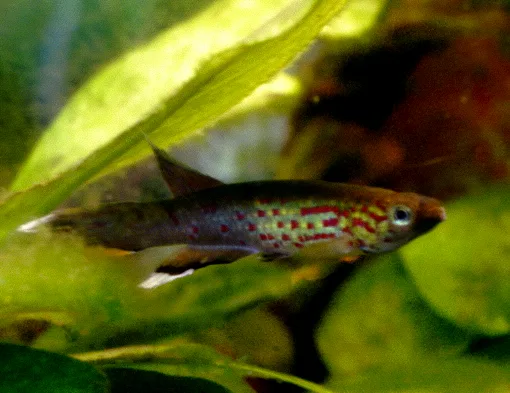
Jellybean tetra
Ladigesia roloffi
17 views
A tiny, translucent tetra from West Africa. It needs a school, soft water and fine food.
- Temperature
- 22 – 26 °C
- pH
- 5.5 – 7 pH
- General hardness
- 10 °dH
- Maximum size
- 3 cm
- Minimum group size
- 10
- Minimum tank size
- 40 L
2 min read · 331 words
Fresh water
Quick facts
Further published values
- Lifespan
- 5 a
Place in the aquarium
Highlighted are the water layer and the spots where the species usually stays in the tank.
- Upper water Usually stays in the top third of the tank.
- Dense plants Looks for dense planting as cover, retreat or grazing ground.
Shrimp in the tank
Shrimplets at risk
- Not shrimp safe
- Dwarf shrimp at risk
- Shrimplets at risk
- Shrimp safe
- Adult dwarf shrimp
- Safe
- Shrimplets
- Get eaten
- Safe from shrimp size
- about 1.5 cm
Adult dwarf shrimp are safe from the jellybean tetra. It grows to only 3 to 4 cm, is peaceful and swims in a school in the middle and upper water. Shrimp from about 1.5 cm are too big for its mouth.
Baby shrimp that drift into open water can be eaten. On the bottom among moss and leaf litter they are well protected. Because the species prefers soft, acidic water, shrimp that tolerate such water suit it best.
Home & range
Hatched countries are where the species occurs. It lives in particular waters there, not across the whole country. The points name known waters for orientation, not collection sites.
- Country of origin
- Water for orientation
Native
Overview
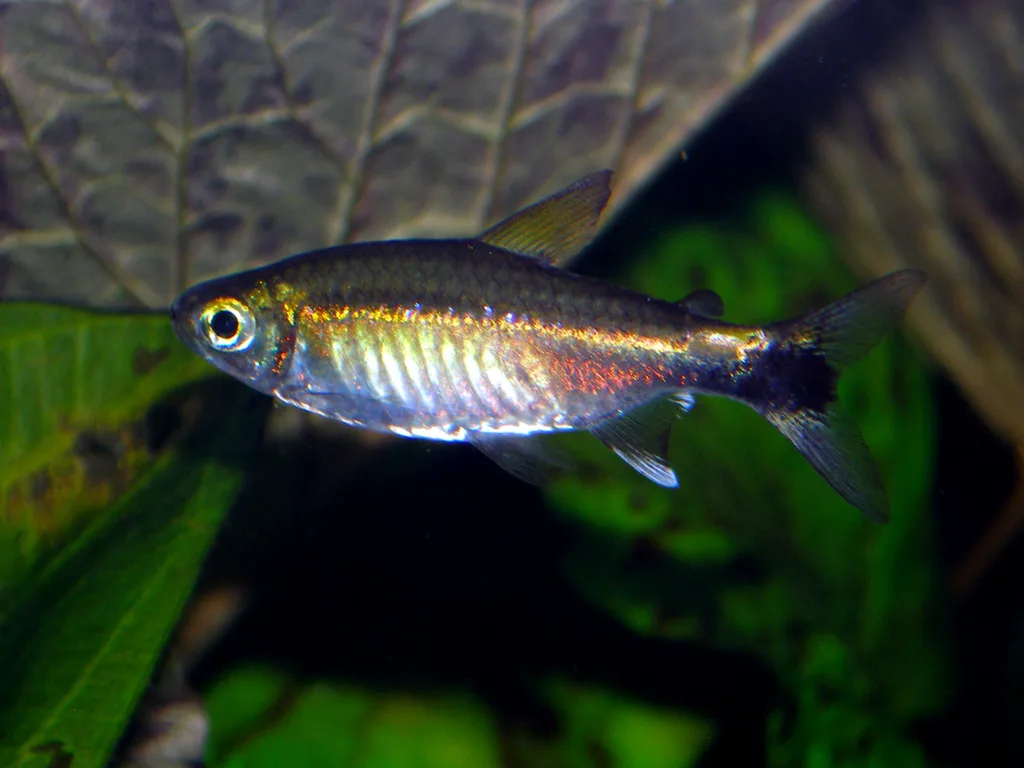
Ladigesia roloffi stays at about 3 cm. The body is glassy with a bluish or reddish sheen. The males carry more colour in the fins. In a school it looks like a chain of small lights. A single fish is hardly visible.
It is not an ember tetra and not a Congo tetra. The body is more delicate, the mouth smaller. Coarse food passes it by.
Features
The genus Ladigesia holds only this species. The Sierra Leone dwarf characin, in the trade also the jellybean tetra, grows to 3 to 4 cm. The body is elongated, the lateral line incomplete, and the anal fin has no spines and 16 to 17 soft rays. Jacques Géry described genus and species in 1968. The name honours the German aquarist Erhard Roloff, who collected the type specimen. The species belongs to the African tetras (Alestidae).
Origin & habitat
This describes the origin, not how to furnish the aquarium.
Small forest streams in West Africa, soft, shaded, full of leaf litter. The origin stays coarse. Hard, bright water is the wrong place.
The species lives in fresh waters of Sierra Leone and Liberia. The IUCN lists it as critically endangered, and about 97 percent of its natural habitat is said to be lost.
Care
Tank
22 to 26 °C, pH 5.5 to 7, soft. A school from ten, tanks from about 40 litres, fine plants, leaf litter, a dark bottom, a cover, little current.
Company
Only equally small, quiet fish, or the species alone. Every larger fish takes the food or the fish. Shrimp fit.
The fish prefer soft, acidic water at 22 to 26 °C. They are peaceful, lively and sociable and swim in a school in the middle and upper water layers. Ordinary flake food is taken. They can live about five years.
Diet
Dust-fine food. Brine-shrimp nauplii, cyclops, crushed flakes. A little, several times a day.
Behavior
A tight school in midwater. The fish jump. A gap in the cover empties the school. Too few fish stand pale in a corner.
Reproduction
Egg scatterer without brood care. The eggs are tiny. A community tank should not be expected to produce young.
Gallery
More species in this group






Similar water needs
Species with a similar temperature, a similar pH and a comparable adult size. Whether their behaviour fits as well is what the compatibility check is for.