Twig catfish
Farlowella acus
23 views
An extremely slender suckermouth catfish that looks like a twig. It eats aufwuchs, needs oxygen and is not a glass cleaner for a new tank.
- Temperature
- 24 – 28 °C
- pH
- 6 – 7.5 pH
- General hardness
- 2 – 12 °dH
- Maximum size
- 15 cm
- Minimum tank size
- 120 L
6 min read · 872 words
Fresh water
Quick facts
Further published values
- Lifespan
- 7 – 12 a
Place in the aquarium
Highlighted are the water layer and the spots where the species usually stays in the tank.
- Dense plants Looks for dense planting as cover, retreat or grazing ground.
- Wood and roots Uses roots as shelter or grazes biofilm from them.
Shrimp in the tank
Shrimp safe
- Not shrimp safe
- Dwarf shrimp at risk
- Shrimplets at risk
- Shrimp safe
- Adult dwarf shrimp
- Safe
- Shrimplets
- Mostly safe
- Safe from shrimp size
- Any size
The twig catfish is shrimp-safe. In nature it eats plants and roots, and in the aquarium mainly algae and vegetable tablets. It accepts meaty food but does not do well on it in the long run. With its small sucker mouth it grazes growth from wood, leaves and glass and ignores shrimp, including their young. Both species benefit from a mature tank with plenty of wood and growth. Feed so that the catfish gets enough plant food before the shrimp take it over.
Home & range
Hatched countries are where the species occurs. It lives in particular waters there, not across the whole country. The points name known waters for orientation, not collection sites.
- Country of origin
- Water for orientation
Native
Overview
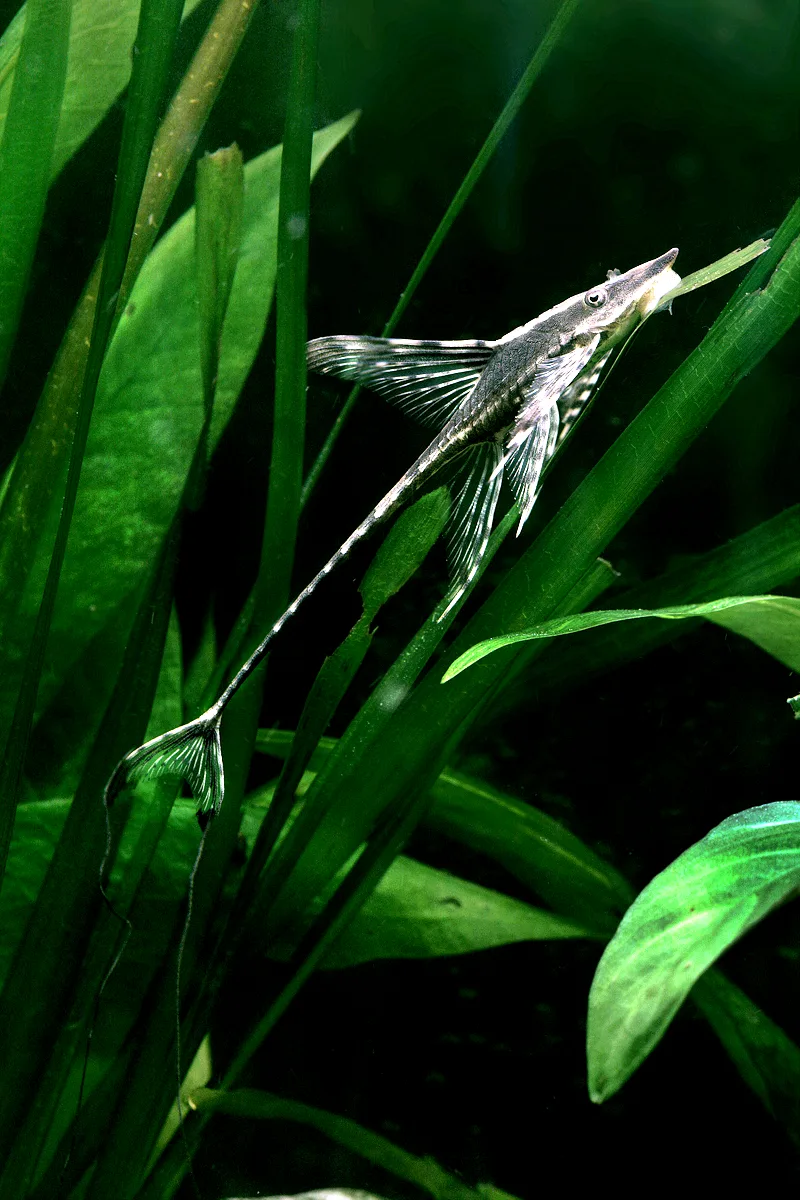
Farlowella acus reaches about 15 cm. The body is round and so thin that it disappears among real twigs. The snout is extended, the sucker mouth small. Males carry a brush of bristles on the snout edge when courting. The species moves little and stands through the day on wood or on the glass.
It is more sensitive than an Ancistrus. Poor water, too little oxygen or a tank without aufwuchs shows as a sunken belly, before the fish looks obviously ill.
Classification and name
There the fish is called whiptail catfish or twig catfish. It belongs to the suckermouth armoured catfishes, Loricariidae, in the subfamily Loricariinae and is the type species of the genus Farlowella. Rudolf Kner described it in 1853 as Acestra acus with Caracas as the type locality. Because the name Acestra was already used for a bug genus and a pipefish genus, Carl H. Eigenmann and Rosa Smith Eigenmann proposed Farlowella as a replacement in 1889. The name honours the Harvard botanist William Gilson Farlow, an algae specialist. Acus means needle.
Appearance
Standard length reaches 16 cm. The colour ranges from olive green to yellow-brown with a yellowish underside. A very distinct, irregular dark band, often with blotches, runs from the head to the tail base. The fins are transparent with dark-spotted rays, and each tail lobe usually carries a dark band. Males have a broader snout, which in mature fish carries small bristles called odontodes. The narrower snout of females always stays smooth.
Origin & habitat
This describes the origin, not how to furnish the aquarium.
Slow to moderate, plant- and wood-rich waters in northern South America. The fish sit on surfaces with growth, not in open water. A country outline without tighter geometry stays coarse.
The twig body is camouflage. A bright, empty tank turns the camouflage into a burden, because the fish finds no surface on which to feed and stand.
Distribution and threats
The species occurs in two separate areas in Colombia and Venezuela. The Colombian populations live in the upper Meta basin and probably the Guaviare, the Venezuelan ones in the Lake Valencia basin and the Río Torito, a tributary of the Orinoco. The IUCN lists the species as Vulnerable, because growing settlements and human use damage both areas. The situation at Lake Valencia is particularly serious.
Care
Water
24 to 28 °C, pH 6 to 7.5, rich in oxygen, with some current, but without a hard jet on the only resting place. From about 120 litres, better longer, with wood, large leaves and a mature growth of aufwuchs. A factory-new tank without a film is a hunger trap.
Stocking
A pair, or a few fish with several resting surfaces. Hectic barbs and digging large cichlids stress them. Calm fish in the upper water fit. Further suckermouths only if each has its own surface. The species does not dig and leaves tough plants alone.
The twig catfish is one of the most commonly exported Farlowella species. The twig catfish is a peaceful, sociable bottom dweller that can live singly or in groups in most community tanks. A tank of at least 60 cm with bogwood, roots, vertical twigs or slender plant stems is recommended. It handles sudden or large water changes poorly and can die from the shock. Several small changes per week with aged water are better.
Diet
Aufwuchs, algae and a plant supplement. The small mouth does not take large tablets. Blanched, thin vegetable strips, spirulina as a fine food, and the film on wood and glass are the diet. Animal food only rarely.
If the glass is cleaned and there is no wood, the food base disappears. Cleaning and feeding belong together.
In the wild the twig catfish eats plants and roots. In the aquarium it lives mainly on algae and vegetable tablets. It accepts worms and other meaty food but does not do well on it in the long run. Feeding correctly is regarded as difficult because of its herbivorous preference.
Behavior
Quiet, attached to a place, visible by day if it feels safe. A twig catfish that constantly changes cover or lies on the bottom with clamped fins has too little oxygen, too much stress or hunger. The normal posture is standing still on the twig.
The species travels badly. After introduction it can stay in the same place for days. As long as the belly does not sink and it feeds at night, that is not a reason to move it.
Reproduction
The male guards the clutch on an open surface, often on the glass. The eggs are visible and fungus if the male is disturbed or the water is loaded. Breeding works in quiet, clean water. The young need fine aufwuchs at once.
In a community tank the clutch is usually eaten as soon as the male leaves it.
In the wild the species spawns between November and March, and in good condition in the aquarium at any time. The male cleans a hard surface, usually the glass, and the female lays about 60 to 80 eggs on it at night or early in the morning. The male tends the eggs with his mouth and fans them with his pectoral fins. Depending on temperature the larvae hatch after six to ten days. In an established tank they immediately eat organic material and microorganisms, supplemented by cucumber, crushed peas, lettuce and courgette.
Gallery
More species in this group


Similar water needs
Species with a similar temperature, a similar pH and a comparable adult size. Whether their behaviour fits as well is what the compatibility check is for.