Asian clam
Corbicula fluminea
3 views
A small freshwater clam from Southeast Asia that filters plankton. Introduced to Europe and the Americas, partly via aquariums.
- Temperature
- 10 – 26 °C
- pH
- 7 – 8.5 pH
- General hardness
- 8 – 20 °dH
- Maximum size
- 3.6 cm
- Social behavior
- Peaceful
3 min read · 507 words
Fresh water
Quick facts
Further published values
- Lifespan
- 2 – 4 a
- Minimum tank size
- 60 L
Place in the aquarium
Highlighted are the water layer and the spots where the species usually stays in the tank.
- Near the bottom Mostly stays just above the bottom. Food has to reach the substrate.
- Substrate Sifts through the substrate or burrows into it. Fine, rounded sand without sharp edges suits it.
Home & range
Hatched countries are where the species occurs. It lives in particular waters there, not across the whole country. The points name known waters for orientation, not collection sites.
- Country of origin
- Water for orientation
Native
- China
- Originally Southeast Asia; the type material comes from China.
Overview
The Asian clam (Corbicula fluminea) lives in fresh water and belongs to the family Corbiculidae. It and the likewise introduced Corbicula fluminalis are hard to tell apart and are often referred to together as Asian clams. Size and the fineness of the ribs separate them, but both features vary and there are hybrids.
Shell
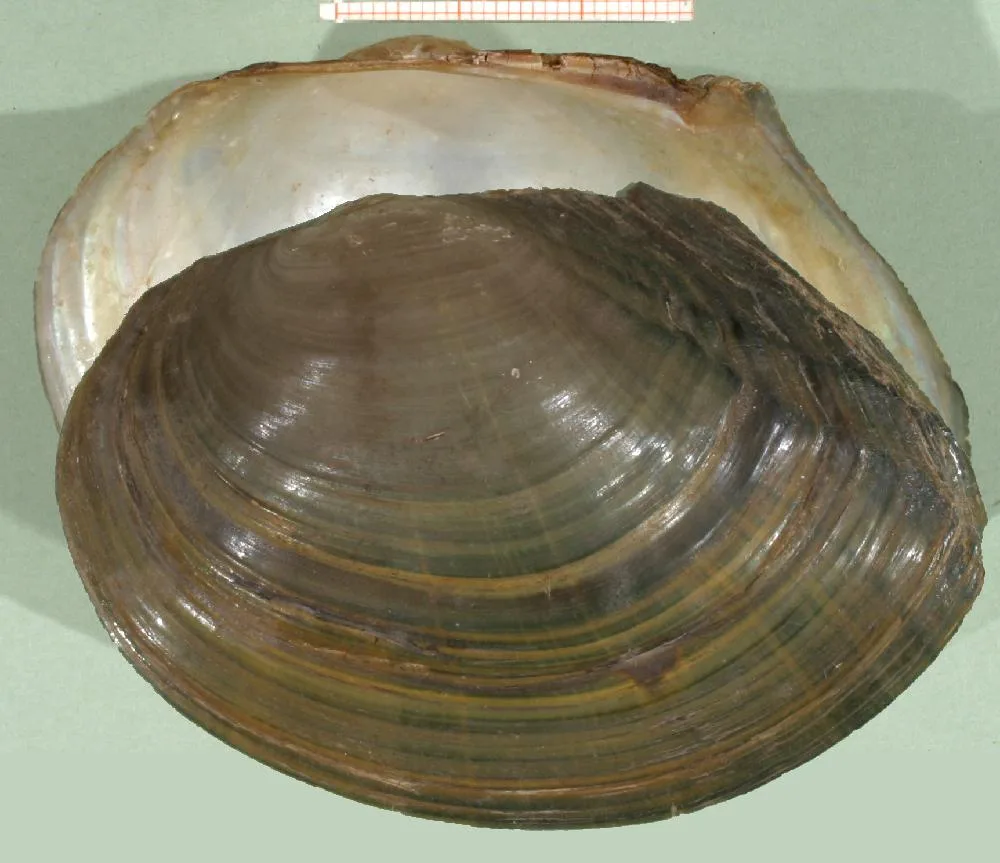
The equivalve, strongly inflated shell grows up to about 36 millimetres long, rounded triangular in outline and hardly longer than high. It is very thick and firm. Outside the colour ranges from ochre to dark brown, sometimes with a green tinge; inside it is white, partly pale blue or faintly violet. Coarse ribs parallel to the margin are characteristic. The large foot is hatchet-shaped, and the short siphons are fringed with tentacles. From about one millimetre in size the young form byssus threads for attachment; adults no longer do.
Range and habitat
This describes the origin, not how to furnish the aquarium.
Originally the species lives in Southeast Asia; the type material comes from China. It inhabits sandy to muddy bottoms of rivers, lakes and canals. It reached North America by 1924 as food, South America in 1979 and western Europe around 1980, most probably with ballast water, possibly also through released aquarium animals. Via the Weser, Rhine, Main and the Main-Danube Canal it spread to the Danube, Elbe, Oder and Lake Constance. Along the Rhine its shells lie in great numbers on the bank at low water. China is listed as a coarse origin.
Keeping
The clam feeds solely by filtering suspended matter from the water. In the aquarium this is the decisive point: a clean tank with little plankton offers it hardly any food. It needs a sandy to muddy bottom to dig into. Because the species is regarded as introduced in many countries and release from aquariums is named as a possible route, animals and juvenile clams must never reach natural waters.
Diet
It filters small organisms such as phytoplankton and organic detritus from the water. Phytoplankton is probably the main part, since it gains weight almost only in the summer half of the year. From November to February the soft body did not grow when there was very little chlorophyll in the water.
Behaviour and moulting
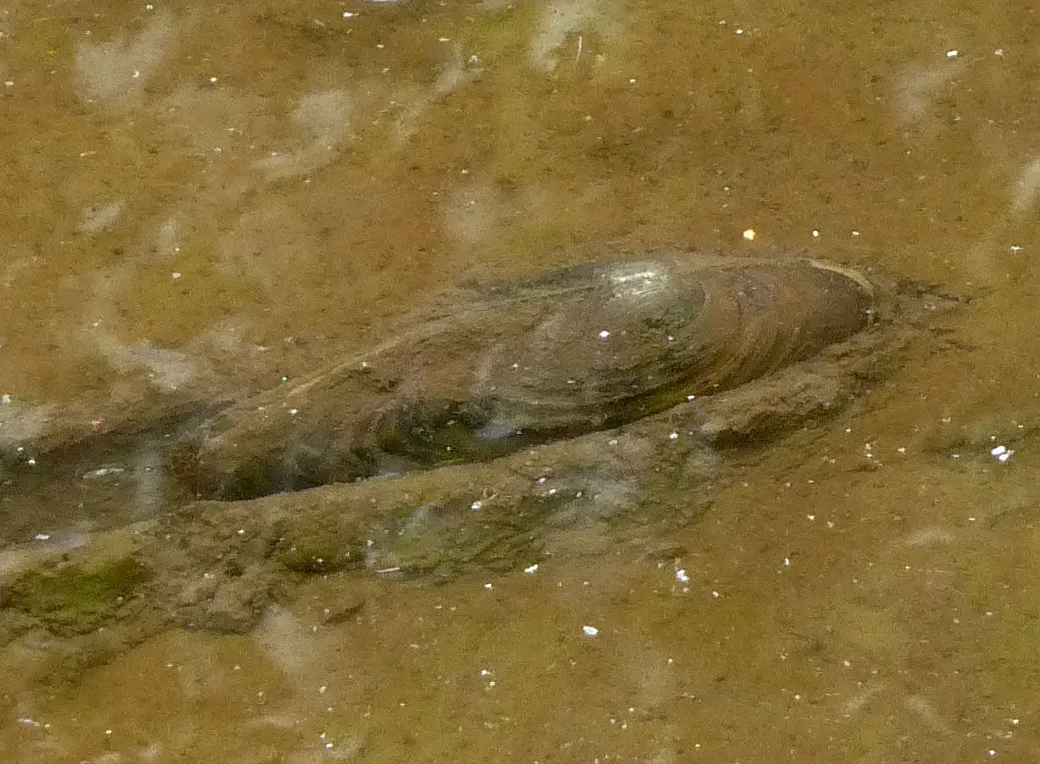
It lives buried in soft ground and filters through its siphons. Since it takes only suspended matter, it does not compete with snails or shrimp for food on the bottom.
Reproduction and larvae
In Europe it is a hermaphrodite with male and female organs at the same time, whereas in Hong Kong the small animals are first males and the large ones females. Usually foreign sperm fertilises the eggs, but self-fertilisation is possible. It matures after half a year to a year. It forms gametes only above 10 °C, in the Rhine with spawning peaks in May and June and in September.
Brood care
The eggs measure 111 to 132 micrometres and develop in the mantle cavity between the gills. After 30 to 60 days the larvae are released into open water above 15 °C, with a D-shaped little shell and a large foot. One animal can thus release several hundred young a day and up to about 8000 a year.
Gallery
More species in this group
Similar water needs
Species with a similar temperature, a similar pH and a comparable adult size. Whether their behaviour fits as well is what the compatibility check is for.