Bala shark
Balantiocheilos melanopterus
20 views
A slender schooling fish with black fin edges. It grows large, jumps and does not belong in a small community tank.
- Temperature
- 24 – 28 °C
- pH
- 6.5 – 7.5 pH
- General hardness
- 5 – 12 °dH
- Maximum size
- 35 cm
- Minimum group size
- 6
- Minimum tank size
- 500 L
5 min read · 684 words
Fresh water
Quick facts
Further published values
- Lifespan
- 9 – 10 a
Place in the aquarium
Highlighted are the water layer and the spots where the species usually stays in the tank.
- Upper water Usually stays in the top third of the tank.
- Middle water Usually stays in the middle of the tank, between bottom and surface.
- Open swimming space Needs an open area without plants or decor to swim at length. Tank length matters more than height.
Shrimp in the tank
Not shrimp safe
- Not shrimp safe
- Dwarf shrimp at risk
- Shrimplets at risk
- Shrimp safe
- Adult dwarf shrimp
- At risk
- Shrimplets
- Get eaten
- Safe from shrimp size
- No size is safe
The bala shark eats shrimp. It grows to 35 to 40 cm and feeds mainly on small crustaceans, rotifers, insects and their larvae. On the bottom it sifts through the sand for food and finds hidden animals too. Dwarf shrimp are easy prey for it, and as it grows, Amano shrimp and other larger species are at risk as well. The fast schools also need very large tanks in which shrimp hardly stand out. Shrimp should not be kept together with bala sharks.
Home & range
Hatched countries are where the species occurs. It lives in particular waters there, not across the whole country. The points name known waters for orientation, not collection sites.
- Country of origin
- Water for orientation
Native
Overview
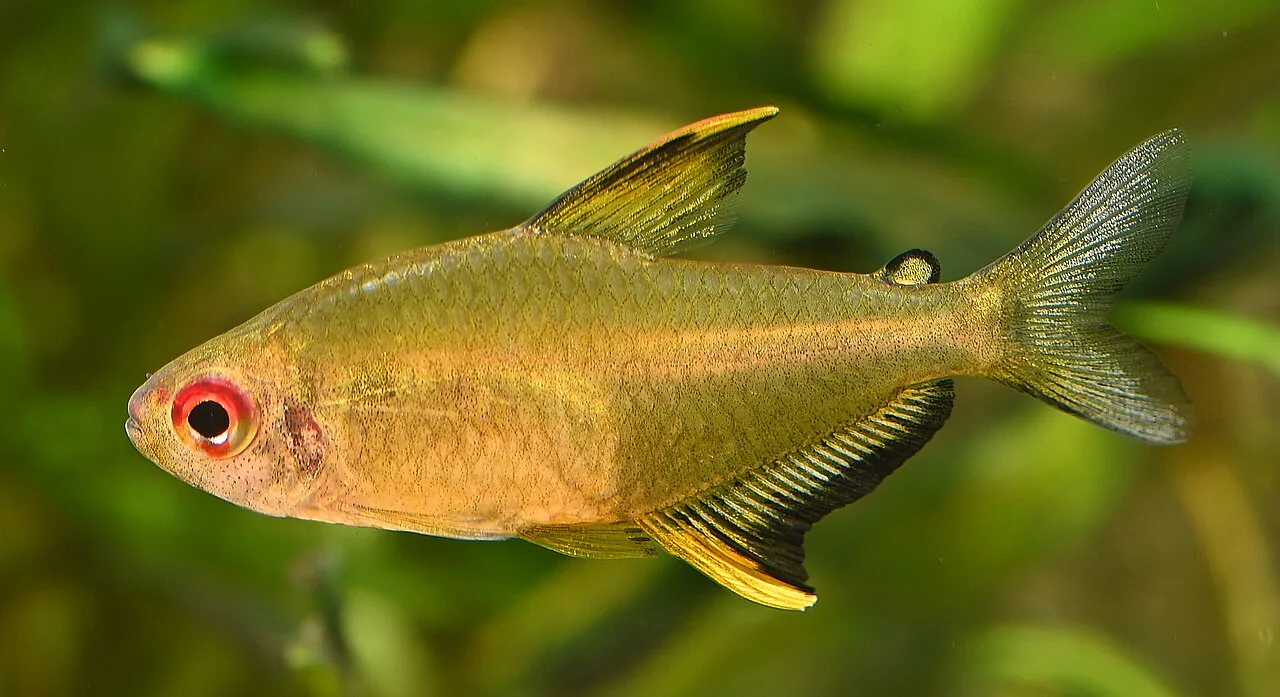
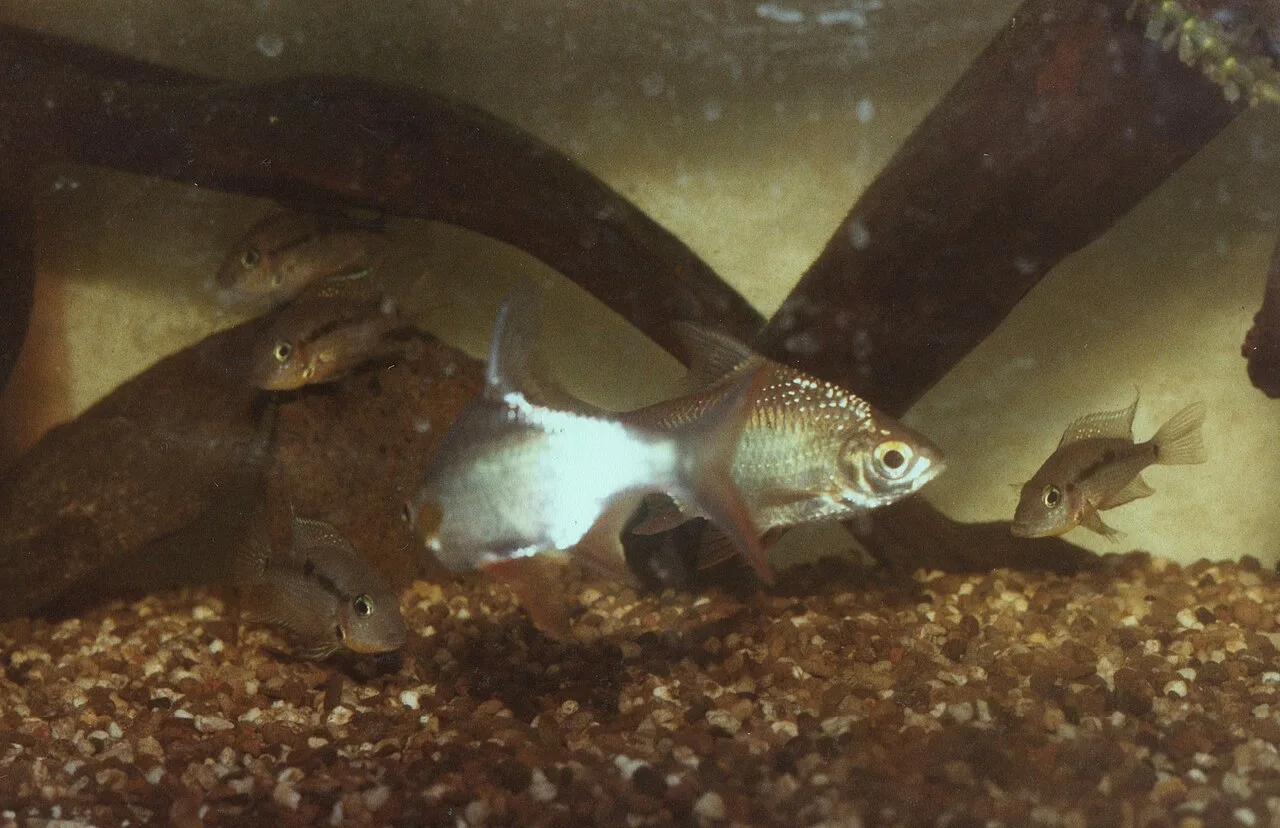
The bala shark reaches about 30 cm. The body is silvery, the fins carry a black edge. The mouth is underneath. Juveniles are sold as small, peaceful schooling fish and then grow over years into a tank they never had.
It is not a shark and not a rainbow shark. The body is torpedo-shaped, the fins are not red. The species stands in midwater and jumps into the cover when startled.
Features in detail
The life expectancy is nine to ten years, and fish 13 years old have been observed. Figures for size range from at most 35 to 40 cm. In English the species is called bala shark, tricolor shark or silver shark. It is one of two species in the genus Balantiocheilos.
The body is elongated, streamlined and strongly compressed, dark grey to blue-black with silver, light-edged scales. The dorsal fin is the largest fin and, like the tail fin, notched and drawn out. Dorsal, tail, anal and pelvic fins are partly golden yellow to almost transparent and broadly edged with deep black at the rear. All fins except the tail fin have a hard ray at the front. This lets them be folded against the body during fast swimming. The large eyes can move about 30 degrees in every direction.
Sexes
The sexes can only be told apart at two to three years and 20 to 30 cm. Males are slimmer, and females are 1 to 2 cm deeper and stockier.
Origin & habitat
This describes the origin, not how to furnish the aquarium.
Rivers of Southeast Asia, now rare in many stocks. The origin stays coarse. Aquarium fish should be captive-bred. The habitat is wide and rich in oxygen.
Distribution and threats
Larger rivers and lakes in Thailand with the Mekong and Chao Phraya basins, Laos, and Malaysia and Indonesia are named. According to a more recent view, however, the species lives only on the Malay Peninsula, Sumatra and Borneo. According to it, the northern records are due to confusion with the recently described and possibly extinct Balantiocheilos ambusticauda.
The IUCN lists the bala shark as vulnerable. In many river basins it has become rare or disappeared. At Danau Sentarum in Borneo, fishermen reported that stocks fell sharply after 1975. Collecting for the aquarium trade, forest fires and the resulting pollution were named as causes. The species is apparently extinct in the Batang Hari basin in Sumatra. Fish in the trade probably all come from captive breeding in Thailand and Indonesia.
Care
Size
24 to 28 °C, pH 6.5 to 7.5. A group from six, tanks from about 500 litres and over 150 cm, with a cover, current and an open run. A single fish becomes shy.
Company
Other large, peaceful fish. Small species are eaten by accident once the mouth is large enough. The bala shark itself is not aggressive, only large and fast.
Keeping
The bala shark is regarded as hardy against changing temperature and pH. pH 6.0 to 8.0, a hardness of 5 to 12 °dGH and 22 to 28 °C are recommended. It keeps the species in groups of two or more and requires a cover, because the fish jump well and can injure themselves on the lid. Tanks from 150 cm to at least 2 metres in length are recommended. Many consider the species too large and too active for ordinary home aquariums. Indoor ponds are seen as a possible alternative.
Diet
A prepared food that arrives in midwater. Granules, flakes, frozen food, a plant share. Several feeds. They are not algae eaters.
In the wild the bala shark eats phytoplankton, but mostly small crustaceans, rotifers, insects and their larvae. On the bottom it sifts the sand for food. In its homeland farmers use it in rice fields to control insects.
Behavior
A close, fast school. Too few fish lose their calm. The cover is mandatory. A gap at the filter is enough for a jump.
Its way of life is benthopelagic: the fish swim in open water but like to stay near the bottom. Young bala sharks move in a noticeably jerky way, probably to save energy. The species is regarded as peaceful with many other tropical fish.
Reproduction
Egg scatterer. Breeding in a private tank is rare. The keeping is decided by the tank size, not by a breeding trick.
Gallery
More species in this group
Similar water needs
Species with a similar temperature, a similar pH and a comparable adult size. Whether their behaviour fits as well is what the compatibility check is for.