
Flying fox
Epalzeorhynchos kalopterus
21 views
A slender carp with a sucker mouth that rasps algae and, with age, holds a bottom territory. It is not the red-tailed black shark.
- Temperature
- 24 – 28 °C
- pH
- 6.5 – 7.5 pH
- General hardness
- 2 – 12 °dH
- Maximum size
- 15 cm
- Minimum tank size
- 200 L
4 min read · 677 words
Fresh water
Quick facts
Further published values
- Lifespan
- 8 – 10 a
Place in the aquarium
Highlighted are the water layer and the spots where the species usually stays in the tank.
- Middle water Usually stays in the middle of the tank, between bottom and surface.
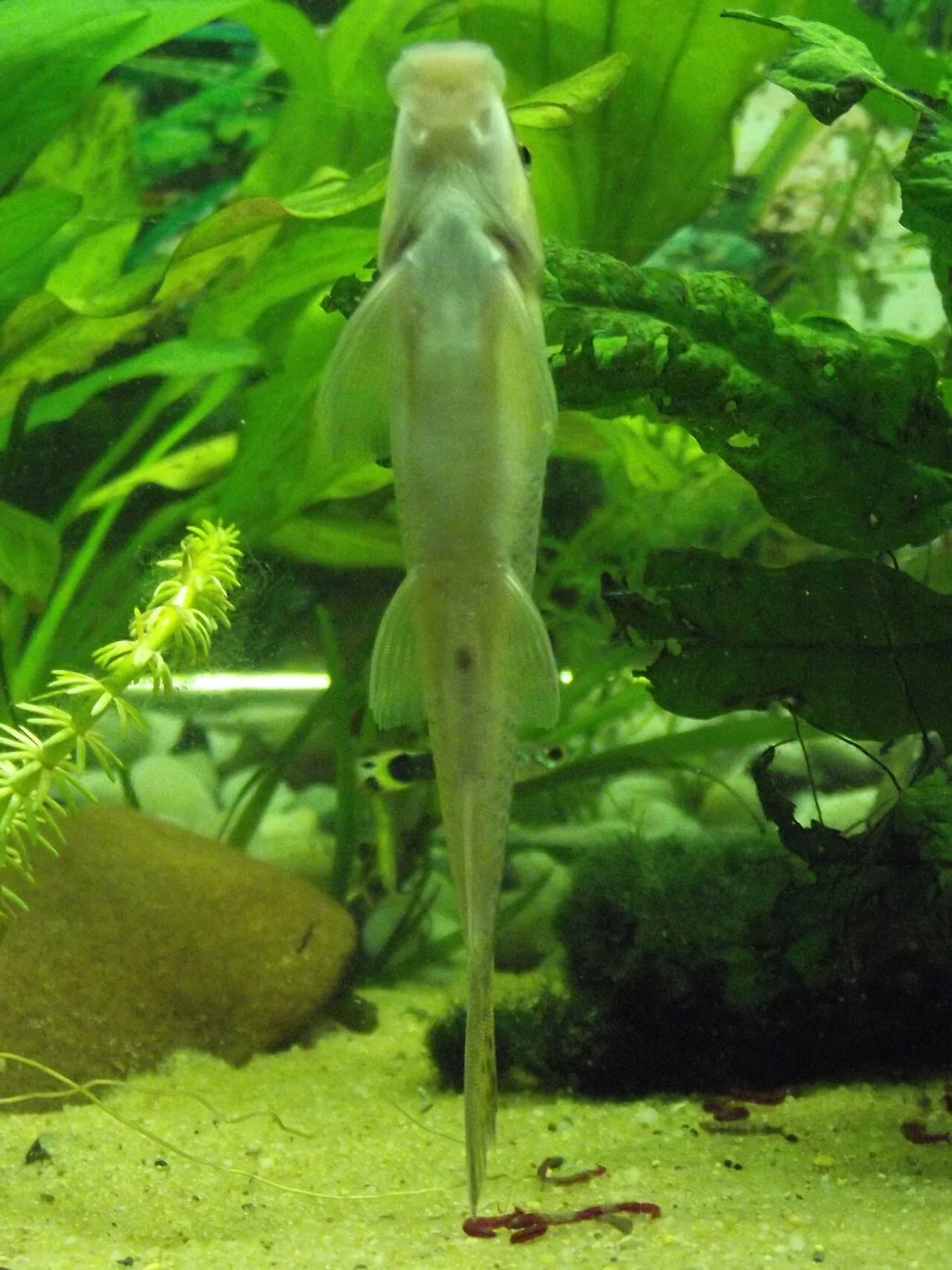
- Near the bottom Mostly stays just above the bottom. Food has to reach the substrate.
- Wood and roots Uses roots as shelter or grazes biofilm from them.
Shrimp in the tank
Dwarf shrimp at risk
- Not shrimp safe
- Dwarf shrimp at risk
- Shrimplets at risk
- Shrimp safe
- Adult dwarf shrimp
- At risk
- Shrimplets
- Get eaten
- Safe from shrimp size
- about 4 cm
The flying fox endangers dwarf shrimp. It grows to 16 cm and eats worms, crustaceans and live food besides algae. It can be territorial towards its own kind. Young shrimp and small Neocaridina or Caridina are eaten. Larger shrimp such as Amano shrimp from about 4 cm are usually safe.
Dwarf shrimp are kept separately. Amano shrimp share algae duty with it if enough plants, stones and roots provide shelter and both get enough food. Fed in the evening, it tends to leave the shrimp alone.
Home & range
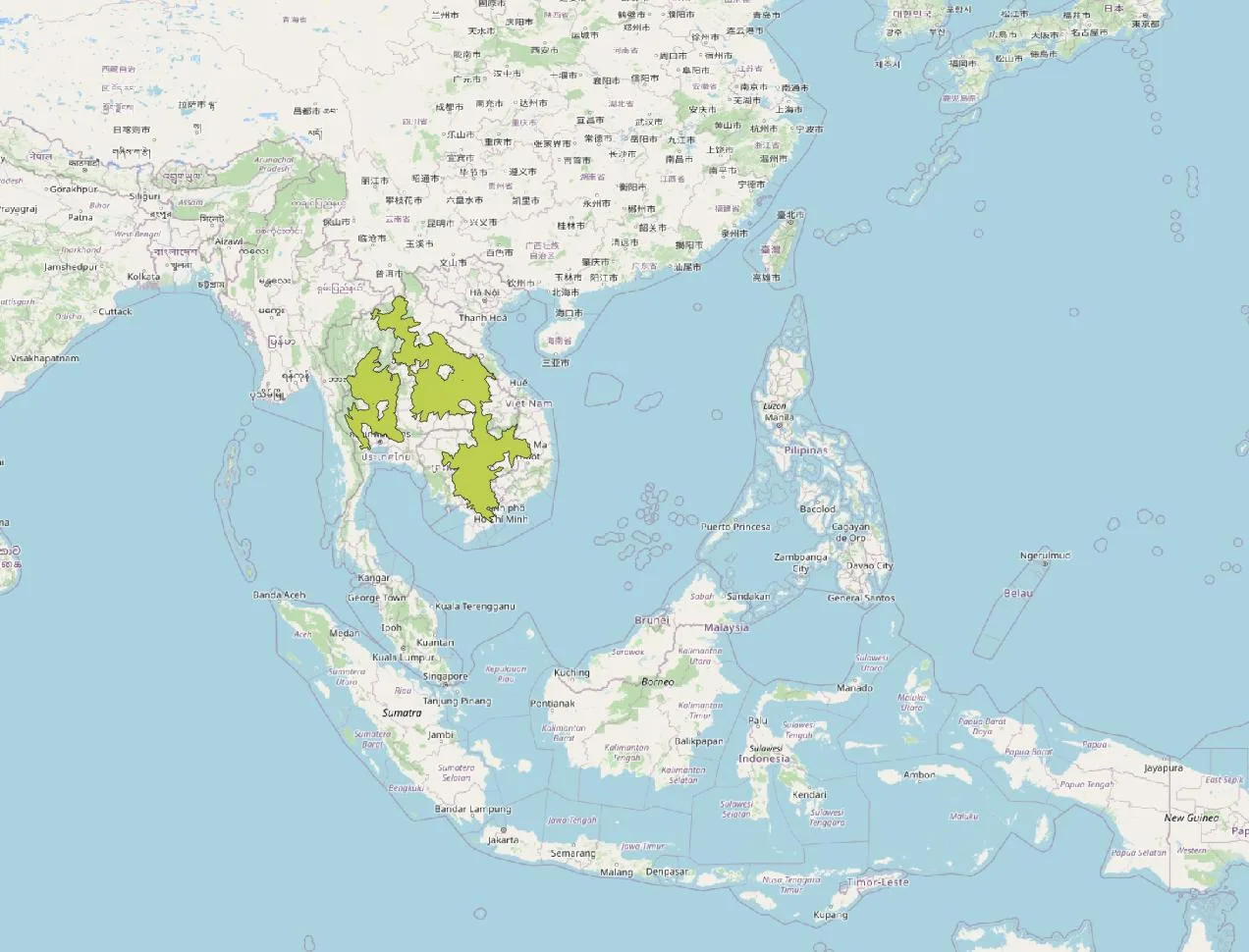
Hatched countries are where the species occurs. It lives in particular waters there, not across the whole country. The points name known waters for orientation, not collection sites.
- Country of origin
- Water for orientation
Native
- Thailand
- Range: southern Thailand.
- Indonesia
- Range: Sumatra and Borneo, perhaps also Java.
Overview
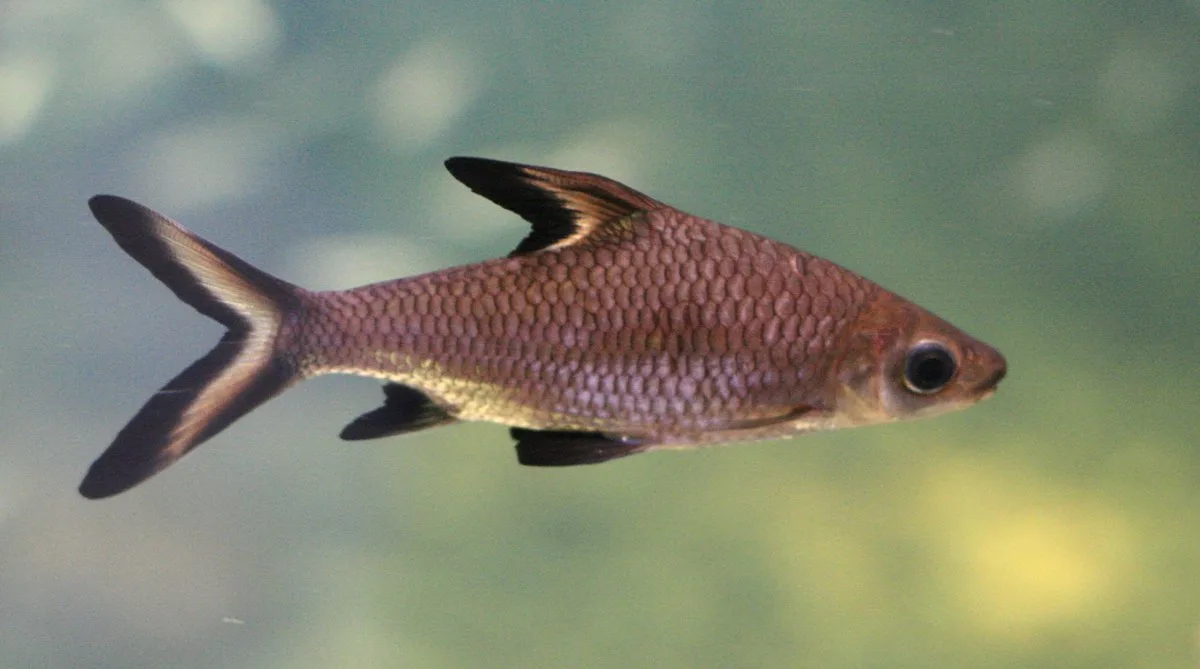
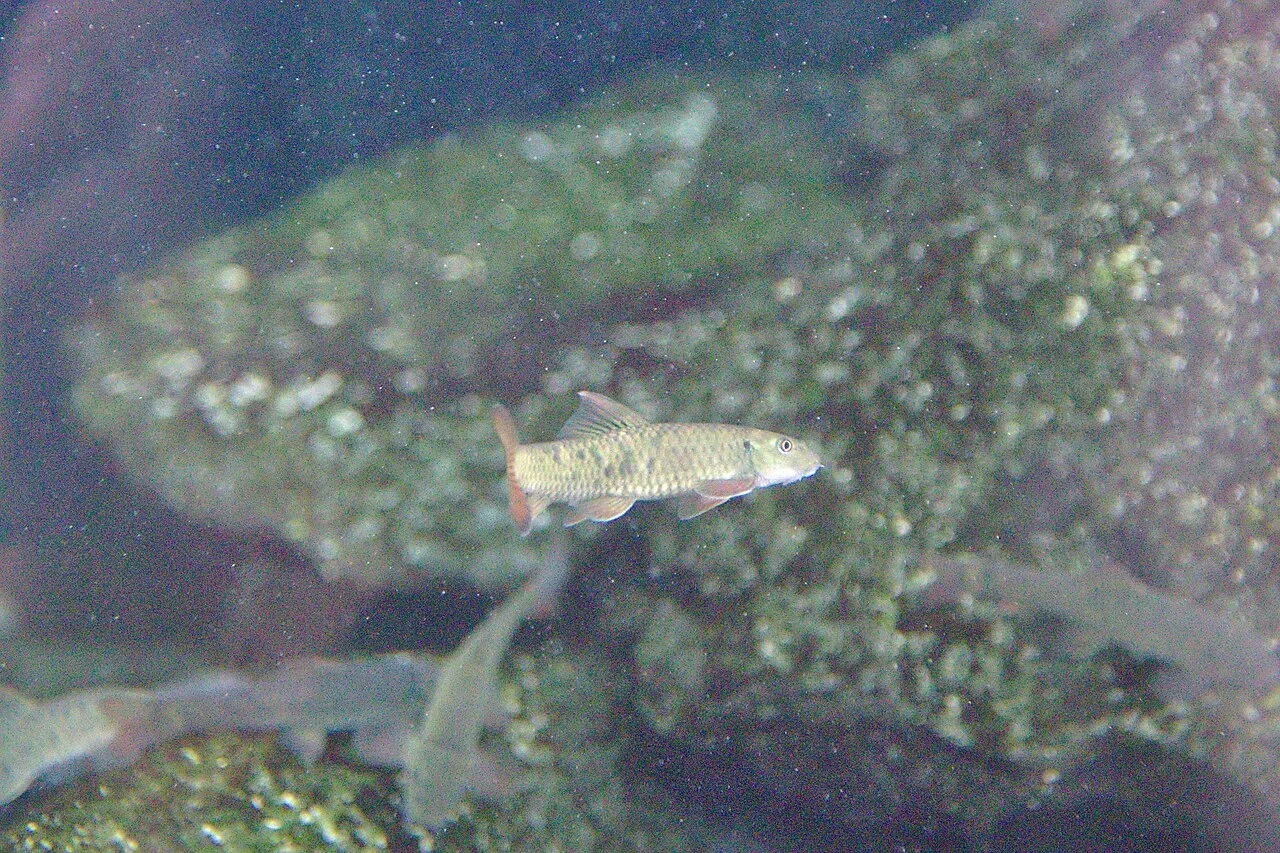
The flying fox reaches about 12 to 15 cm. A dark band runs into the tail, often with a gold line above it. The fins are not velvet black with a red flag. That is how it is separated from Epalzeorhynchos bicolor. Juveniles of both species are confused in the trade.
The mouth is underneath and rasps aufwuchs. The species is not a pure algae eater and not a fish that keeps a algal tank clean on the side while living on leftovers.
Features
According to a description by Bănărescu the body is yellowish, with a broad dark brown band along the back and on each side from the eye to the tail fork. A golden stripe lies above the blackish brown band, the iris can be reddish, and the dorsal, anal and pelvic fins are transparent in front with a thick black band. The species reaches up to 16 cm, about 12 cm on average. Mature females are plumper and males slimmer, but outwardly the sexes are hard to tell apart. It is often confused with the Siamese algae eater (Crossocheilus siamensis). Pieter Bleeker described the species in 1850 as Barbus kalopterus.
Origin & habitat
This describes the origin, not how to furnish the aquarium.
Flowing waters of Thailand, the Malay Peninsula and the Greater Sunda Islands. Current, oxygen and surfaces with aufwuchs. The countries stay a coarse origin.
The habitat explains the need for length and for movement in the water. A short, still tank shows a fish that swims up and down the glass.
The flying fox lives in the south of the Malay Peninsula, southern Thailand and Malaysia, via Singapore to Indonesia on Sumatra, Borneo and perhaps Java. It does not occur in the Chao Phraya or Mekong. Many populations have shrunk or disappeared in recent decades. It lives in rivers and mountain streams and usually grazes sandy or rocky ground. In the rainy season it moves into flooded areas and forests. The IUCN lists the species as least concern.
Care
Space
24 to 28 °C, pH 6.5 to 7.5. From about 200 litres and 120 cm for one adult. Wood, rock, current and an open run. One adult is the rule. Two adults on one run fight. Juveniles in a shop tank tolerate each other because nobody holds a fixed territory.
Company
Calm fish in the upper and middle water. Other suckermouths, red-tailed sharks and bottom catfish with a similar claim are the poor combination. Shrimp are often eaten. Soft plants suffer less from being eaten than from the constant grazing of the leaves.
Diet
Aufwuchs, algae, blanched vegetables, spirulina tablets and a share of frozen food. The food has to arrive at the bottom. A hope that the fish will live off the glass ends in a hollow belly once the glass is clean.
Several small plant feeds through the day fit better than one large meat tablet.
Behavior
With growth the schooling juvenile becomes a territorial fish on the bottom. Toward fish that clearly swim above, it often stays calm. Toward anything that grazes the same root, it does not. A losing fish stands up in the current and stops feeding.
The species is active by day and needs the run. A purely nocturnal tank does not show it.
The species is regarded as very hardy and suitable for beginners. It stays in the middle and lower zones and needs lush planting with open swimming space, moderate to strong current and quiet places to rest at night. A suitable tank holds about 150 litres (40 gallons) or more with fine gravel or sand, rocks and roots, pH 6 to 7.5, 2 to 12 dH and 23 to 27 °C. It gets along with many species and can be kept alone or in groups, but may be territorial towards other flying foxes. It eats mainly algae, except red algae, plus flakes, tablets, vegetables and live food. Eight to ten years are reached in the aquarium. No captive breeding is known.
Reproduction
Egg scatterer. Deliberate breeding in a private community tank is uncommon. The sexes are uncertain on the living fish. For keeping a single animal that does not matter.
A thin flying fox beside a well-fed one is a stocking mistake, not a breeding sign.
Gallery
More species in this group
Similar water needs
Species with a similar temperature, a similar pH and a comparable adult size. Whether their behaviour fits as well is what the compatibility check is for.



