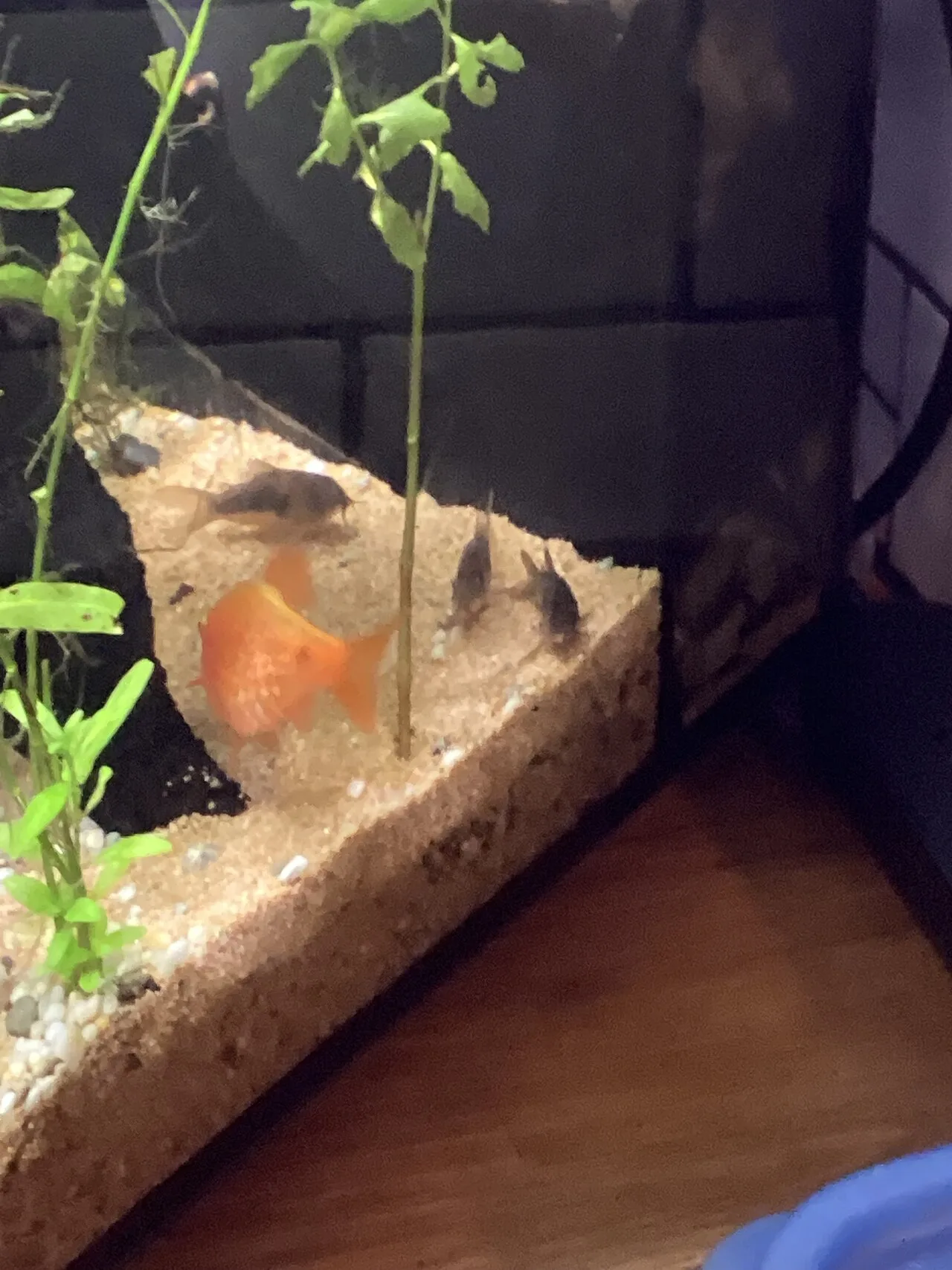
Goldfish
Carassius auratus
20 views
One carp species. Orange, white, veil fins and oranda are breeds, not further species.
- Temperature
- 15 – 24 °C
- pH
- 7.2 – 7.6 pH
- General hardness
- 8 – 20 °dH
- Maximum size
- 35 cm
- Minimum tank size
- 120 L
4 min read · 668 words
Fresh water
Quick facts
Place in the aquarium
Highlighted are the water layer and the spots where the species usually stays in the tank.
- Middle water Usually stays in the middle of the tank, between bottom and surface.
- Near the bottom Mostly stays just above the bottom. Food has to reach the substrate.
- Open swimming space Needs an open area without plants or decor to swim at length. Tank length matters more than height.
Shrimp in the tank
Not shrimp safe
- Not shrimp safe
- Dwarf shrimp at risk
- Shrimplets at risk
- Shrimp safe
- Adult dwarf shrimp
- At risk
- Shrimplets
- Get eaten
- Safe from shrimp size
- No size is safe
Goldfish and shrimp do not go together. Depending on the breed, goldfish grow to 20 to 35 cm, and even wild fish eat crustaceans, insects and plants. With their highly protrusible mouth they take up anything sitting on the bottom or among plants, and they do not stop eating on their own. Dwarf shrimp are eaten, and even larger species such as Amano shrimp are not safe from adult goldfish. In addition, the cool water does not suit many tropical shrimp. Shrimp therefore belong in a tank of their own.
Home & range
Hatched countries are where the species occurs. It lives in particular waters there, not across the whole country. The points name known waters for orientation, not collection sites.
- Country of origin
- Water for orientation
Native
Overview
Up to 35 cm depending on the breed. Aquarium strains stay about one third smaller. No stomach, pharyngeal teeth, gills adapted to low oxygen. The oranda has a scaleless head growth.
Body and senses
The goldfish is considered the oldest known domestic animal kept without direct economic use. Its jaws are toothless. Food is crushed between the pharyngeal teeth and a hard chewing plate, the carp stone, and digested only in the gut. The two-chambered swim bladder is connected to the foregut by an air duct. Apart from the oranda with its scaleless head growth, the body is fully scaled and has a complete lateral line.
Goldfish see with four cone types, one of them for ultraviolet light. They hear in roughly the same frequency range as humans, because the swim bladder passes sound to the inner ear through the Weberian apparatus. Wild goldfish usually grow to 12 to 22 cm and rarely over 40 cm. Kept in the dark they gradually turn grey, because pigment forms in response to light. Food, water quality, age and health also shape the colour.
Origin and breeds
Linnaeus described the species as Cyprinus auratus. The earlier idea that the goldfish descends from the crucian carp is regarded as disproved. Besides the common goldfish and the comet there are many breeds such as shubunkin, veiltail, telescope eye, ranchu, celestial eye and bubble eye. Breeds with altered eyes or skulls are debated in Western Europe as cruel breeding. Released goldfish now live on every continent except Antarctica and, thanks to a high salt tolerance, also enter brackish water.
Origin & habitat
This describes the origin, not how to furnish the aquarium.
Linnaeus names rivers in China and Japan. Both countries stay coarse. Worldwide releases, including brackish water, are not a natural range and are not mapped.
Care
A small bowl is not justified by the historical keeping in vessels.
Water and space
Goldfish release a lot of waste through faeces and gills and need much oxygen. For common and comet varieties about 76 litres per fish are needed, for smaller fancy varieties about 38 litres per fish. The water surface determines how much oxygen enters the water, and aeration helps further. Bowls and mini tanks lead to disease, stunting and death.
As a coldwater fish the goldfish needs no heater. Rapid temperature changes are dangerous, for example at night in a cooled-down office. Below about 10 °C it becomes critical for fancy varieties, and above 30 °C it harms all of them. Live plants are eaten, and only a few such as Cryptocoryne and Anubias survive with care. In captivity goldfish can live beyond ten years.
In frosty regions a pond should be at least 80 cm deep. In winter the fish become sluggish, stop eating and rest on the bottom. In spring they become active again.
Diet
A generalist.
In the wild goldfish eat crustaceans, insects and various plants. They do not stop eating on their own. Overfeeding can cause blockages, especially in fancy breeds with a convoluted gut. Goldfish food contains less protein and more carbohydrate. Shelled peas, blanched leafy greens and bloodworms supplement it, and young fish benefit from brine shrimp.
Behavior
Goldfish are peaceful with each other. The real problem is competition for food: fast varieties such as comets eat everything before slow fancy breeds can reach it. Goldfish learn and get used to people. After a few weeks many take food from the hand. Touching them, however, damages the slime coat.
Reproduction
Breeding of veil-finned races began in Japan. Florida, Italy and Israel are breeding places, not the native range.
Spawning
Goldfish only reach sexual maturity with enough water and good nutrition. Spawning usually follows a clear temperature change, often in spring and mostly in ponds. Males chase the ripe females and nudge them. The adhesive eggs stick to dense plants or a spawning mop and hatch after 48 to 72 hours. Parents eat any young they find. Heavily altered breeds can partly no longer reproduce naturally.
Like the Prussian carp, the goldfish can reproduce gynogenetically. Contact with the sperm of another cyprinid species is enough to start the development of the egg.
Gallery
More species in this group
Similar water needs
Species with a similar temperature, a similar pH and a comparable adult size. Whether their behaviour fits as well is what the compatibility check is for.