
Rainbow shark
Epalzeorhynchos frenatum
26 views
A slender carp with red fins. As an adult it stays a solitary bottom fish. It is not the red-tailed black shark.
- Temperature
- 24 – 28 °C
- pH
- 6.5 – 7.5 pH
- General hardness
- 5 – 11 °dH
- Maximum size
- 15 cm
- Minimum tank size
- 200 L
4 min read · 567 words
Fresh water
Quick facts
Further published values
- Lifespan
- 4 – 6 a
Place in the aquarium
Highlighted are the water layer and the spots where the species usually stays in the tank.
- Middle water Usually stays in the middle of the tank, between bottom and surface.
- Near the bottom Mostly stays just above the bottom. Food has to reach the substrate.
- Wood and roots Uses roots as shelter or grazes biofilm from them.
Shrimp in the tank
Dwarf shrimp at risk
- Not shrimp safe
- Dwarf shrimp at risk
- Shrimplets at risk
- Shrimp safe
- Adult dwarf shrimp
- At risk
- Shrimplets
- Get eaten
- Safe from shrimp size
- about 4 cm
The rainbow shark is a risk for dwarf shrimp. It grows to about 15 cm and grazes algae and biofilm but also eats insect larvae and crustaceans. In the tank it is territorial and chases other fish out of its area.
Neocaridina and Caridina are eaten or hunted, and their young anyway. Larger shrimp from about 4 cm, such as Amano shrimp, are usually safe but get chased. A separate tank is the better solution for dwarf shrimp. Anyone who wants to add shrimp should choose robust, larger species and introduce them only once the tank is well run in and densely planted.
Home & range
Hatched countries are where the species occurs. It lives in particular waters there, not across the whole country. The points name known waters for orientation, not collection sites.
- Country of origin
- Water for orientation
Native
Overview
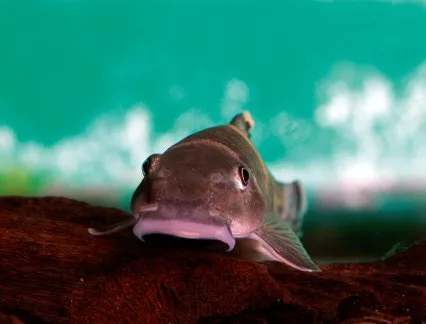
The rainbow shark reaches about 12 to 15 cm. The body is grey to olive, the fins bright red to orange. A dark band sits at the dorsal. Albino is a cultivated form of the same species. The mouth is underneath and rasps aufwuchs. Juveniles in a school look peaceful. Adults hold a territory and drive off other suckermouths.
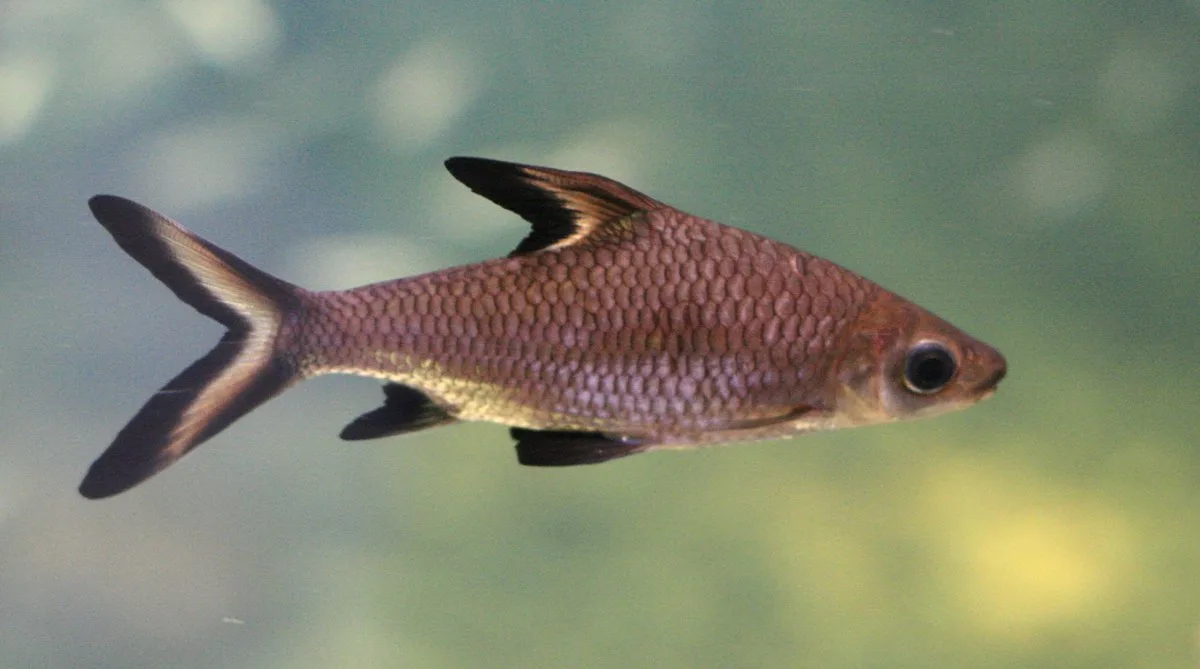
It is not Epalzeorhynchos bicolor. The red-tailed shark lacks the grey ground colour. Its body is black and only the tail is red. The two are confused in the trade while they are small.
Name and forms
In German the species is also called the green fringelip or red-finned labeo. The body is greenish brown to bluish, a short stripe runs from the snout to the gill cover, and a large black spot lies at the tail base. The dorsal, anal and pelvic fins are red with a smoky tinge. Males are slimmer and more strongly coloured. There is an albino form with a white body and red fins. Epalzeorhynchos munense is sometimes confused with it but is a separate, rarely traded species. Fowler described the rainbow shark in 1934 as Labeo frenatus from Chiang Mai. Frenatus refers to the bridle-like stripe.
Origin & habitat
This describes the origin, not how to furnish the aquarium.
Flowing waters in Thailand, Laos and Cambodia, with current, oxygen and surfaces to graze. The countries stay a coarse origin. The habitat is long and moving, not a short community tank without a hiding place.
The species lives in the Mae Klong, Chao Phraya and Mekong in Thailand, the Mekong basin in Laos including the lower Xe Bangfai, the lower Mekong in Cambodia and the Tonle Sap river and lake. It stays near solid surfaces and on the bottom, also over sand. In the flood season it moves onto flooded banks and into forest.
Care
Space
24 to 28 °C, pH 6.5 to 7.5. From about 200 litres and 120 cm for one adult. Wood, rock, current, a cave. One adult is the rule. Two adults on one run fight. Juveniles in a shop tank tolerate each other because nobody holds a fixed territory.
Company
Calm fish in the upper and middle water. Other suckermouths, flying foxes and red-tailed sharks are the poor combination. Shrimp are often eaten. Soft plants suffer while it grazes.
It is kept at 24 to 27 °C, 5 to 11 °dH and pH 6 to 8 in tanks from about 200 litres and 120 cm in length. Peaceful with its own kind in the wild, the species turns aggressive in tanks, threatening, butting and biting, and can chase smaller fish to death. Hiding places reduce this. It jumps. Other sharkminnows and shark catfish do not fit, while barbs, rasboras, rainbowfish and loaches fit better.
Diet
Aufwuchs, algae, blanched vegetables, spirulina and a share of frozen food. The food has to arrive at the bottom. A hope that the fish will live off the glass ends in a hollow belly once the panes are clean.
In the wild it eats algae, biofilm and plankton, and in aquaria mainly algae flakes, plus bloodworms, lettuce, spinach and brine shrimp.
Behavior
With growth the schooling juvenile becomes a territorial fish on the bottom. Toward fish that clearly swim above, it often stays calm. Toward anything that grazes the same root, it does not. A losing fish stands up in the current and stops feeding.
Reproduction
Egg scatterer. Breeding in a private community tank is uncommon. The sexes are uncertain on the living fish. For keeping a single animal that does not matter.
Gallery
More species in this group
Similar water needs
Species with a similar temperature, a similar pH and a comparable adult size. Whether their behaviour fits as well is what the compatibility check is for.



