
Red-tailed black shark
Epalzeorhynchos bicolor
15 views
A black and red carp that looks peaceful as a juvenile and needs a clear bottom territory as an adult. It grows larger than the shop tank suggests.
- Temperature
- 22 – 26 °C
- pH
- 6.5 – 7.5 pH
- General hardness
- 5 – 15 °dH
- Maximum size
- 15 cm
- Minimum tank size
- 250 L
5 min read · 820 words
Fresh water
Quick facts
Further published values
- Lifespan
- 5 – 8 a
Place in the aquarium
Highlighted are the water layer and the spots where the species usually stays in the tank.
- Near the bottom Mostly stays just above the bottom. Food has to reach the substrate.
- Wood and roots Uses roots as shelter or grazes biofilm from them.
- Rocks and caves Needs caves, crevices or rockwork as hiding place, territory or spawning site.
Shrimp in the tank
Not shrimp safe
- Not shrimp safe
- Dwarf shrimp at risk
- Shrimplets at risk
- Shrimp safe
- Adult dwarf shrimp
- At risk
- Shrimplets
- Get eaten
- Safe from shrimp size
- No size is safe
The red-tailed black shark eats shrimp. It grows to 12 to 16 cm, searches the bottom for insects, small crustaceans, worms and detritus as an omnivore and is strongly territorial. Anyone keeping it with shrimp must expect them to be eaten. This applies to dwarf shrimp and to larger species, which are chased within its territory.
Shrimp belong in a separate tank. The red-tailed black shark needs a large tank with stones, roots and visual barriers and fast tankmates that can get out of its way.
Home & range
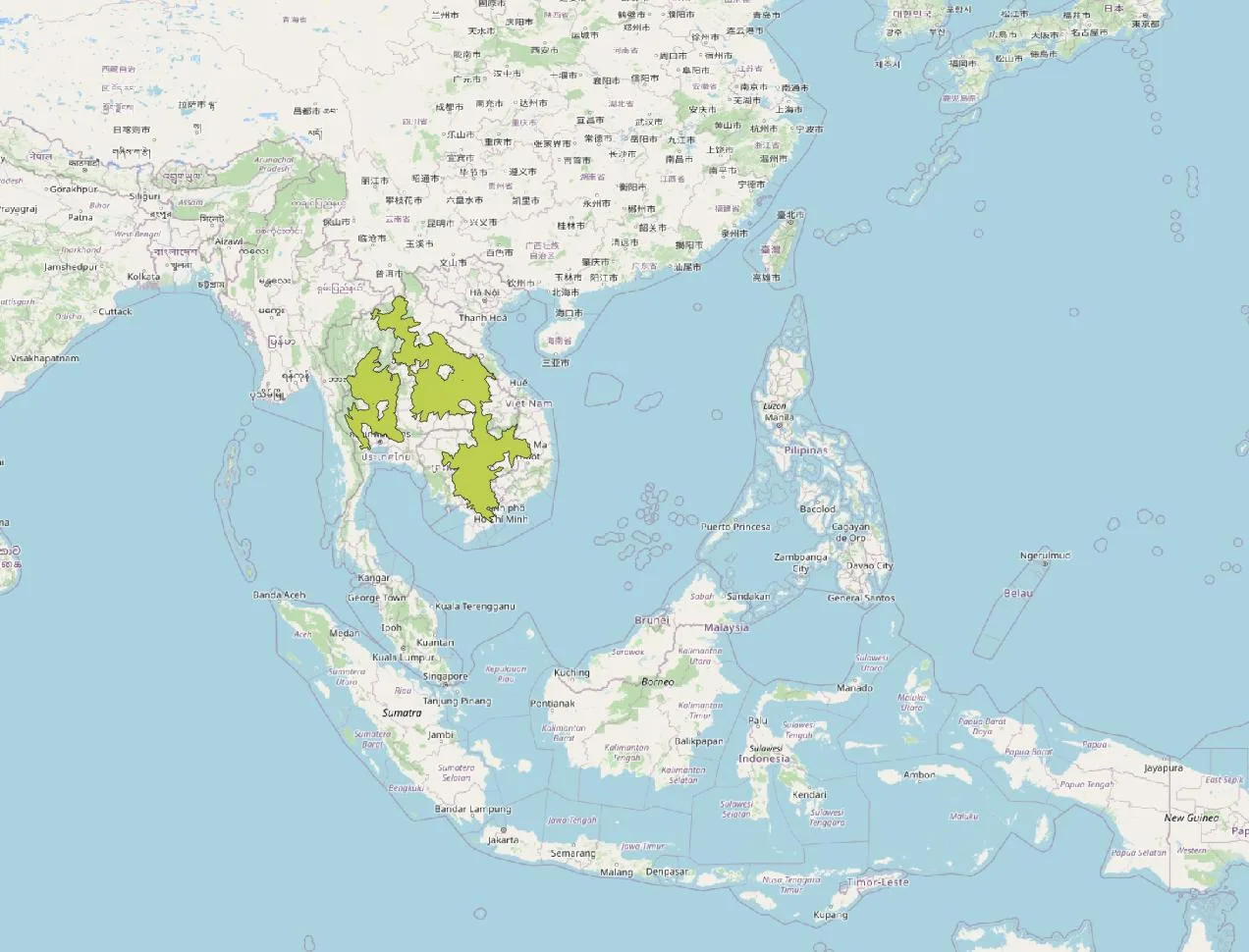
Hatched countries are where the species occurs. It lives in particular waters there, not across the whole country. The points name known waters for orientation, not collection sites.
- Country of origin
- Water for orientation
Native
- Thailand
- Range: the lower Mae Klong, Chao Phraya and Bang Pakong in Thailand.
Overview
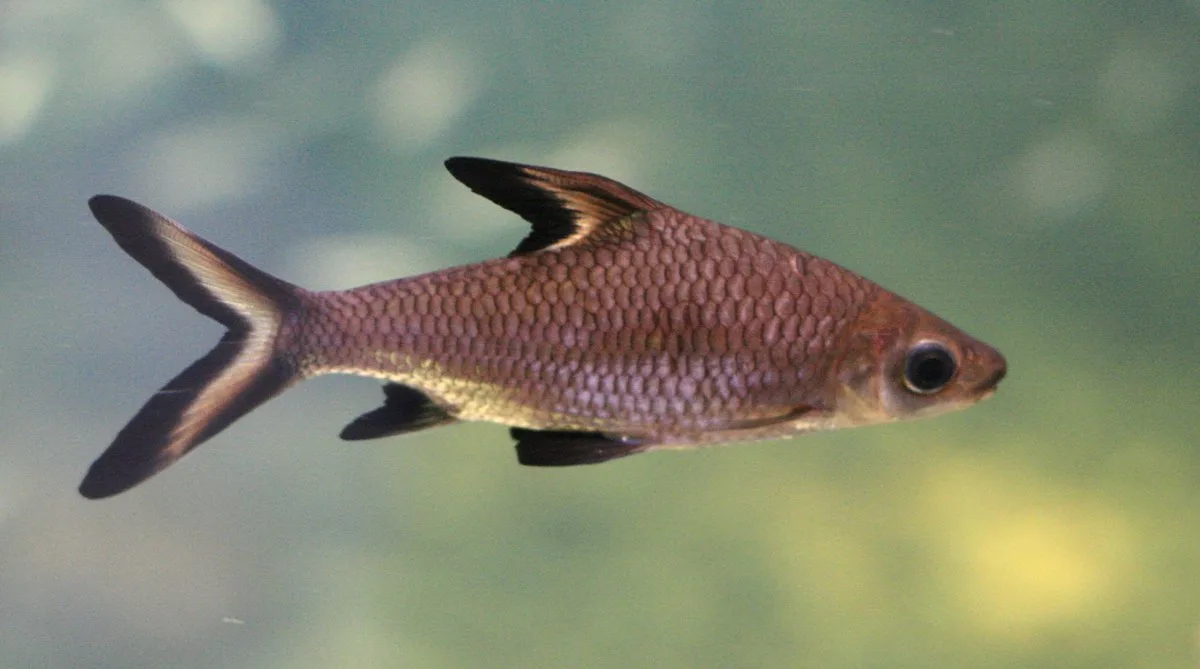
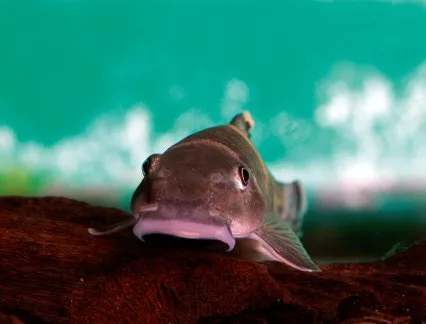
The red-tailed black shark reaches about 12 to 15 cm. The body is velvet black, the tail bright red. The mouth is underneath and carries barbels. Juveniles already show the pattern, which is why the adult size is underestimated. The species is not a shark and not a shark catfish, whatever the trade name says.
Some old fish fade, especially in poor water or constant fighting. The red fin remains the clearest mark against the flying fox, which has a different body and different fins.
Features and sexes
The slender cyprinid has a small mouth with barbels, a fairly high dorsal fin and small scales. A small spot sits above the pectoral fins, and the edge of the dorsal fin is narrowly white. The snout overhangs the mouth, the tail lobes are longer than the head, and the pectoral fins can be black, clear or orange. The red fades with stress, illness or poor water. Before about 15 months the sexes are hard to tell apart. The male's dorsal fin tapers to a point at the rear, while the female's ends straight at a right angle. Females are larger, wider and paler. It differs from the rainbow shark, in which all fins are red.
Hugh McCormick Smith described the species in 1931 as Labeo bicolor. It reached Germany in 1952 through Aquarium Hamburg.
Origin & habitat
This describes the origin, not how to furnish the aquarium.
The species comes from flowing waters in Thailand, especially the Mae Klong drainage. Wild stocks are treated as strongly reduced or locally gone. Almost all aquarium fish are captive-bred. That does not remove the need for a large enough tank.
The habitat is current, oxygen and structure, not a bare community tank without a hiding place. Thailand stays a coarse origin.
The red-tailed black shark is endemic to Thailand, in the lower Mae Klong, Chao Phraya and Bang Pakong. It lives in rivers with rocky or sandy and gravelly bottoms and moves into flooded areas. It was considered extinct in the wild from 1996 to 2011. In 2011 it was known from one site in the Chao Phraya basin, and in 2013 a single fish was found at the Mae Klong. The IUCN rates it as critically endangered. Dam building, swamp drainage, road construction and pollution are named. All fish in the trade are captive-bred, and in 1987 Thailand exported up to five million a year.
Care
Space
22 to 26 °C, pH about 6.5 to 7.5. Tanks from about 250 litres and 120 cm long for one adult. Roots, rock and caves, plus an open run. Current and oxygen must not be scarce. One adult is the rule. Two adults on one run fight, often until the loser is exhausted.
Tankmates
Calm fish that do not hold a bottom territory, in the middle and upper water. Other suckermouths, flying foxes and bottom catfish with a similar claim are the worst mix. Shrimp are often eaten. Soft plants suffer less from being eaten than from the constant patrolling.
Diet
Aufwuchs, algae and added food. Tablets, blanched vegetable strips, plant flakes and a share of frozen food. The food has to reach the bottom before the rest of the stock takes it.
The species is not a pure algae eater. A tank with no targeted feeding, in the hope that the fish will clean the glass, does not keep it.
Behavior
As it grows, the schooling juvenile becomes a solitary fish with a territory. Young fish in a shop tank tolerate each other because nobody holds a fixed ground. In a furnished tank that changes. The dominant fish stands in front of the cave and drives off anyone who crosses the same stretch of bottom.
Toward fish that clearly swim above, it often stays calm. Toward anything that feeds on the same wood, it does not.
The red-tailed black shark is territorial and aggressive, especially towards its own kind. For a long time it was thought to be solitary. Today conspecifics are considered necessary: groups of two to three are very nippy, and from about five the balance of power evens out. Fine sand, roots and stone structures, plenty of open swimming space, plants that create visual barriers and 250 to 500 litres are recommended. It is kept at 22 to 26 °C in neutral water with strong current and under a lid, because the fish jump. As an omnivore it takes plant food and small bottom animals and grazes algae. It is mainly active at night and reaches 5 to 8 years in captivity.
Reproduction
Egg scatterer. Deliberate breeding in a private community tank is uncommon. The shop fish come from farms. Sexes are uncertain on the living fish. For keeping that does not matter, because only one fish is kept.
A thin fish that is constantly driven off is not a breeding problem. It is a stocking mistake.
Breeding in the home aquarium is practically impossible because of its aggression. Since at least 1987 the species has been bred with hormone injections, with mortality after spawning of up to 80 percent. Vaccination against Streptococcus iniae reduced losses.
Gallery
More species in this group
Similar water needs
Species with a similar temperature, a similar pH and a comparable adult size. Whether their behaviour fits as well is what the compatibility check is for.

