
Three-stripe cory
Hoplisoma trilineatum
20 views
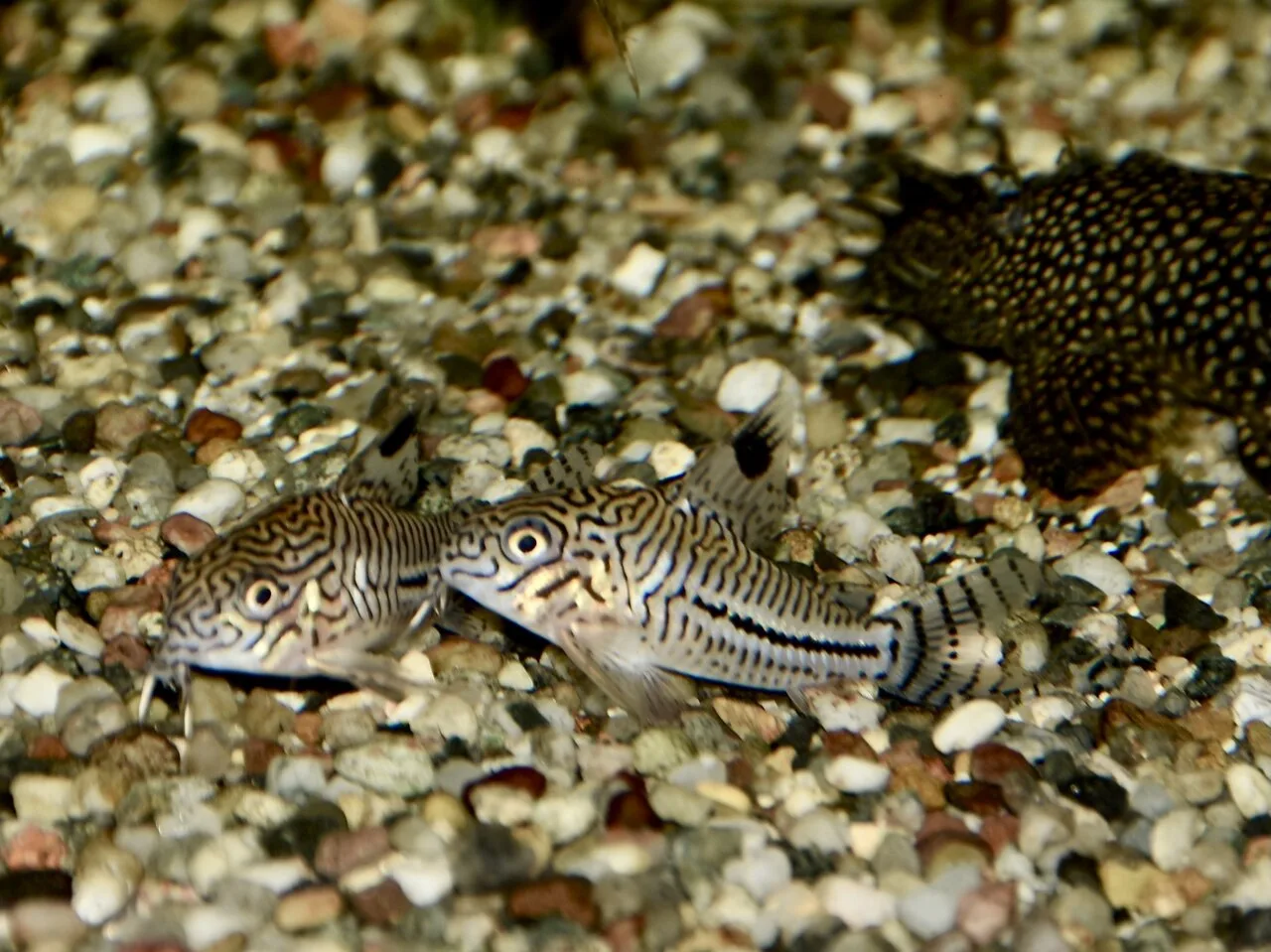
A cory from Peru and Ecuador. Not Hoplisoma julii and not Brochis leopardus. Corydoras trilineatus is the synonym.
- Temperature
- 22 – 27 °C
- pH
- 6 – 7.5 pH
- General hardness
- 2 – 15 °dH
- Maximum size
- 6 cm
- Minimum group size
- 5
- Minimum tank size
- 60 L
3 min read · 403 words
Fresh water
Quick facts
Further published values
- Lifespan
- 5 – 10 a
Place in the aquarium
Highlighted are the water layer and the spots where the species usually stays in the tank.
- Near the bottom Mostly stays just above the bottom. Food has to reach the substrate.
- Substrate Sifts through the substrate or burrows into it. Fine, rounded sand without sharp edges suits it.
Shrimp in the tank
Shrimplets at risk
- Not shrimp safe
- Dwarf shrimp at risk
- Shrimplets at risk
- Shrimp safe
- Adult dwarf shrimp
- Safe
- Shrimplets
- Get eaten
- Safe from shrimp size
- about 1.5 cm
Adult dwarf shrimp are safe from the threestripe corydoras. It grows to only 5 to 6 cm and forages with its small, downward mouth for worms, small crustaceans, algae and detritus. It cannot handle shrimp from about 1.5 cm. Freshly hatched young living on the bottom, however, are eaten while it forages.
Moss and plants where the young stay reduce losses. A separate feeding spot for the corydoras keeps them away from the shrimp hiding places.
Home & range
Hatched countries are where the species occurs. It lives in particular waters there, not across the whole country. The points name known waters for orientation, not collection sites.
- Country of origin
- Water for orientation
Native
Overview
Males to 5 cm, females to 6 cm, 5 to 10 years. Silver-grey with a black, very variable pattern. The trade name leopard cory often means the wrong fish. julii is usually spotted, leopardus long-snouted.
Identification
The Latin name trilineatum means three-striped. The pattern is reticulated, while H. julii is rather spotted like a leopard, although there is also a spotted form of the threestripe corydoras. The lateral line separates them most reliably: in H. trilineatum the stripe there is much more pronounced and solid. Brochis leopardus is the long-snouted counterpart. Edward Drinker Cope described the species in 1872. Corydoras episcopi and C. dubius are regarded as synonyms. English names include threestripe corydoras and false julii corydoras.
Origin & habitat
This describes the origin, not how to furnish the aquarium.
Fast tributaries of the middle Amazon in Peru and Ecuador, including the Javari, Huitoyacu, Nanay, Ampiyacu, Pastaza, Yasuní and Morona. Both countries stay coarse.
More broadly, the range covers the central Amazon basin in Brazil and Colombia, the Peruvian Amazon and coastal rivers in Suriname. The waters have pH 6.0 to 8.0, a hardness of 5 to 19 dGH and 22 to 26 °C. The IUCN lists the species as least concern.
Care
A school from five, cover, 22 to 27 °C, pH 6.0 to 7.5, KH 2 to 5, GH 2 to 15, from 60 litres. KH has no own trait field. Free access to the surface, because it breathes through the gut.
Diet
Omnivore: algae, detritus, small animals.
In the aquarium it takes live food such as brine shrimp, mosquito larvae, daphnia and tubifex, frozen food, tablets, flakes and vegetables. In the wild the species eats worms, bottom-living crustaceans, insects and plant matter.
Reproduction
Mostly on the bottom, in smaller schools.
Spawning in the T position
In the wild breeding follows the rainy season, when the water is warm and full of suspended matter and prey. In the aquarium a cooling of 2 to 3 degrees for one to three days helps, followed by rich feeding and warming. Breeding groups consist of two males and one female. A male clamps the female's barbels with his pectoral spines, the so-called T position. The female catches a few eggs in a pouch formed by her pelvic fins, where they are fertilised, and sticks them onto glass, under leaves or into Java moss. This repeats for hours until about 100 eggs are laid. At 26 to 28 °C almost transparent larvae hatch after about four days. Two to three days later they take freshly hatched brine shrimp, then fine flake food. The parents do not guard the eggs.
More species in this group

Similar water needs
Species with a similar temperature, a similar pH and a comparable adult size. Whether their behaviour fits as well is what the compatibility check is for.


