Ticto barb
Pethia ticto
18 views
A small barb from South Asia with two dark spots. The males redden when courting. The group has to be large enough.
- Temperature
- 20 – 26 °C
- pH
- 6.5 – 7.5 pH
- General hardness
- 5 – 12 °dH
- Maximum size
- 8 cm
- Minimum group size
- 8
- Minimum tank size
- 100 L
3 min read · 503 words
Fresh water
Quick facts
Place in the aquarium
Highlighted are the water layer and the spots where the species usually stays in the tank.
- Middle water Usually stays in the middle of the tank, between bottom and surface.
- Open swimming space Needs an open area without plants or decor to swim at length. Tank length matters more than height.
Shrimp in the tank
Dwarf shrimp at risk
- Not shrimp safe
- Dwarf shrimp at risk
- Shrimplets at risk
- Shrimp safe
- Adult dwarf shrimp
- At risk
- Shrimplets
- Get eaten
- Safe from shrimp size
- about 3 cm
The ticto barb is only partly suitable for dwarf shrimp. It grows up to 10 cm and eats crustaceans, insects and plankton, mainly on the bottom. That means it searches exactly where shrimp live. Juvenile shrimp are eaten, and small adult dwarf shrimp too. Larger shrimp from about 3 cm are usually safe.
In a large tank with many hiding places among stones and wood Amano shrimp can fit. Dwarf shrimp and their breeding belong in a separate tank.
Home & range
Hatched countries are where the species occurs. It lives in particular waters there, not across the whole country. The points name known waters for orientation, not collection sites.
- Country of origin
- Water for orientation
Native
Overview
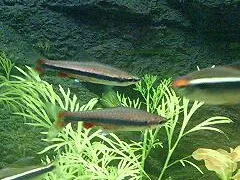
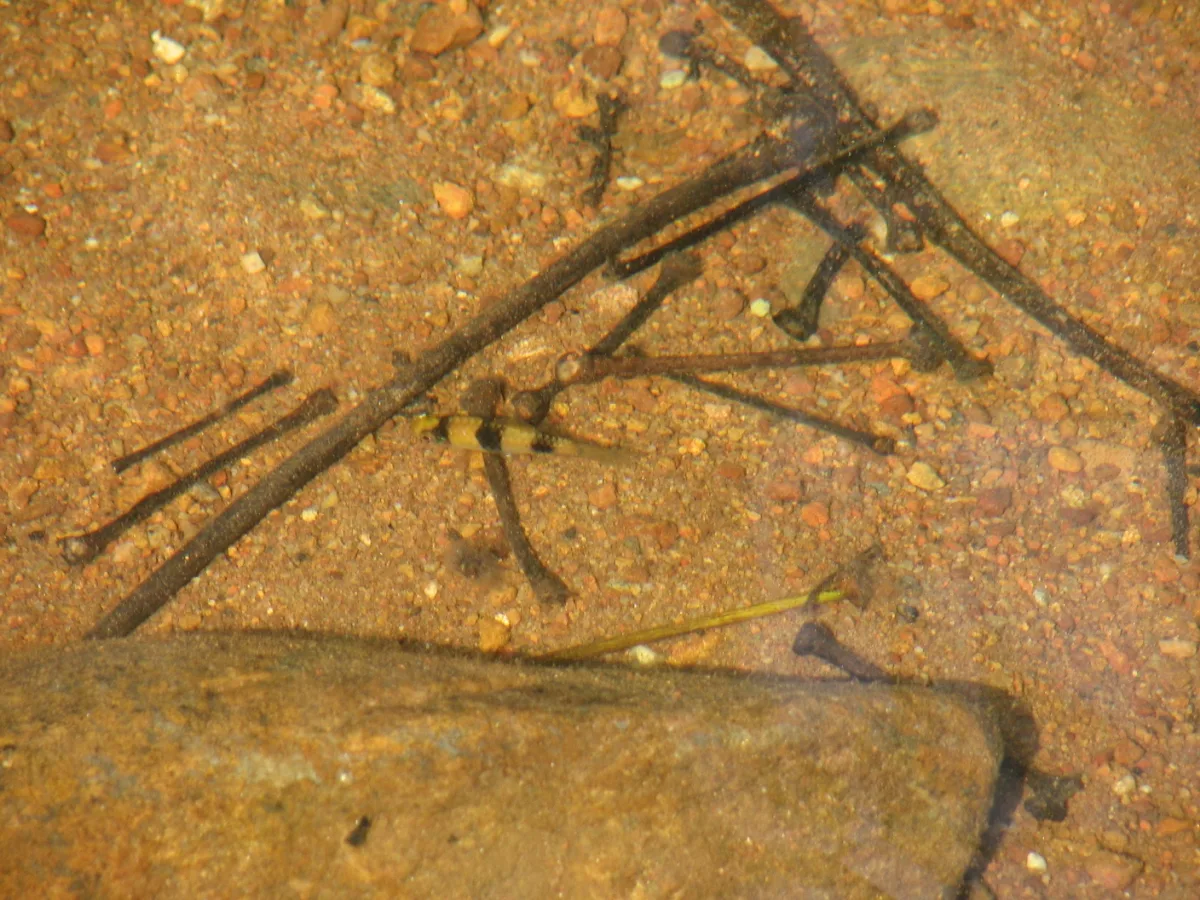
Pethia ticto reaches about 8 cm, in the aquarium often less. Two black spots, one behind the gill cover and one in front of the tail base, stay the mark. Males become reddish when courting and grow a higher dorsal. Females stay more silvery.
It is not the Odessa barb and not the rosy barb. The two spots separate it. Like the other barbs it shows the colour only in a school.
Name and systematics
The species is also called two-spot barb. Francis Buchanan-Hamilton described it in 1822; older names are Puntius ticto and Barbus ticto. The species name goes back to a local name. Pethia was split off as a genus of its own in 2012 from the group around Puntius conchonius. From peripheral parts of India, P. muvattupuzhaensis, P. nigripinnis and P. pookodensis have since been separated from P. ticto as species.
Features
Length figures range up to 10 cm. Older fish become higher-backed. The back is olive-grey to grass green, the flanks silvery, the belly white. A small elongated dark spot lies above the pectoral fins, a larger, gold-edged one above the end of the anal fin on the caudal peduncle. Outside the spawning season the fins are colourless to slightly greenish; when spawning, the pelvic and anal fins redden. The dorsal fin is usually speckled black along its edge. The lateral line is short and covers only 6 to 12 scales. There are no barbels. Males have a fawn-brown belly and an eye that is blood red at the top. Because the range is large there are many colour forms.
Origin & habitat
This describes the origin, not how to furnish the aquarium.
Rivers, ditches and flooded fields in India, Nepal, Bangladesh and Sri Lanka. The countries stay a coarse origin. The water is not extremely soft.
The range includes the Indian subcontinent, Sri Lanka, the Irrawaddy and Salween in Myanmar and the upper Chao Phraya and upper Mekong in Thailand. The fish live near the shore in shallow, slow-flowing waters, usually over muddy ground.
Care
School
20 to 26 °C, pH 6.5 to 7.5. A group from eight, tanks from about 100 litres and 80 cm. Plants at the edge, an open middle, some current. Permanently very warm water is unfavourable.
Company
Other peaceful barbs and medium-sized tetras. Long fins are a risk when the own group is too small. In the right number it stays tolerant.
Diet
Omnivore with a plant share. Flakes, granules, vegetables, frozen food. Several small feeds. Mosquito larvae alone make them fat.
In the wild the species eats crustaceans, insects and plankton and searches for food mainly on the bottom.
Behavior
A lively school. The males display with the dorsal. That is courtship, not a permanent chase, as long as there is room to get away. A single fish turns pale or nips.
Reproduction
Egg scatterer without brood care. Fine plants and removing the parents are the breeding path. In a community tank the eggs are eaten.
A female lays about 150 eggs in all, in portions of about 20. The larvae hatch after 24 to 30 hours depending on water temperature and swim freely 4 to 5 days later.
Gallery
More species in this group
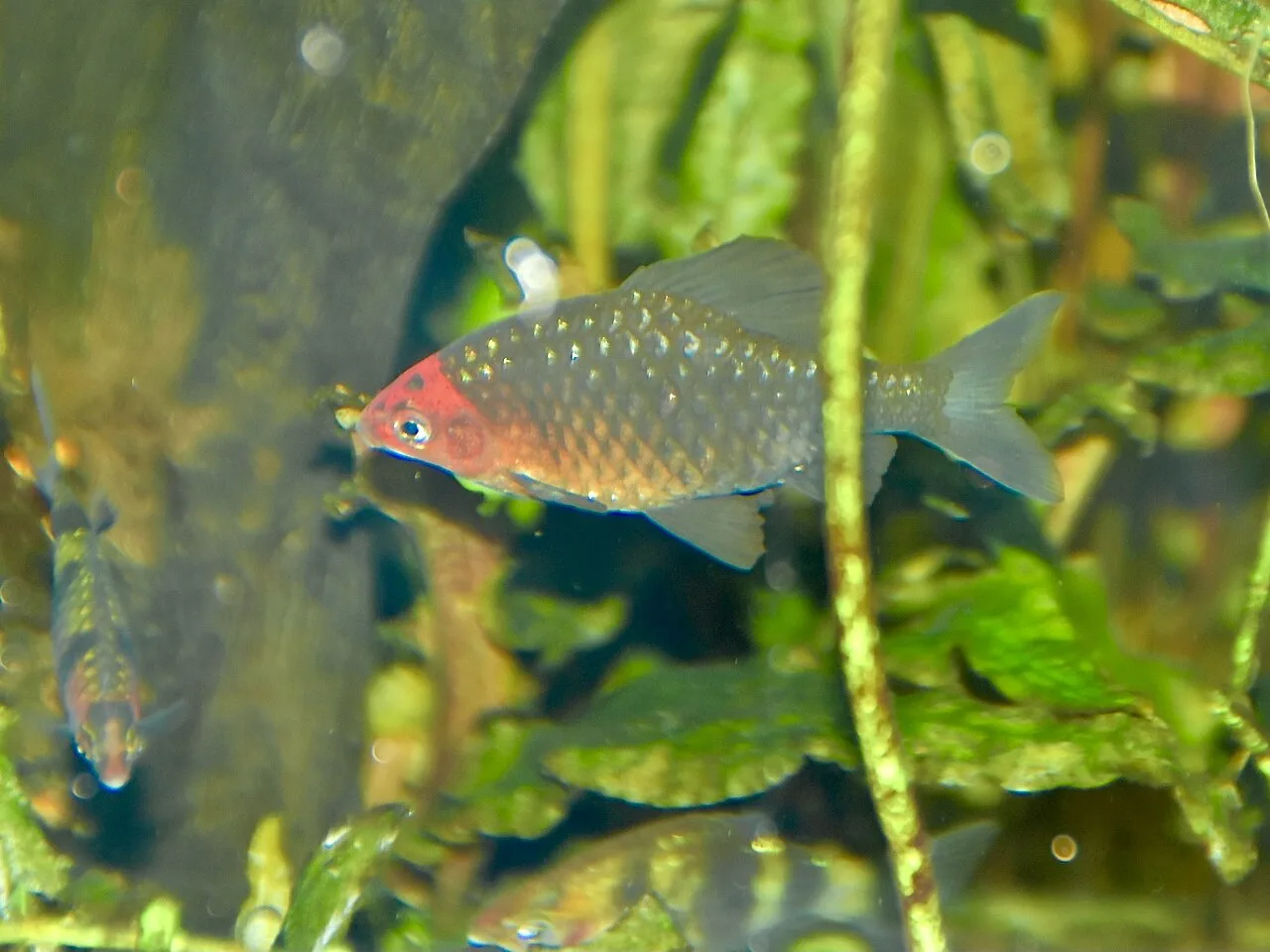
Similar water needs
Species with a similar temperature, a similar pH and a comparable adult size. Whether their behaviour fits as well is what the compatibility check is for.