
Zebra pleco
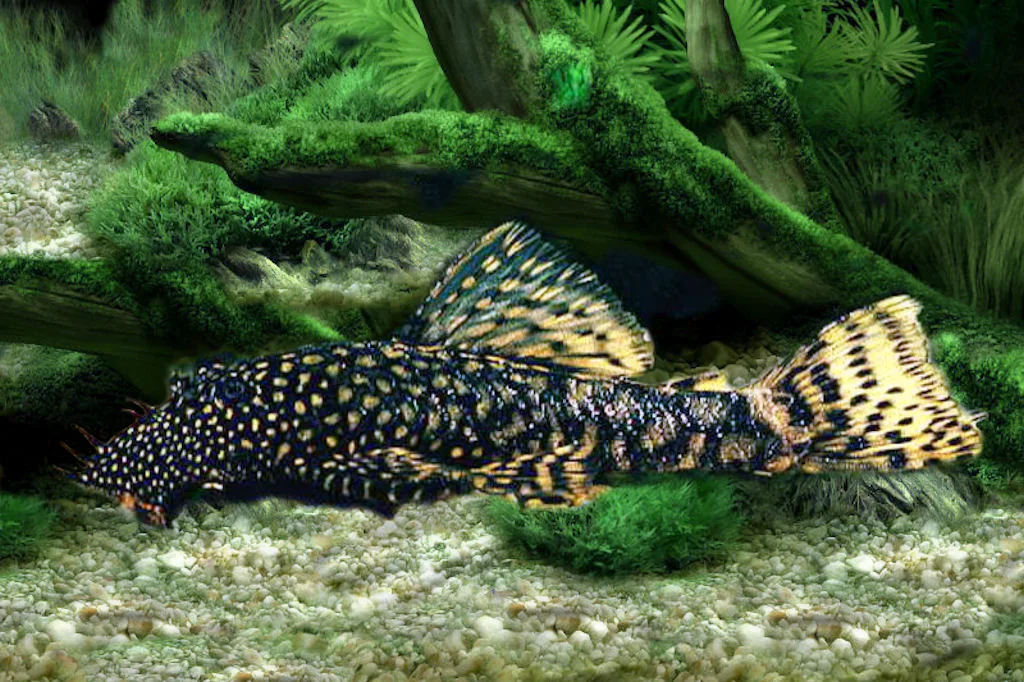
Hypancistrus zebra
26 views
An armoured catfish from the Rio Xingu, about 8 to 10 cm, old males also about 12 cm. L 27 and other L numbers are not this species. L 46 is the trade name of this fish.
- Temperature
- 24 – 28 °C
- pH
- 6 – 8 pH
- General hardness
- 2 – 10 °dH
- Maximum size
- 12 cm
- Minimum tank size
- 80 L
3 min read · 368 words
Fresh water
Quick facts
Place in the aquarium
Highlighted are the water layer and the spots where the species usually stays in the tank.
- Near the bottom Mostly stays just above the bottom. Food has to reach the substrate.
- Rocks and caves Needs caves, crevices or rockwork as hiding place, territory or spawning site.
Shrimp in the tank
Shrimplets at risk
- Not shrimp safe
- Dwarf shrimp at risk
- Shrimplets at risk
- Shrimp safe
- Adult dwarf shrimp
- Safe
- Shrimplets
- Get eaten
- Safe from shrimp size
- about 1.5 cm
Adult shrimp are usually safe with the zebra pleco. It grows 8 to 10 cm long, old males about 12 cm, and eats fine granules, flakes and chopped frozen food. It is not an algae grazer but takes animal food. It does not chase shrimp from about 1.5 cm. Juvenile shrimp sitting on the bottom at night can be eaten, however.
The catfish needs warm, strongly flowing water around 28 °C, which stresses dwarf shrimp in the long run. Keeping them together is therefore more of an exception.
Home & range
Hatched countries are where the species occurs. It lives in particular waters there, not across the whole country. The points name known waters for orientation, not collection sites.
- Country of origin
- Water for orientation
Native
- Rio Xingu
- Only the Rio Xingu.
Overview
Sex differences only after two or three years: males broader-headed, with longer odontodes on the gill covers and pectoral fins. About six males to one female. An age of over 20 years is reachable.
Discovery and identification
The species was discovered in the late 1980s and described in 1991 by Isbrücker and Nijssen. It belongs to the armoured suckermouth catfishes (Loricariidae). Despite high prices for good specimens it quickly became popular.
Seen from above, females look thicker at the belly. Males, by contrast, taper evenly towards the tail. The males' longer skin teeth sit on the gill covers and on the first pectoral fin ray.
Origin & habitat
This describes the origin, not how to furnish the aquarium.
Rio Xingu in Brazil. Brazil stays coarse and is not filled as a country shape. The Belo Monte dam threatens the habitat. Capture, breeding and export have been banned in Brazil since 2005. Since 2023 it is on CITES and specially protected in the EU.
Protection
Since 23 February 2023 the species has been listed in the CITES appendices, and in the EU since 20 May 2023 in Regulation (EC) No 338/97. In Germany it has since been specially protected under the Federal Nature Conservation Act. Stocks must be reported to the competent authority, and legal origin must be documented before buying or selling. Brazil banned catching, breeding and export in early 2005, because the stocks in the Rio Xingu are severely threatened. The planned Belo Monte dam would dry out the entire habitat.
Care
About 28 °C is a single approximate value, not a span. Otherwise no special water values. Strong current and oxygen, sand or gravel to 2 mm. From 80 litres for two or three fish. Every adult male needs its own flat cave. Not with loaches, because their eye spines injure.
Tank height does not matter; current, oxygen and caves do. Females and juveniles hide in rock crevices or under roots, while every adult male claims a flat cave of its own.
Diet
Fine granules, flakes and chopped frozen food.
Behavior
A cave dweller, mostly nocturnal, also by day.
Reproduction
The male tends 4 to 30 eggs of about 5 mm. The young are a good 1 cm at hatching and swim free after about two weeks.
The young swim freely once the yolk sac is used up. Until then the male alone tends the clutch in his cave.
Gallery
More species in this group


Similar water needs
Species with a similar temperature, a similar pH and a comparable adult size. Whether their behaviour fits as well is what the compatibility check is for.





