Tiger barb
Puntius tetrazona
14 views
The barred barb of the trade. It is regarded as scientifically undescribed and does not occur on Sumatra.
- Temperature
- 20 – 26 °C
- pH
- 6 – 7 pH
- General hardness
- 2 – 10 °dH
- Maximum size
- 7 cm
- Minimum group size
- 8
- Minimum tank size
- 100 L
3 min read · 484 words
Quick facts
Place in the aquarium
Highlighted are the water layer and the spots where the species usually stays in the tank.
- Middle water Usually stays in the middle of the tank, between bottom and surface.
- Open swimming space Needs an open area without plants or decor to swim at length. Tank length matters more than height.
Shrimp in the tank
Dwarf shrimp at risk
- Not shrimp safe
- Dwarf shrimp at risk
- Shrimplets at risk
- Shrimp safe
- Adult dwarf shrimp
- At risk
- Shrimplets
- Get eaten
- Safe from shrimp size
- about 3 cm
The tiger barb is not suitable for dwarf shrimp. It grows 5 to 7 cm long, is a lively omnivore and likes to nip at other animals. Juvenile shrimp are eaten, and small adult dwarf shrimp are often chased and bitten. Larger shrimp from about 3 cm such as Amano shrimp are usually safe.
The school is on the move all day and hardly lets shrimp settle. To keep both, choose larger, robust shrimp and plenty of hiding places. Dwarf shrimp are bred separately.
Home & range
Hatched countries are where the species occurs. It lives in particular waters there, not across the whole country. The points name known waters for orientation, not collection sites.
- Country of origin
- Water for orientation
Native
Overview
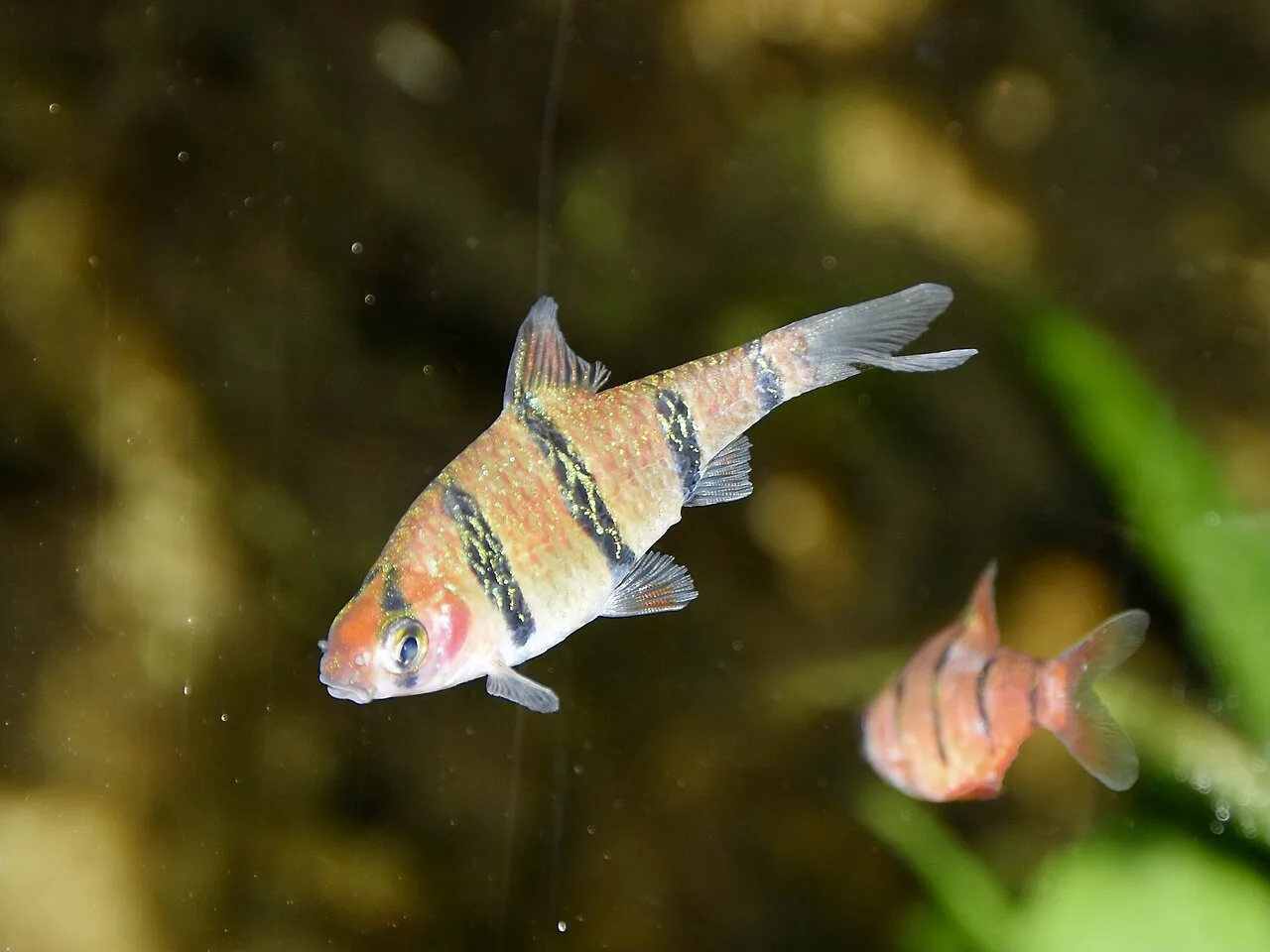
The trade fish are regarded as Puntigrus cf. tetrazona, not as the species Bleeker described in 1855 from southern Sumatra. Bleeker named barred barbs more than once and from different places, including a form from the Kahajan on Borneo that is now Desmopuntius rhomboocellatus. After a live import from Borneo in 2007, Zarske concluded that the fish long carried as Puntius tetrazona, the “Sumatra barb”, cannot be assigned to a described species. In 2013 Kottelat placed the Southeast Asian tiger barbs in the genera Desmopuntius and Puntigrus. The catalogue keeps the previously published name Puntius tetrazona without equating the trade fish with a described species. The body is deep and laterally compressed. Four broad bands encircle it: across the eyes, in front of the dorsal and pelvic fins, as a continuation of the dorsal colour into the anal fin, and around the caudal base. Pectoral and pelvic fins are often red. Males reach five centimetres, females at most seven centimetres in total length.
Distinction from Puntigrus tetrazona
The species named by Bleeker, Puntigrus tetrazona, grows to about 6 cm. According to Zarske it differs clearly from the trade tiger barb despite similar shape and colour: it has four barbels, the trade fish none. Its lateral line is complete with 19 to 23 scales, while that of the trade fish is incomplete.
Origin & habitat
This describes the origin, not how to furnish the aquarium.
The only soundly documented occurrences are Singapore and the Gunung Pulai Recreational Forest in Johor, in the south of the Malay Peninsula. The Sumatra barb does not occur on Sumatra. Other distribution records rest on confusion or on captive-bred stocks.
Care
Since the probable first import in 1933 by Otto Winckelmann in Hamburg-Altona, the fish has been one of the most frequently traded aquarium species. It is bred in the millions in Thailand, Malaysia, Singapore, the United States, Canada, Israel and the Czech Republic. Colour and attainable length vary with the breeding strain. Green, leucistic, albinotic and xanthoristic forms are named, and a leucistic form without an operculum.
Only as a large school
The tiger barb nips fins when the group is small or the tankmates wear long veils. From ten fish, better more, from about 100 litres and 80 cm, 24 to 28 °C. Several males, so the rivalry stays in the school and is not taken out on an angelfish. Dense plants at the edge, an open middle.
Moss barbs and green cultivated forms are not tamer species. They are the same fish in another coat. An albino in a group of four nips just the same.
Behavior
It should not be kept with long-finned fish, for example guppies, because it eats their fins.
Lively all day. Quiet bottom animals cope with that. Bettas, gouramis and angelfish do not. The species is a schooling fish for a tank set up for it, not the gap-filler beside expensive long fins.
Reproduction
Mass breeding in Southeast Asia, North America, Israel and the Czech Republic is stated as a trade fact, not as instructions.
Gallery
More species in this group
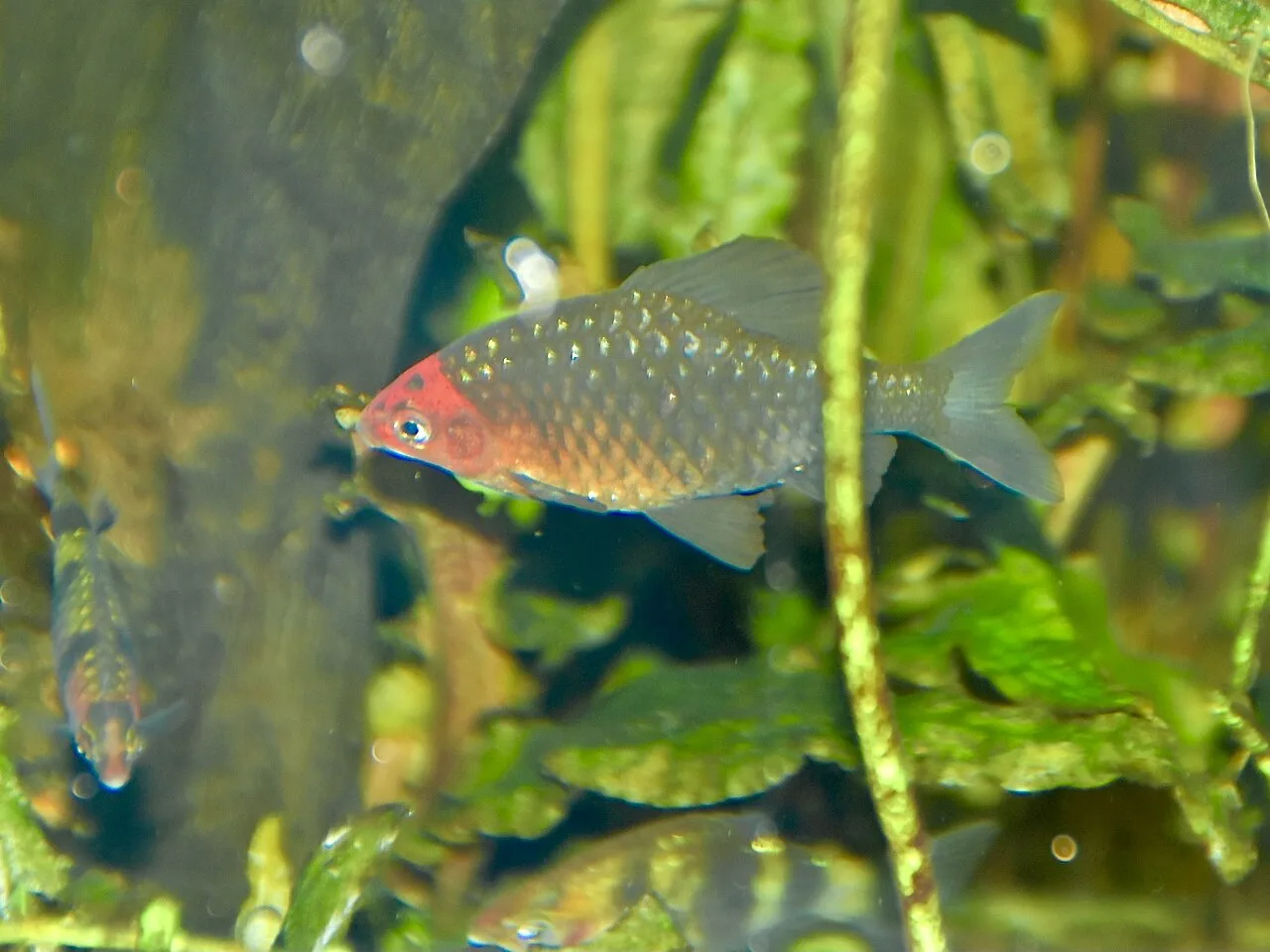
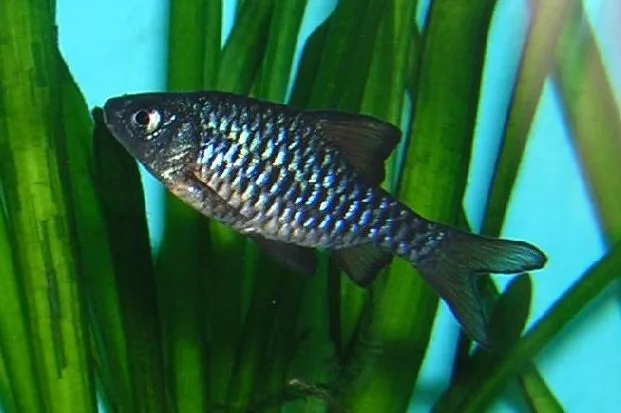
Similar water needs
Species with a similar temperature, a similar pH and a comparable adult size. Whether their behaviour fits as well is what the compatibility check is for.