Great pond snail
Lymnaea stagnalis
1 view
The largest freshwater pulmonate of central Europe, with a pointed shell. Good for unheated tanks and ponds, not for warm planted tanks.
- Temperature
- 10 – 22 °C
- pH
- 7 – 8.5 pH
- General hardness
- 8 – 20 °dH
- Maximum size
- 7 cm
- Social behavior
- Group
- Diet
- Omnivore
3 min read · 409 words
Fresh water
Quick facts
Further published values
- Lifespan
- 3 – 4 a
- Minimum tank size
- 30 L
Place in the aquarium
Highlighted are the water layer and the spots where the species usually stays in the tank.
- Water surface Stays just below the surface. The top needs a calm current and a cover.
- Dense plants Looks for dense planting as cover, retreat or grazing ground.
Home & range
Overview
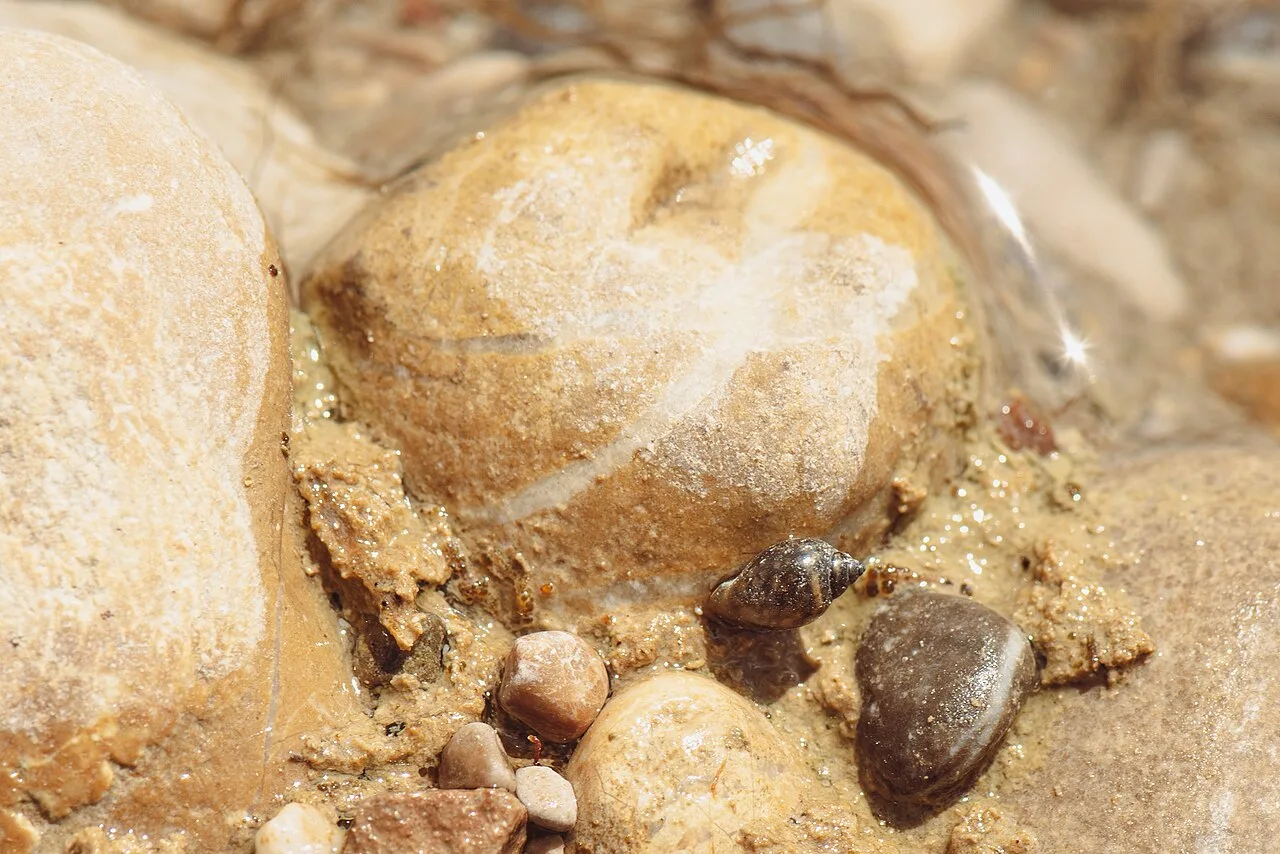
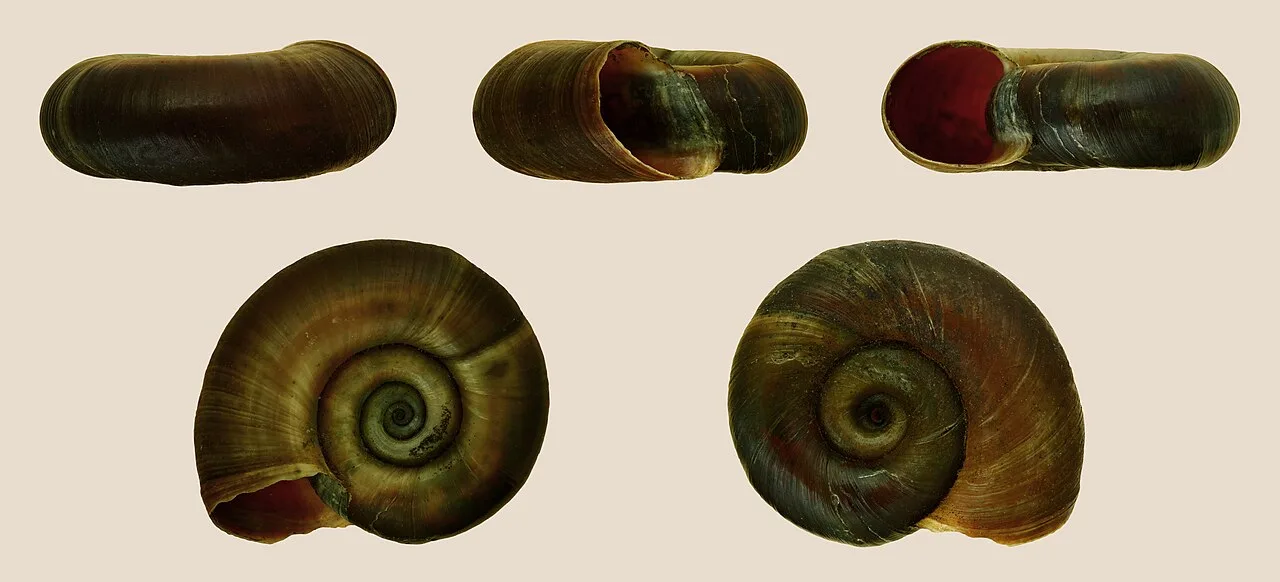
The right-coiled, thin, horn-brown shell reaches 4.5 to at most 7 cm, has about 7.5 whorls and ends in a long point. The last whorl is inflated. The shape varies with habitat: in the surf of large lakes the spires are shorter and the aperture wider, among reeds some animals form a hook at the lip. The body is grey to brown; the large tentacles are triangular, with the eyes at their base.
DNA comparisons show that some populations formerly identified as Lymnaea stagnalis are separate species. The range may therefore be smaller than assumed.
Range and habitat
This describes the origin, not how to furnish the aquarium.
Holarctic, in Scandinavia to northern Norway, in central Europe up to 1700 metres. Very common in larger pools, ponds, lakes, ditches and lowland rivers with rich plant growth. It tolerates pH 6.5 to 9 and is therefore absent from acidic bog waters. It survives drying out and freezing, as well as salinity up to 0.7 percent. In the northern Baltic Sea it stays clearly smaller at 2 to 3 cm. Above 26 °C mortality rises sharply because oxygen runs short.
Keeping
Tank
A coldwater tank at room temperature from about 30 litres, or a pond. No direct sun. Above 24 °C it becomes critical.
Water
10 to 22 °C, pH 7 to 8.5, hard water. A piece of cuttlebone provides calcium for the shell. Leftovers are removed often and the water is changed regularly, because leftover food quickly turns into nitrate.
Note
It is an intermediate host of flukes whose larvae can cause an itchy skin rash in swimmers. Animals from the tank never belong in natural waters, and animals from natural waters not unchecked in the tank.
Diet
Mainly algae, plus soft and decaying plant parts, detritus, carrion and the spawn of other animals. In the tank vegetables, lettuce, dandelion, flakes and food tablets. Lettuce and vegetables must be free of pesticides. Aquatic plants are eaten too. It grazes off mats of green hydra and also eats other snails' spawn.
Behaviour and moulting
It glides on its mucus trail and can even crawl upside down along the water surface. To breathe it takes air at the surface; through its well-supplied tentacles it also takes up oxygen from the water. When threatened it expels air and sinks to the bottom. When overcrowded it eats its own spawn.
Reproduction and larvae
Hermaphrodite, mature at about ten weeks. Fertilisation always runs in one direction only, not mutually. The firm, jelly-like egg strings on plants contain up to 200 eggs. After about 14 days, depending on temperature, fully formed young snails hatch. The animals live three to four years.
Gallery
More species in this group
Similar water needs
Species with a similar temperature, a similar pH and a comparable adult size. Whether their behaviour fits as well is what the compatibility check is for.