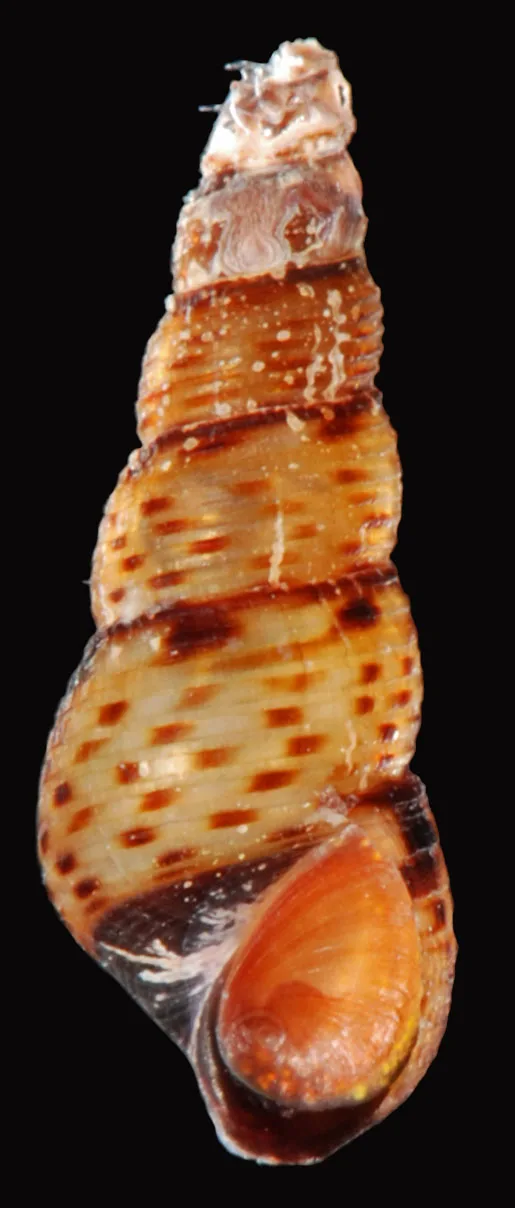
Crown nerite
Clithon corona
2 views
A small nerite with spiky projections on its shell. It eats algae and does not breed in fresh water.
- Temperature
- 22 – 28 °C
- pH
- 7 – 8.5 pH
- General hardness
- 8 – 18 °dH
- Maximum size
- 2 cm
- Social behavior
- Peaceful
- Diet
- Herbivore
2 min read · 219 words
Fresh water, larvae in salt or brackish water
Quick facts
Further published values
- Minimum tank size
- 20 L
Place in the aquarium
Highlighted are the water layer and the spots where the species usually stays in the tank.
- Near the bottom Mostly stays just above the bottom. Food has to reach the substrate.
- Wood and roots Uses roots as shelter or grazes biofilm from them.
- Rocks and caves Needs caves, crevices or rockwork as hiding place, territory or spawning site.
Home & range
Overview
The rounded shell reaches about 0.5 to 2 cm and carries calcified, horn-like projections. They make it harder for predators to get hold of it. The projections vary in length with origin and age and can break off. The base colour is dark, often with pale bands.
Range and habitat
This describes the origin, not how to furnish the aquarium.
Rivers and brackish estuaries in the Indo-Pacific. The species lives in the intertidal zone or in fast-flowing streams on hard ground and grazes algae there. The freshwater hermit crab Clibanarius fonticola uses only its shells.
Keeping
Tank
From about 20 litres with stones, wood and tough leaves as grazing area. The cover must be tight; nerites like to leave the water.
Water
22 to 28 °C, pH 7 to 8.5, GH from about 8 °dH. In soft, acidic water the shell erodes.
Companions
With shrimp and peaceful fish. Barbs and pufferfish pick at it.
Diet
Algae and biofilm. Once the surfaces are grazed, algae tablets and blanched vegetables supplement it.
Behaviour and moulting
Peaceful and slow. A snail that has been turned over has difficulty righting itself; if one lies on its back for long, help it.
Reproduction and larvae
Separate sexes. Females place small white egg capsules on stones, wood and glass. The larvae need brackish or sea water; nothing develops from them in fresh water. The capsules remain visible as white dots until they wear off. Animals in the trade are wild-caught.
Gallery
More species in this group
Similar water needs
Species with a similar temperature, a similar pH and a comparable adult size. Whether their behaviour fits as well is what the compatibility check is for.