Nigerian krib
Pelvicachromis taeniatus
24 views
A dwarf cichlid whose female shows a coloured belly when courting. Local forms differ in colour and stay one species.
- Temperature
- 24 – 27 °C
- pH
- 6 – 7 pH
- General hardness
- 2 – 10 °dH
- Maximum size
- 7 cm
- Minimum tank size
- 80 L
4 min read · 612 words
Fresh water
Quick facts
Place in the aquarium
Highlighted are the water layer and the spots where the species usually stays in the tank.
- Near the bottom Mostly stays just above the bottom. Food has to reach the substrate.
- Rocks and caves Needs caves, crevices or rockwork as hiding place, territory or spawning site.
Shrimp in the tank
Dwarf shrimp at risk
- Not shrimp safe
- Dwarf shrimp at risk
- Shrimplets at risk
- Shrimp safe
- Adult dwarf shrimp
- At risk
- Shrimplets
- Get eaten
- Safe from shrimp size
- about 4 cm
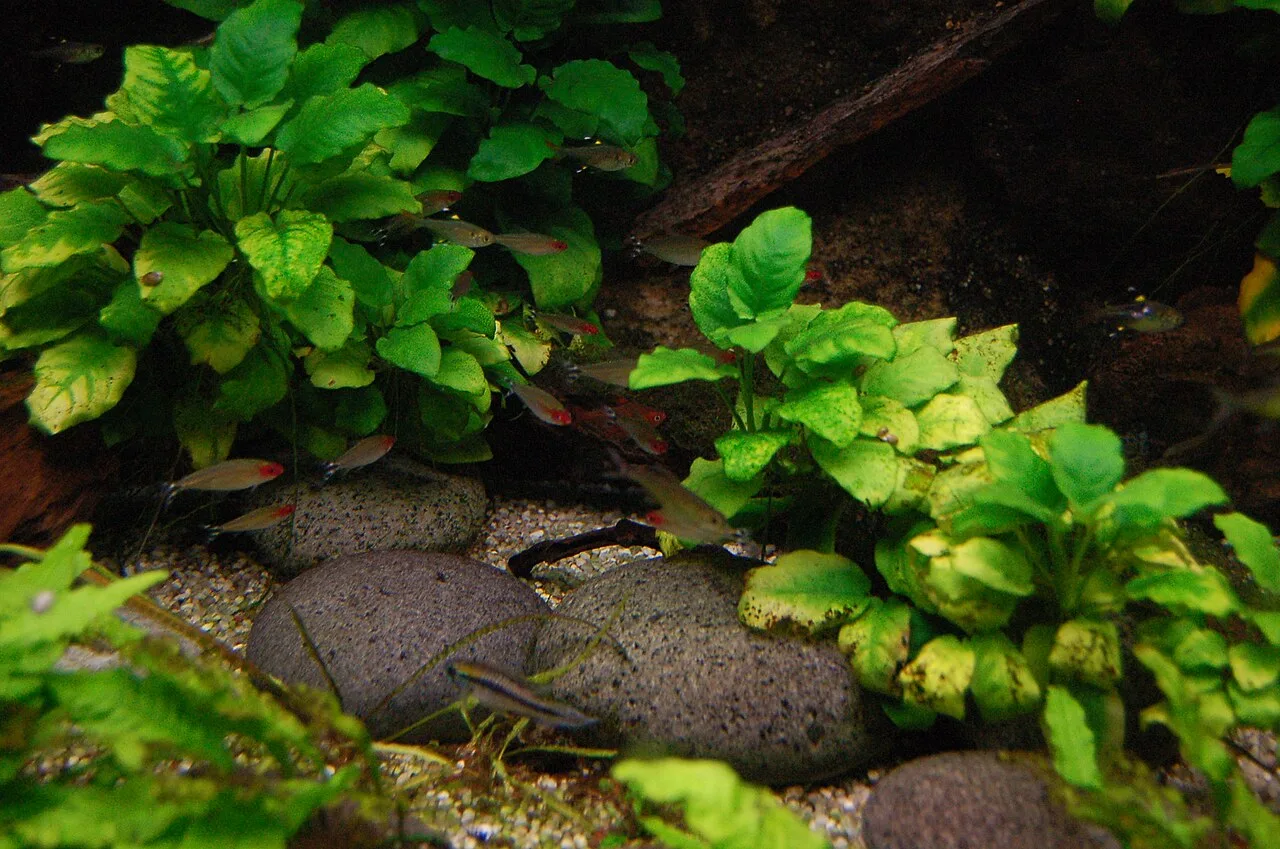
The striped kribensis is a risk for dwarf shrimp. Males grow to 8 cm, females to 6 cm. As cave brooders the pair defends its territory for weeks and chases anything that comes too close to the brood. At this size small shrimp are prey, juveniles all the more. Larger shrimp from about 4 cm are usually safe.
In a large, well-structured tank Amano shrimp can fit. Dwarf shrimp and their breeding belong in a separate tank.
Home & range
Hatched countries are where the species occurs. It lives in particular waters there, not across the whole country. The points name known waters for orientation, not collection sites.
- Country of origin
- Water for orientation
Native
Overview
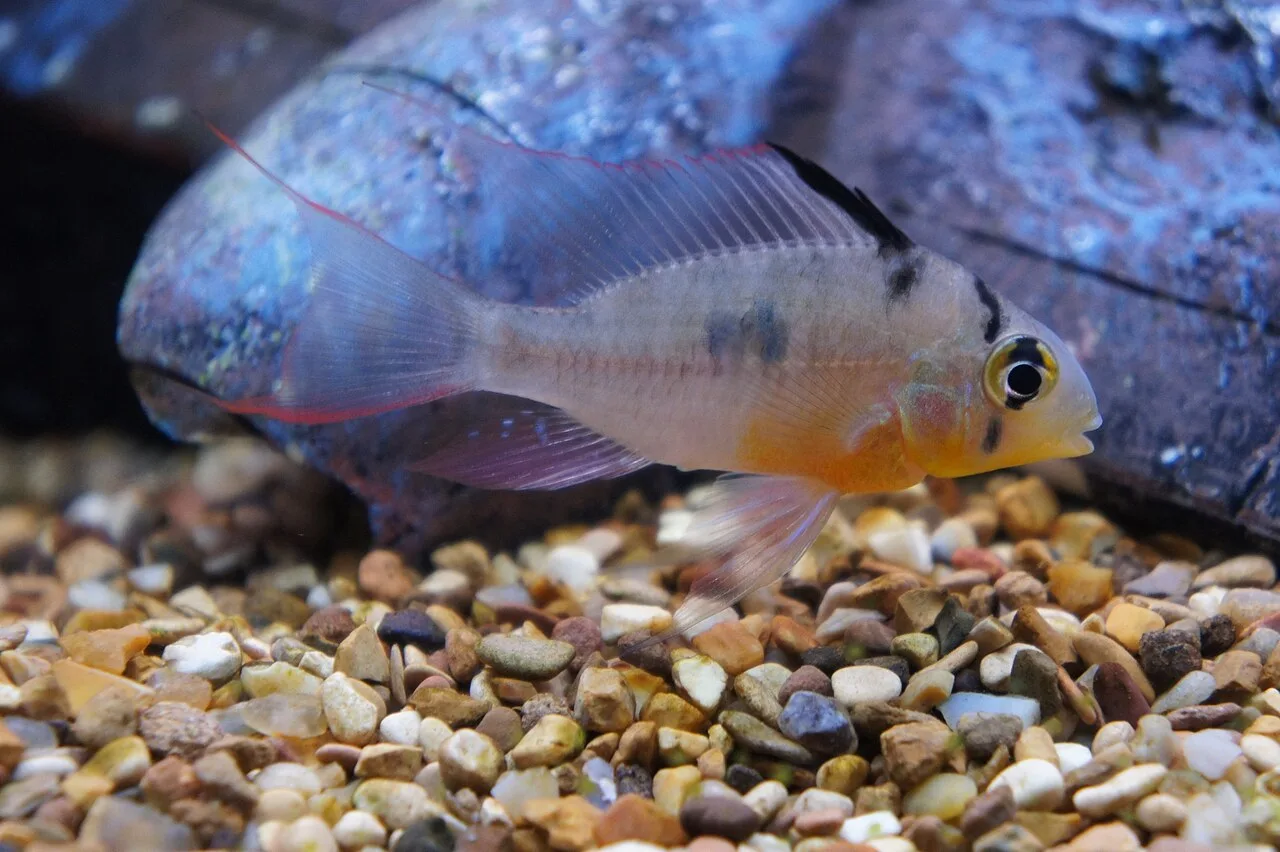
Pelvicachromis taeniatus reaches about 7 cm. The males are slimmer and carry extended fins. The females have a round belly that turns yellow, red or violet when courting. The colour depends on the origin. Those origins are not counted here as separate species.
It is not Pelvicachromis pulcher, the kribensis. Taeniatus stays slimmer. The pattern is a longitudinal band rather than the typical purple belly of the krib. Both want a cave.
Systematics
George Albert Boulenger described the species in 1901. In Germany it is sometimes also called Smaragdprachtbarsch. It belongs to the tribe Chromidotilapiini. The Cameroon populations formerly included have been listed as Pelvicachromis kribensis since a 2014 revision. For the population from the Wouri in Cameroon, P. drachenfelsi was set up in 2014.
Features
Females reach 6 cm, males 8 cm. The unpaired fins of males are strongly extended, those of females rounded. The males' caudal fin carries vertical rows of red and blue dots, and their dorsal and anal fins coloured spots in the soft-rayed part. In females the anal fin is mostly colourless, and the dorsal and caudal fins are yellowish. Males have a yellow belly, females a violet one. Fin formula: dorsal XVII–XVIII/7–8, anal III/7. There are very many colour variants.
Origin & habitat
This describes the origin, not how to furnish the aquarium.
Slow, plant-rich streams in Nigeria and Cameroon. The countries stay a coarse origin. Soft to medium-hard water and a cave match that.
The species lives in standing and flowing waters from Benin to the Niger delta, from the river mouths up to about 50 km inland. The water is soft, usually with low pH, at 22 to 25 °C. The fish often stay near the bank under overhanging vegetation. They are freshwater fish but also enter brackish river sections. In Germany the species is rarely offered, mostly as wild-caught fish.
Care
Pair
24 to 27 °C, pH 6 to 7. A pair from about 80 litres, with a cave for each female, plants and a fine bottom. Several pairs need clearly more floor area.
Company
Quiet tetras in the upper water. Other dwarf cichlids on the same cave, no. At spawning time the cave is defended. Afterwards that eases if the pair can get away.
Diet
Frozen food and fine granules. Brine shrimp, mosquito larvae, cyclops. The food also has to reach the female, not only the male at the glass.
Behavior
A pair with a cave. A female that is not allowed into the cave is not a pair. Two males on one tube end with one winner.
Mate choice
The species is a socially monogamous cave brooder. Males compete for territories with breeding caves, females for access to territorial males. Because brood care is costly, both sexes choose their partners carefully. This makes the species a research model for mutual mate choice. Males prefer females with large violet belly areas and large pelvic fins, females prefer yellow over pale males. The violet area predicts egg number and readiness to spawn. Both sexes prefer partners as large as possible and therefore pair with fish of similar size.
In the Moliwe population, females given a choice picked a brother as partner. Males paired with related females guarded the clutch longer. No inbreeding depression was found.
Reproduction
Cave spawner. The female stays with the clutch, the male holds the wider zone. The larvae are led. In a community tank they survive only if the other fish cannot reach the cave.
The female tends the eggs inside the cave, the male guards outside. After six to eight days the larvae leave the cave led by the female, while the male attacks predators from further away. Joint brood care lasts four to six weeks. It decreases as the brood grows. Weaker young are given up earlier, better-fed ones cared for longer.
More species in this group
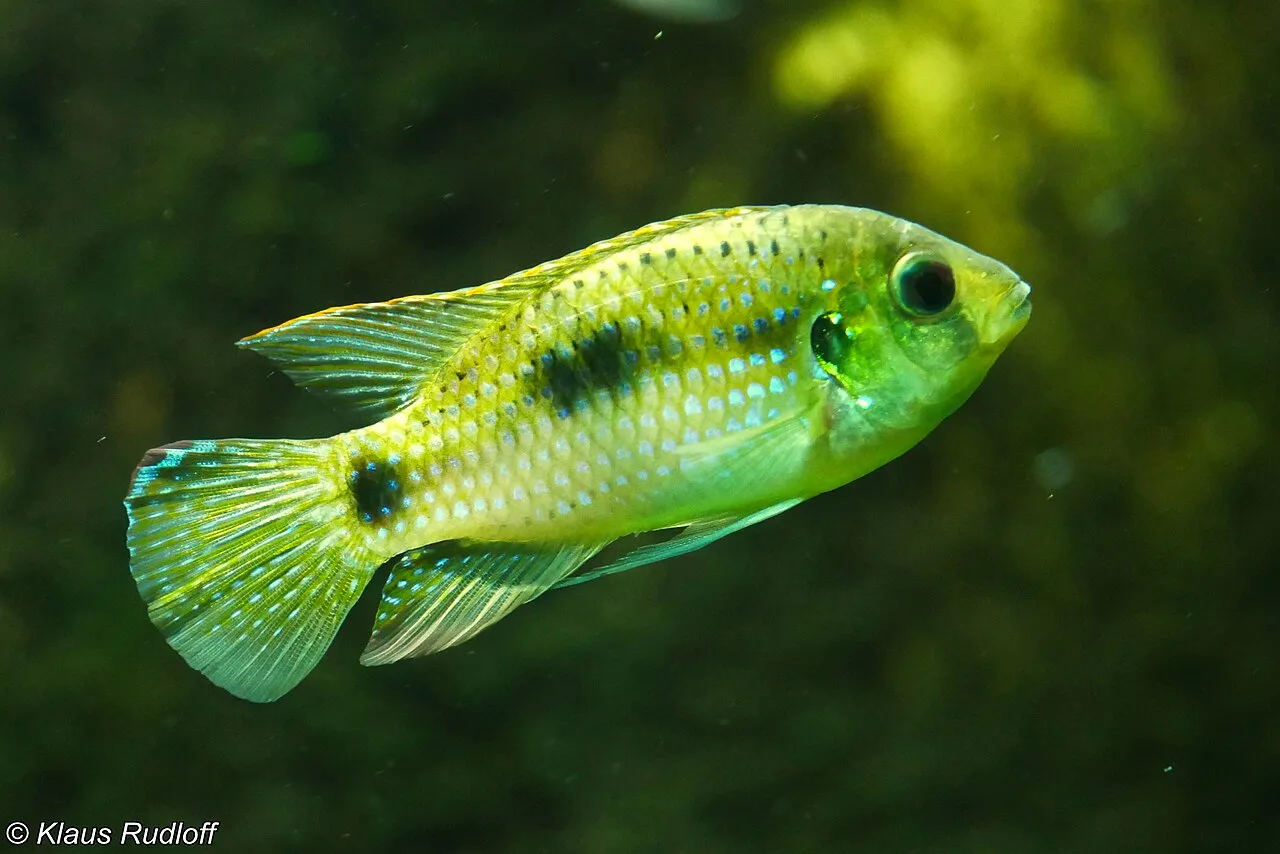
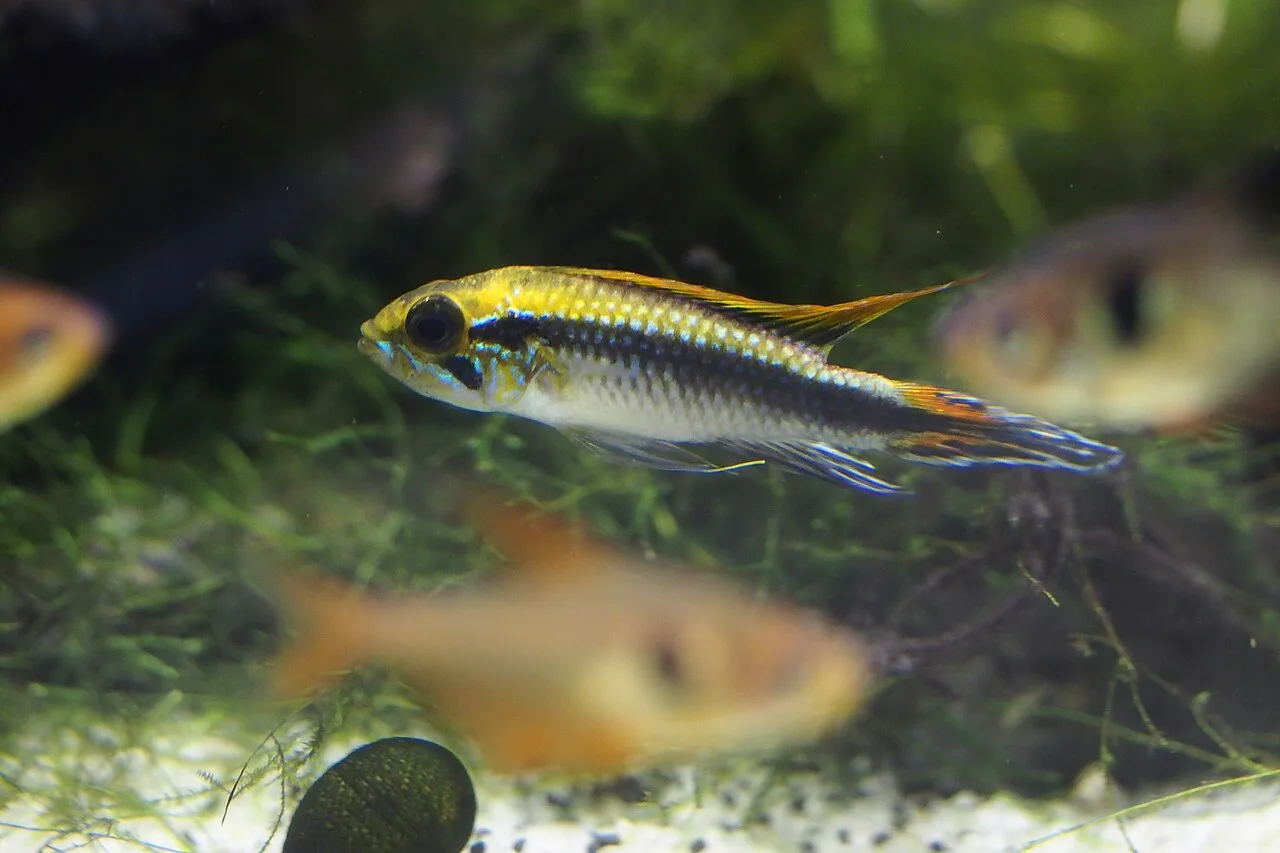

Similar water needs
Species with a similar temperature, a similar pH and a comparable adult size. Whether their behaviour fits as well is what the compatibility check is for.