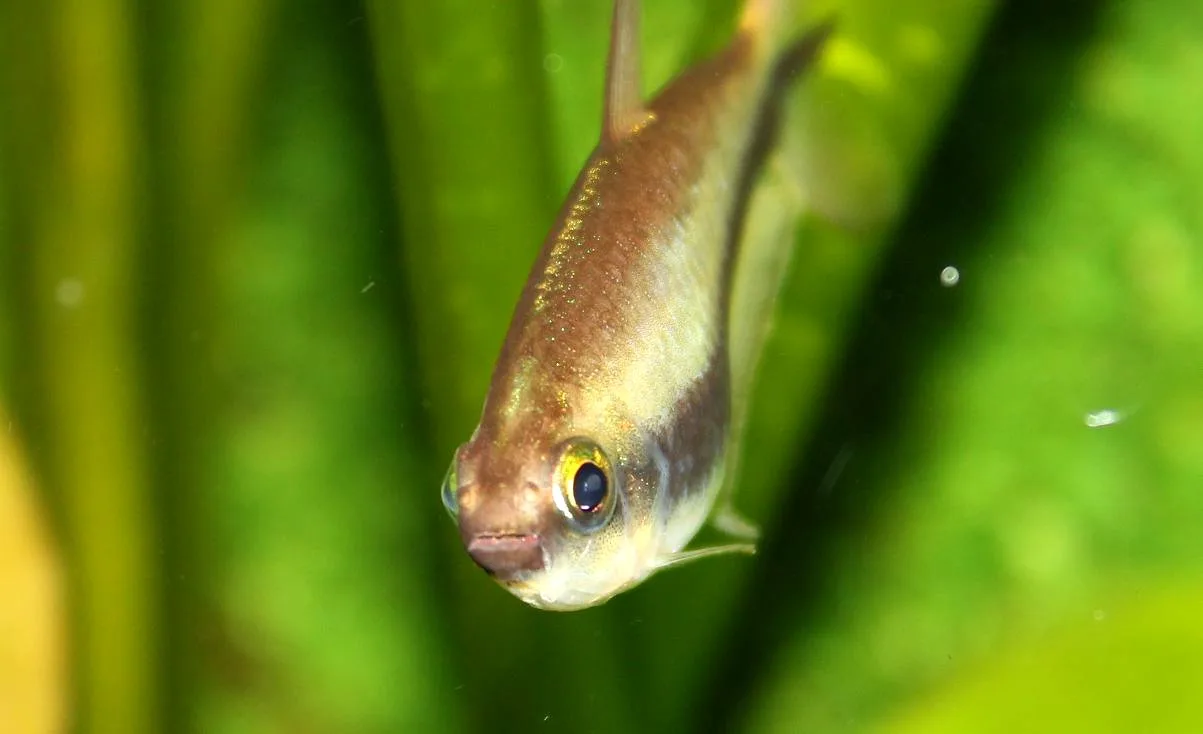
Pygmy cory
Gastrodermus pygmaeus
20 views
A very small cory from the Madeira basin. Corydoras pygmaeus is the synonym. It does not stay only on the bottom.
- Temperature
- 22 – 27 °C
- pH
- 6 – 8 pH
- General hardness
- 6 – 16 °dH
- Maximum size
- 3
- Minimum group size
- 10
- Minimum tank size
- 50 L
3 min read · 377 words
Fresh water
Quick facts
Further published values
- Lifespan
- 8 a
Place in the aquarium
Highlighted are the water layer and the spots where the species usually stays in the tank.
- Middle water Usually stays in the middle of the tank, between bottom and surface.
- Near the bottom Mostly stays just above the bottom. Food has to reach the substrate.
- Dense plants Looks for dense planting as cover, retreat or grazing ground.
Shrimp in the tank
Shrimplets at risk
- Not shrimp safe
- Dwarf shrimp at risk
- Shrimplets at risk
- Shrimp safe
- Adult dwarf shrimp
- Safe
- Shrimplets
- Get eaten
- Safe from shrimp size
- about 1 cm
The pygmy corydoras is a good shrimp partner. It stays at about 2 to 3 cm and eats very fine frozen food such as cyclops and fine live food. Adult shrimp from about 1 cm are safe. Newly hatched shrimp may be eaten while it sifts the sand.
The species often swims in open water too and needs fine sand and dense planting. Moss cushions away from the sand let enough young shrimp grow up. Neocaridina and Caridina both fit.
Home & range
Hatched countries are where the species occurs. It lives in particular waters there, not across the whole country. The points name known waters for orientation, not collection sites.
- Country of origin
- Water for orientation
Native
Overview
Of 51 fish examined from Peru and Ecuador the longest was 21.5 mm standard length. A paratype from Brazil measured 23.7 mm. That is the longest measured standard length. A dark stripe runs into the tail and ends arrow-shaped.
Description and markings
Joachim Knaack described the species in 1966. The holotype is a male of 10 mm standard length with 23 and 21 bony plates and seven branched pectoral fin rays. The paratype is a female from Brazil.
The pygmy corydoras is very small and elongated and has a short snout. The dark flank stripe lies where the two rows of plates meet. A narrow unpigmented zone runs along each side of it. The caudal fin is brownish overall but white around the contrasting spot. A dark brown line runs from the front edge of the eye to the snout tip, and a blackish line on the belly between the pelvic and anal fins. The upper row of plates has alternating mid-brown and brown edges.
Origin & habitat
This describes the origin, not how to furnish the aquarium.
Madeira basin. Brazil stays the coarse origin of that basin. Peru and Ecuador are finds of the measured series and are not added as extra country shapes.
The species is a facultative gut breather and can take air at the surface when needed.
Care
Tanks from 60 cm edge length, fine sand, dense plants with open space. It also breathes air through the gut at the surface.
For the small tank, not for the single fish
The pygmy cory stays at about 3 cm. 22 to 26 °C, pH 6 to 7.5, fine sand, a group from eight, tanks from about 40 litres with enough floor area. It is peaceful and a good bottom neighbour for small tetras and shrimp. A single fish searches constantly and feeds poorly.
Coarse gravel and a hungry tank without food on the bottom are the two common mistakes. The species does not clean glass.
Diet
It searches the sand.
Fine frozen food and very small tablets that fall apart on the sand. Several feeds in the evening.
Behavior
Group and food
The species should be kept in groups of at least ten. Food should be varied and mainly animal-based, for example very fine frozen food such as cyclops or fine live food. The fish can live up to eight years.
Reproduction
It also moves through open water, unlike many other corys.
More species in this group

Similar water needs
Species with a similar temperature, a similar pH and a comparable adult size. Whether their behaviour fits as well is what the compatibility check is for.