
Reticulated flying fox
Crossocheilus reticulatus
17 views
A small sucker barb with a net pattern that rasps aufwuchs and stays in a group. It is not the flying fox and not the Chinese algae eater.
- Temperature
- 24 – 28 °C
- pH
- 6.5 – 7.5 pH
- General hardness
- 0 – 15 °dH
- Maximum size
- 12 cm
- Minimum group size
- 5
- Minimum tank size
- 150 L
5 min read · 691 words
Fresh water
Quick facts
Place in the aquarium
Highlighted are the water layer and the spots where the species usually stays in the tank.
- Middle water Usually stays in the middle of the tank, between bottom and surface.
- Near the bottom Mostly stays just above the bottom. Food has to reach the substrate.
- Wood and roots Uses roots as shelter or grazes biofilm from them.
Shrimp in the tank
Shrimplets at risk
- Not shrimp safe
- Dwarf shrimp at risk
- Shrimplets at risk
- Shrimp safe
- Adult dwarf shrimp
- Safe
- Shrimplets
- Get eaten
- Safe from shrimp size
- about 2 cm
Adult dwarf shrimp are usually safe from the silver flying fox. It grows to 15 to 17 cm but feeds mostly on plants, grazing growth and beard algae. Shrimp from about 2 cm are usually not hunted. Young shrimp, however, may end up in its mouth while it grazes plants and surfaces. The lively fish need very large tanks with current, in which shrimp only do well with many hiding places. Amano shrimp suit especially well, because they also eat algae.
Home & range
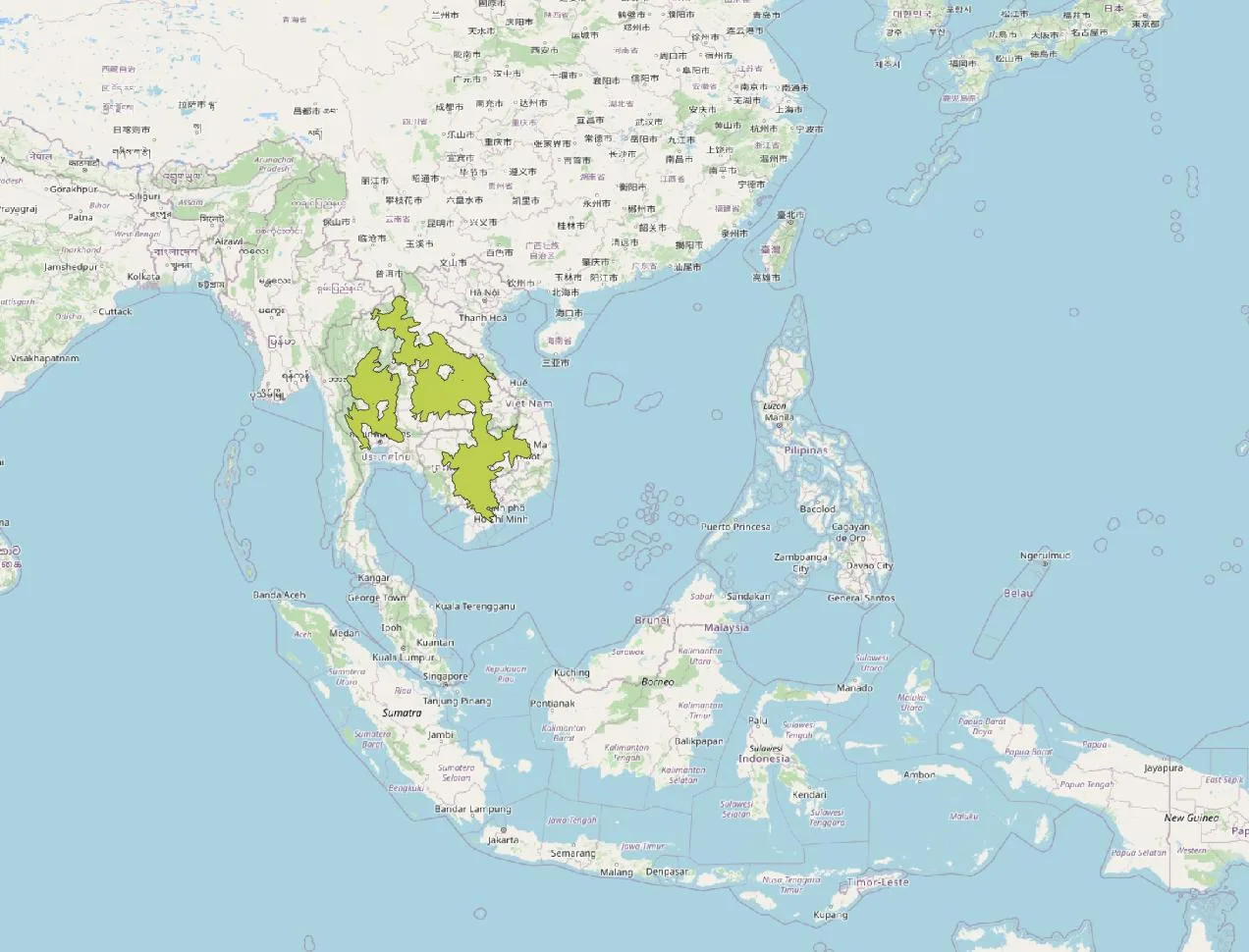
Hatched countries are where the species occurs. It lives in particular waters there, not across the whole country. The points name known waters for orientation, not collection sites.
- Country of origin
- Water for orientation
Native
Overview
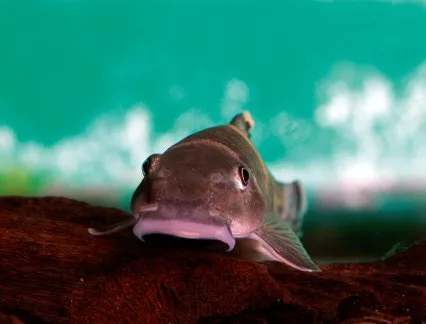
Crossocheilus reticulatus reaches about 10 to 12 cm. The body wears a dark net pattern instead of a single longitudinal band. The mouth sits underneath. The species stays more social than the flying fox and does not grow as large and intrusive as the Chinese algae eater. Juveniles of all three are sold mixed in the trade. The net instead of the gold band is the better mark.
It eats algae and aufwuchs, but not as the only food source. A tank without a film and without vegetables lets it thin out.
Names and features
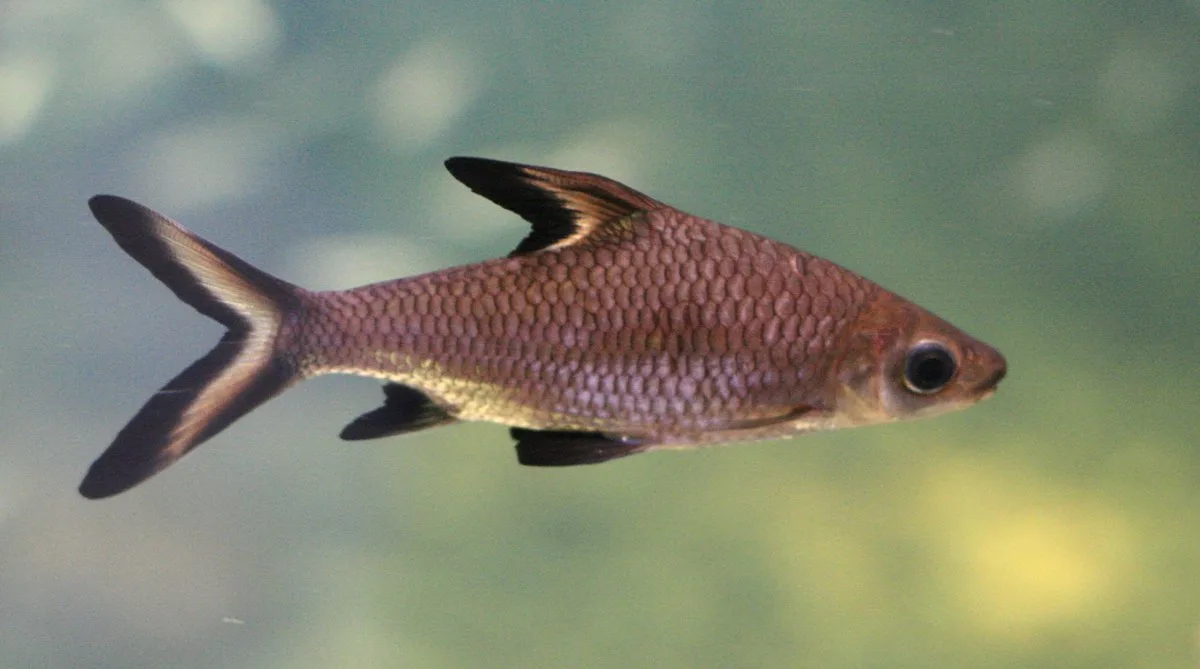
In German the species is also called tail-spot algae eater or reticulated beard-algae eater, and further German names translate as puzzle barb and golden-brown algae eater. The older name of the holotype is Holotylognathus reticulatus. In English it is called silver flying fox, silver algae eater, reticulated Siamese algae eater or beard algae eater. The fish grow 15 to 17 cm long.
The body is elongated and spindle-shaped, and the underslung mouth carries two barbels at the tip of the snout. The base colour is grey-brown, and the large scales form a net pattern. A square black spot at the tail base is striking. The fins are slightly yellowish to transparent. External sex differences are not always clear, and females grow somewhat larger and heavier on average.
Origin & habitat
This describes the origin, not how to furnish the aquarium.
Flowing waters in Thailand and the neighbouring countries, rich in oxygen, over rock and gravel. The origin stays coarse. Current belongs with it. A still tank without oxygen shows fish that stick to the glass and do not feed.
The species is especially common in central and eastern Thailand. It lives in clear, oxygen-rich and rather cool flowing waters over various substrates, for example in tributaries of the Mekong and Chao Phraya. It also lives in Cambodia, Laos, Vietnam and southern China, in the Mekong in Yunnan, Laos, Thailand, Cambodia and Vietnam and in the Chao Phraya and Mae Klong in Thailand. In the Mekong basin it is an important food fish for subsistence and commercial fisheries. The IUCN lists it as Least Concern.
Care
Layout
24 to 28 °C, pH 6.5 to 7.5. A group from five, tanks from about 150 litres and 100 cm. Smooth stones, wood, current, fine gravel or sand. The tank should be mature. Several resting surfaces, so one fish does not drive all the others off the feeding stone.
Company
Calm fish in the upper water. Other large suckermouths only with a surface of their own. Shrimp are sometimes harassed. Soft plants can suffer while it grazes. Tough epiphytes usually do not.
Water values
The species is kept at 16 to 25 °C, in soft to medium-hard water up to 15 °dH, carbonate hardness around 5 °dH and pH 6 to 7. Because the species comes from cooler mountain waters it can be kept without a heater, and it tolerates very high temperatures poorly. Groups of seven or more and tanks of at least 450 litres and 150 cm length are recommended, with roots, stones, plants, plenty of swimming space and light to moderate current. Under certain conditions aggression and minor rank fights occur. Many fish in the trade are wild-caught or have been treated with hormones.
Diet
Aufwuchs, blanched vegetable strips, spirulina and sinking plant tablets. Animal food only as a side. Anyone who wipes the glass clean every day has to replace the food. Several small feeds through the day.
The species eats plant food and also beard algae. In one trial five fish cleared a tank of it completely in two weeks. With age the fish lose interest in algae growth, so mainly young to half-grown fish are suitable for algae control. In the aquarium they are mostly given green food, also cucumber or lettuce. Without supplementary feeding they often nibble aquarium plants.
Behavior
A group with a loose rank order around the best surfaces. A short push with the mouth is normal. Serious injury starts when too many fish stand on too little rock. The species is active by day and stands visible on the surfaces.
Reproduction
Breeding in the aquarium is uncommon. The sexes are uncertain outside courtship. For keeping, the fed group in flowing, oxygen-rich water is what counts.
Gallery
More species in this group
Similar water needs
Species with a similar temperature, a similar pH and a comparable adult size. Whether their behaviour fits as well is what the compatibility check is for.



