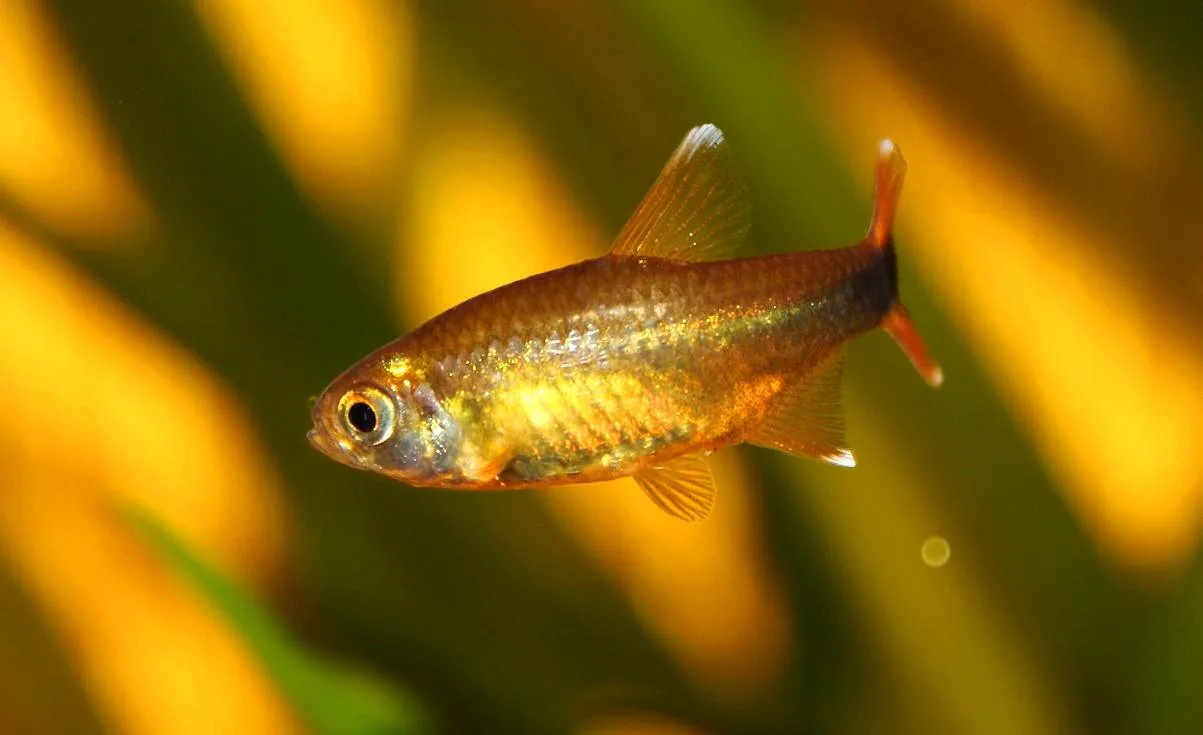
Sparkling gourami
Trichopsis pumila
23 views
A very small labyrinth fish that growls audibly while courting. It belongs in a quiet, finely furnished tank, not among busy barbs.
- Temperature
- 24 – 28 °C
- pH
- 6 – 7.5 pH
- General hardness
- 5 – 19 °dH
- Maximum size
- 4 cm
- Minimum group size
- 5
- Minimum tank size
- 40 L
7 min read · 1,030 words
Fresh water
Quick facts
Further published values
- Lifespan
- 6 a
Place in the aquarium
Highlighted are the water layer and the spots where the species usually stays in the tank.
- Middle water Usually stays in the middle of the tank, between bottom and surface.
- Dense plants Looks for dense planting as cover, retreat or grazing ground.
Shrimp in the tank
Dwarf shrimp at risk
- Not shrimp safe
- Dwarf shrimp at risk
- Shrimplets at risk
- Shrimp safe
- Adult dwarf shrimp
- At risk
- Shrimplets
- Get eaten
- Safe from shrimp size
- about 4 cm
Although the pygmy gourami grows to only about 3 to 4 cm, it does not suit dwarf shrimp. It hunts them and injures them even when it cannot swallow them whole. Next to a group of these fish a dwarf shrimp population does not last. In nature the species eats zooplankton and small aquatic insects, and males defend their bubble nest very aggressively. Larger shrimp from about 4 cm are usually safe. Dwarf shrimp belong in a separate tank.
Home & range
Hatched countries are where the species occurs. It lives in particular waters there, not across the whole country. The points name known waters for orientation, not collection sites.
- Country of origin
- Water for orientation
Native
Overview
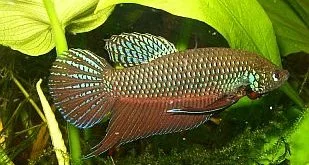
Trichopsis pumila stays at about 3.5 to 4 cm. The body is brown-red with blue spots that sparkle in the right light, which is where the English name comes from. The thread fins are short but present. Males have longer anal fins and growl louder. The sound is made by tendons snapping over bone, not by the gills.
The species is shy when the tank is empty and bright. In a planted tank with a dark bottom it suddenly stands in the open and shows the sparkle that is hardly visible in a shop tank.
Features
The pygmy gourami is the smallest species of the genus. Compared with Trichopsis schalleri it has two fewer dark stripes, and its stripes are not continuous. Under bright light its body shines more than that of the other two described species. Colouring varies greatly from fish to fish. There is always a central band and above it a second band usually formed of dots. The red-brown dots are round or oval, and in the right light the scales shine emerald green. The fins have red edges and markings, and the light blue eyes have a red rim. The fish usually grow 2.4 to about 3.1 cm, with a maximum of 4 cm given. In the aquarium they reach about six years.
Telling the sexes apart
Externally the sexes are very hard to tell apart. Looking through the fish against the light has proved useful: in males the visceral sac ends rounded at the rear, while in females it rises triangularly towards the rear because of the ovaries.
Origin & habitat
This describes the origin, not how to furnish the aquarium.
Quiet, densely planted waters in Thailand, Vietnam and neighbouring lowlands: ditches, swamps, rice fields. Warm, often soft water, little current, a lot of surface structure. The countries are a coarse origin.
The habitat explains the demand. An open current tank with a few plastic plants is the opposite of these banks.
A study by Panijpan and colleagues in 2015 names the Thai provinces of Chanthaburi, Pathum Thani, Prachin Buri, Ratchaburi, Rayong, Sa Kaeo and Samut Songkhram, as well as catches in Cambodia, including Kampong Thom. The species is also reported from Laos and Indonesia. Many native waters are soft rasbora streams with about 30 to 100 microsiemens and pH 5.5 to 6.5.
Care
Layout
24 to 28 °C, pH 6 to 7.5. From about 40 litres for a small group, if the tank is truly quiet and not a corridor for large fish. Floating plants, fine stems, moss, a dark bottom. Weak current. A cover against jumps and against cold draught above the surface.
Company
Other small, slow fish, or a species tank. Mosquito rasboras can fit. Tiger barbs, danios and large corydoras do not. The sparkling gouramis lose every feeding to faster mouths.
Water values
The species tolerates pH 6.0 to 7.0 and 5 to 19 °dH. Temperature figures range from 25 to 28 °C to 21 to 29 °C. At least 54 to 55 litres are recommended. Captive-bred fish tolerate 3 to 15 °dGH and pH 6.5 to 7.5, while wild-caught fish need softer water of 2 to 10 °dGH and pH 5.8 to 7. At least five fish should live together, so that a social structure forms and aggression is spread. Weedy tanks darkened by floating plants come closest to the habitat. A species tank suits best. Dwarf shrimp are unsuitable, because the fish hunt and injure them.
Diet
Fine animal food. Brine shrimp, cyclops, microworms and very small frozen food. Dry food is taken when it is small enough and stays in the upper water long enough. A pure flake diet lets the fish thin out without it being obvious at once in a dark tank.
Two feeding corners, so dominant males do not clear everything.
In nature the pygmy gourami eats zooplankton and small aquatic insects.
Behavior
Peaceful, but the males hold mini-territories while courting and growl at each other. The sound is audible in a quiet room. It is courtship and threat, not a sound of illness. A fish that is hunted all the time needs a second visual barrier, or it has to come out.
The species leaves the open water under glaring light and comes forward when the light is dimmed.
Sounds and territory
Both sexes croak during the breeding season and when excited, hence the name. A master's thesis by Noémie Liesch in 2020 showed that male sounds consist of twice as many pulse bursts and, with a main frequency around 2090 Hz and about 114 dB, are deeper and louder than those of females. Contrary to earlier assumptions, about two thirds of females also croak during disputes. Strong tail beating while croaking has been observed only in this species. It keeps the largest distances when circling and attacks least often.
A male defending his bubble nest, however, is very aggressive. He claims about 25 by 25 cm and rams even fish twice his size within it. In a community tank the species often stays shy and is hardly seen.
Reproduction
A bubble nest, often small and hidden under a leaf. The male guards the nest. The clutches are small compared with the dwarf gourami. The larvae are tiny. Rearing is a patient species tank with infusoria, not a by-product of the community tank.
After spawning the male can drive the female off. A second hiding place is then not decoration. It is the difference between courtship and injury.
How the brood proceeds
The bubble nest, usually the size of a walnut, is built near the bottom, in the aquarium often under a leaf such as a Cryptocoryne. The female releases a total of 100 to 170 eggs in packets of three to five, which the male carries into the nest. Spawning lasts 20 to 60 minutes, after which the male cares for the brood alone. Depending on temperature the larvae hatch after 22 to 30 hours and at first hang by adhesive threads on the head. After about four days they swim freely, and after three months they measure 3 to 3.5 cm. Soft water, first feeding with infusoria and rearing in a well-established, densely planted tank with mulm on the bottom are recommended.
The species has been known in Germany since 1913, but remained uncommon because of low productivity and laborious rearing. According to Norén and colleagues in 2017 it is nevertheless the most common Trichopsis species in the trade. Feral populations are so far known only from the Philippines.
Gallery
More species in this group
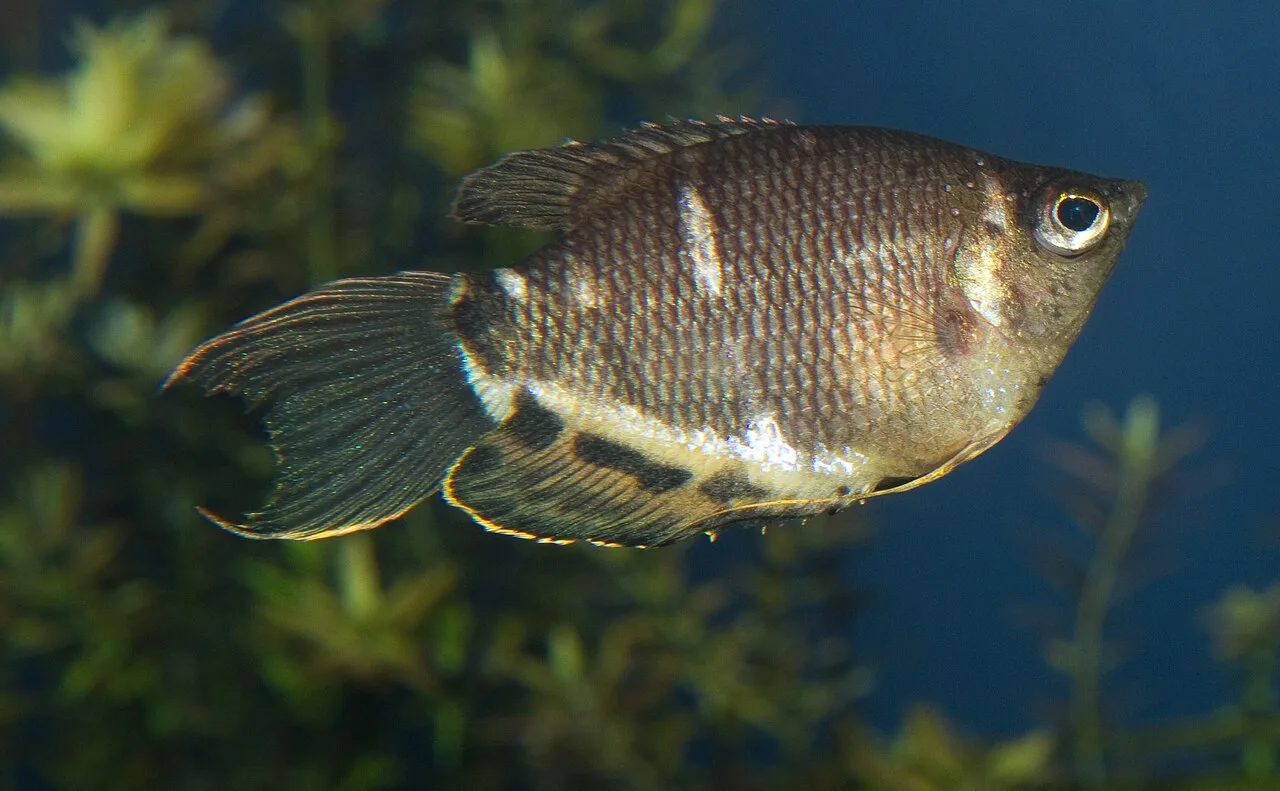
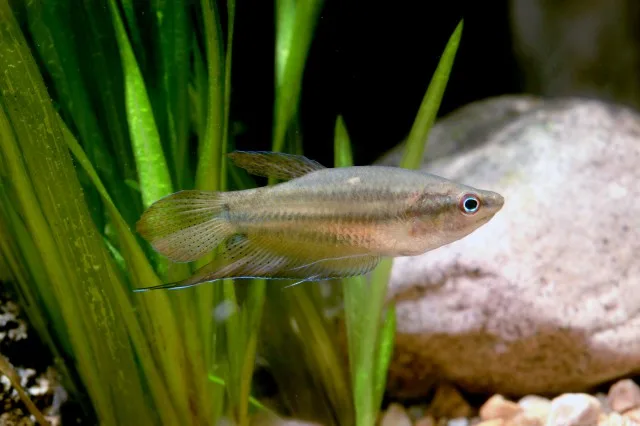
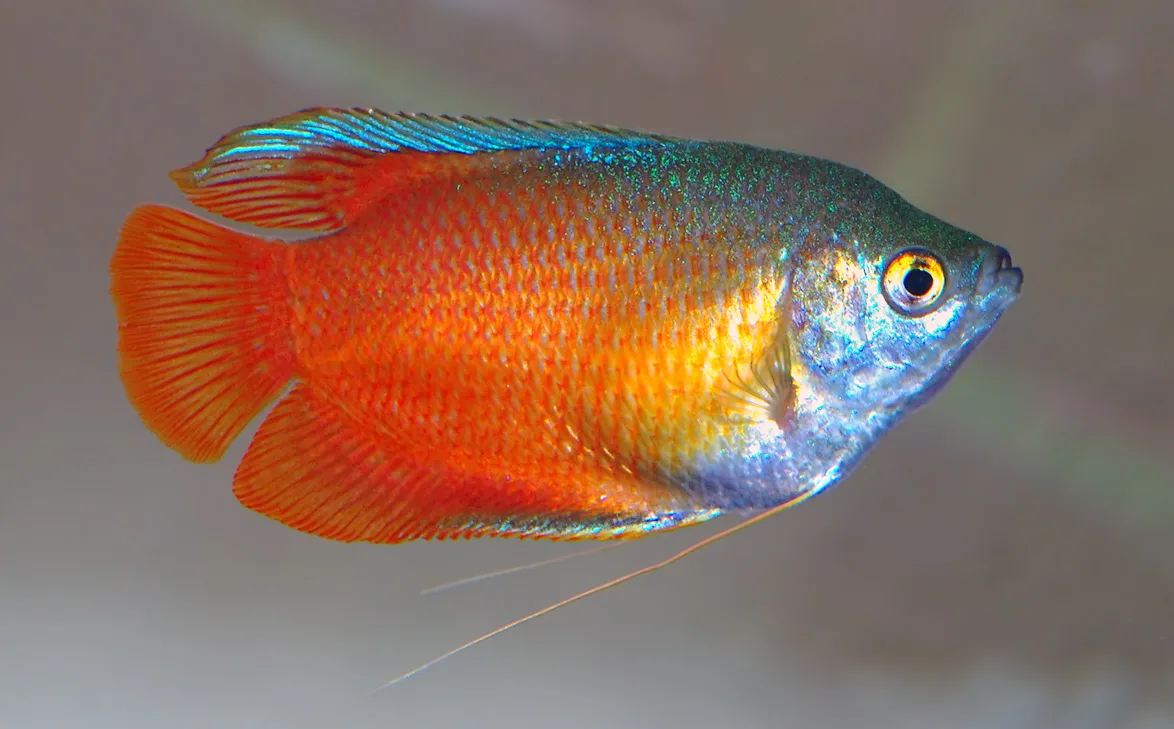

Similar water needs
Species with a similar temperature, a similar pH and a comparable adult size. Whether their behaviour fits as well is what the compatibility check is for.