
Spiketail paradisefish
Pseudosphromenus cupanus
1 view
A small, calm labyrinth fish from southern India and Sri Lanka with a pointed tail fin. It lives as a pair.
- Temperature
- 22 – 28 °C
- pH
- 6 – 7.5 pH
- General hardness
- 2 – 12 °dH
- Maximum size
- 6 cm
- Minimum tank size
- 54 L
2 min read · 172 words
Quick facts
Place in the aquarium
Highlighted are the water layer and the spots where the species usually stays in the tank.
- Near the bottom Mostly stays just above the bottom. Food has to reach the substrate.
- Dense plants Looks for dense planting as cover, retreat or grazing ground.
Shrimp in the tank
Dwarf shrimp at risk
- Not shrimp safe
- Dwarf shrimp at risk
- Shrimplets at risk
- Shrimp safe
- Adult dwarf shrimp
- At risk
- Shrimplets
- Get eaten
- Safe from shrimp size
- about 2.5 cm
The spiketail paradisefish eats mainly small insects, larvae and crustaceans. At about 6 cm it takes juvenile shrimp and occasionally small adult dwarf shrimp. Shrimp from about 2.5 cm are usually safe.
In a densely planted tank with plenty of leaf litter and moss a group of Neocaridina can hold on, but grows more slowly. For breeding a separate tank is better.
Home & range
Hatched countries are where the species occurs. It lives in particular waters there, not across the whole country. The points name known waters for orientation, not collection sites.
- Country of origin
- Water for orientation
Native
Overview
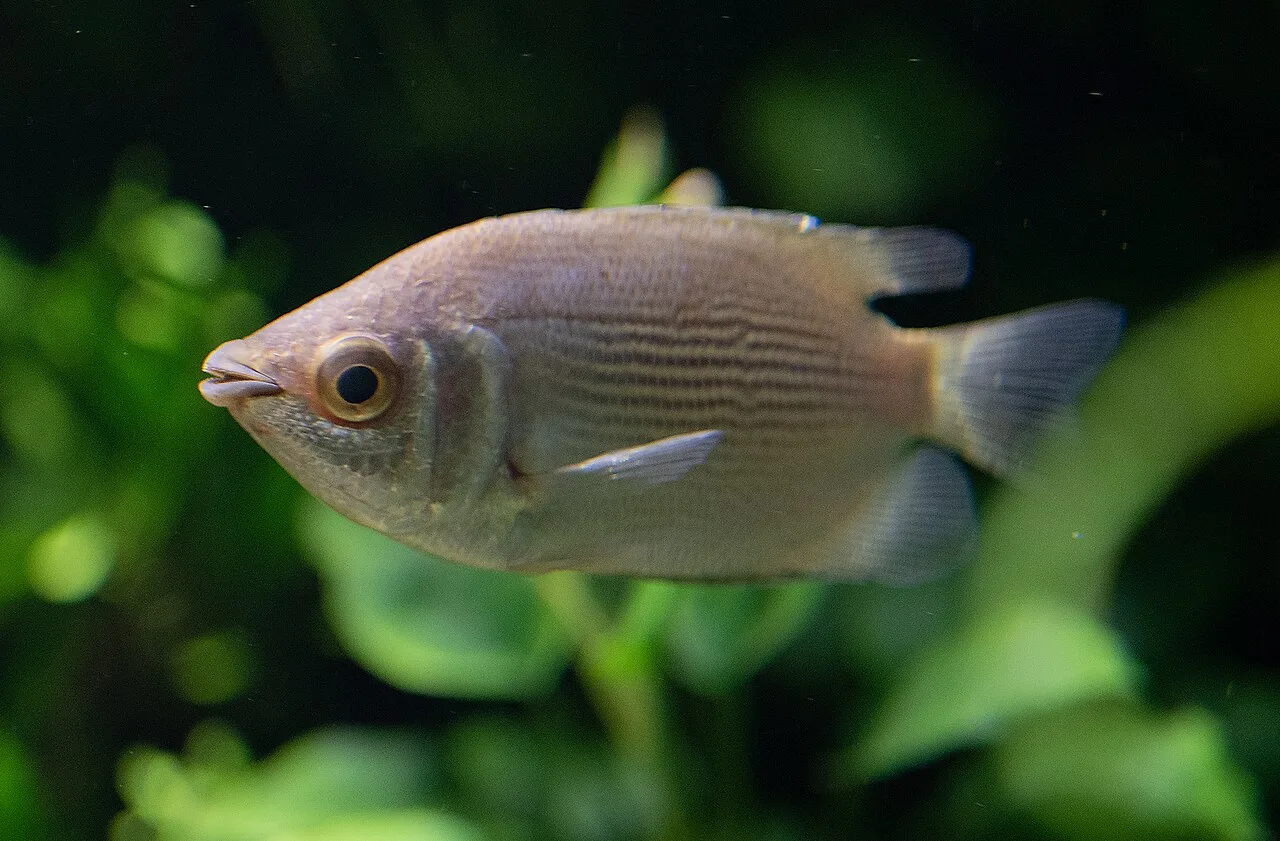
Pseudosphromenus cupanus reaches about 6 cm. The body is brownish to reddish, and courting males turn almost black with pale fin edges. The tail fin ends in a point. Females show pale longitudinal stripes when breeding.
It is not the paradise fish. The paradise fish grows larger, wears bars and can turn rough. The spiketail paradisefish stays small and calm.
Origin & habitat
This describes the origin, not how to furnish the aquarium.
Slow waters, ditches and rice fields in southern India and Sri Lanka. The countries stay a coarse origin. Calm, plant-rich water with leaf litter matches that.
Care
Pair
22 to 28 °C, pH 6 to 7.5. A pair from about 54 litres. Leaf litter, plants, caves, floating plants, a calm surface.
Company
Calm, small fish. A species tank suits it well.
Diet
Meaty food. Mosquito larvae, brine shrimp, daphnia, plus granules. Flakes are taken but are not enough on their own.
Behavior
A calm pair. At spawning time the fish defend a small zone. Outside breeding they stay peaceful.
Reproduction
Bubble-nest builder in caves or under leaves. The male tends the nest. The young are hardly hunted by the parents.
Gallery
More species in this group

Similar water needs
Species with a similar temperature, a similar pH and a comparable adult size. Whether their behaviour fits as well is what the compatibility check is for.




