Sunshine peacock
Aulonocara baenschi
21 views
A mouthbrooding peacock from a small rock area of Lake Malawi. The yellow males need sand, a territory and several females.
- Temperature
- 24 – 28 °C
- pH
- 7.5 – 8.5 pH
- General hardness
- 10 – 30 °dH
- Maximum size
- 12 cm
- Minimum tank size
- 200 L
5 min read · 694 words
Fresh water
Quick facts
Place in the aquarium
Highlighted are the water layer and the spots where the species usually stays in the tank.
- Near the bottom Mostly stays just above the bottom. Food has to reach the substrate.
- Rocks and caves Needs caves, crevices or rockwork as hiding place, territory or spawning site.
- Substrate Sifts through the substrate or burrows into it. Fine, rounded sand without sharp edges suits it.
Shrimp in the tank
Not shrimp safe
- Not shrimp safe
- Dwarf shrimp at risk
- Shrimplets at risk
- Shrimp safe
- Adult dwarf shrimp
- At risk
- Shrimplets
- Get eaten
- Safe from shrimp size
- No size is safe
The Nkhomo-benga peacock is a hunter of small invertebrates and eats shrimp. In the wild it detects prey in the sand with enlarged sensory pores on its head, sifts the substrate or strikes as soon as something moves. This way of hunting catches shrimp of every size, even in hiding places on the bottom.
Shrimp do not belong in its tank. It suits a Malawi tank with sandy areas, scattered rocks and other calmer cichlids. Even large shrimp are not safe there.
Home & range
Overview
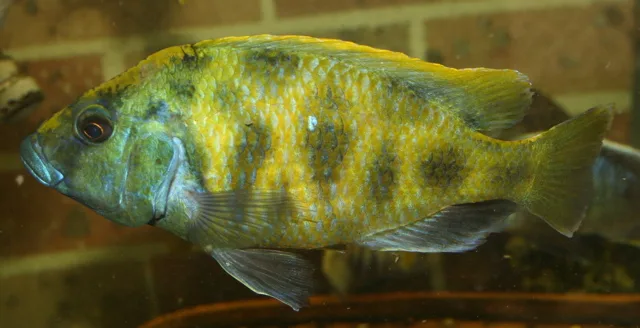
Male Aulonocara baenschi reach about 10 to 12 cm and turn bright yellow with a blue face when they dominate and the water is right. Females and juveniles stay silver-grey. Anyone who buys three yellow fish often buys three future males.
The species does not rasp aufwuchs from rock like an mbuna. It searches the sand for small animals. A pure rock tank without a sand area takes away the way it feeds. Crosses with other Aulonocara are common in the trade and should not be passed on as this species.
Features
In English it is called Nkhomo-benga peacock or new yellow regal peacock. Males carry egg-like spots on the anal fin and show their breeding colour all year round. The species grows to about 13 cm (5 inches) and can live around 10 years. M. K. Meyer and Riehl described the species in 1985. The name honours Ulrich Baensch, inventor of the flake food Tetramin and founder of the Tetra company.
Origin & habitat
This describes the origin, not how to furnish the aquarium.
The rock-and-sand transition near Nkhomo in Lake Malawi, a narrow area. Clear, alkaline water. Malawi is the coarse origin. The small area is a reason to keep captive-bred fish and not to mix the population with other yellow peacocks.
In the lake the male searches over a pocket of sand between rocks. The tank needs that pocket.
The species is endemic to Lake Malawi and is known only from Nkhomo Reef and possibly nearby areas in the west of the lake. It lives over sand with scattered rocks, mostly at 2 to 6 m depth, recorded down to 16 m. The IUCN rates it as critically endangered, mainly because of collection for the aquarium trade.
Care
Layout
24 to 28 °C, pH 7.5 to 8.5, hard. From about 200 litres and 120 cm. Sand, rock ridges that separate territories, and open sand between them. One male with several females. Further male Aulonocara only in clearly longer tanks and only if the colours are not the same.
Company
Calm Malawi species that do not claim the same sand. Mbuna that constantly dig the sand and need aufwuchs are the poorer mix. Tetras and shrimp are prey. Water changes stay regular, filtration strong.
Diet
Small animals from the sand, and added food. Frozen food, brine shrimp and a granule that sinks. The fish strike into the sand and sift it. Plant food alone is too little. Too much fattening food makes them fat and sluggish without replacing the search.
Food in two places, so the females do not receive only the male’s leftovers.
In the wild the species hunts small invertebrates in the sand. It detects prey with enlarged pores on the head, sifts the substrate through its mouth or watches for movement and grabs. In the aquarium it takes live food such as bloodworms, snails or brine shrimp, as well as frozen, flake and pellet food.
Behavior
The male displays over the sand and courts every female. Females need distance and rocks behind which the courtship breaks off. A female that is hunted all the time grows thin and stands at the top. Then the group is wrongly composed or the tank is too short.
The yellow colour is rank and condition. A pale male in hard, clear water is often the subordinate fish.
Males are territorial, with the territory centred on a shelter they dig. Females live in small schools. Suitable keeping conditions are a tank of about 190 litres (50 gallons) or more, 26 °C, pH 7.0 to 8.0 and a hardness of 10 to 25 degrees. The species is regarded as semi-aggressive, mostly peaceful but territorial when spawning.
Reproduction
Mouthbrooder. The female carries for about three weeks and then releases free-swimming young. In a tank of hungry adults little of it survives. Do not chase a carrying female behind the glass. The brood is lost in a panic.
The young are plain grey and colour only as they grow.
The male courts. When the female spawns she takes the eggs into her mouth. Attracted by the egg-like spots on the male's anal fin, she opens her mouth as if to take them, and the male releases sperm that fertilises the eggs in her mouth. After four weeks of mouthbrooding the female releases free-swimming young.
More species in this group

Similar water needs
Species with a similar temperature, a similar pH and a comparable adult size. Whether their behaviour fits as well is what the compatibility check is for.