Tamoata
Hoplosternum littorale
18 views
A hoplo, to 24 cm. Colour morphs are not species. Trinidad is the only origin state named as such.
- Temperature
- 22 – 28 °C
- pH
- 6 – 7.5 pH
- General hardness
- 5 – 20 °dH
- Maximum size
- 24 cm
- Minimum group size
- 5
- Minimum tank size
- 300 L
4 min read · 521 words
Fresh water
Quick facts
Further published values
- Lifespan
- 4 a
Place in the aquarium
Highlighted are the water layer and the spots where the species usually stays in the tank.
- Near the bottom Mostly stays just above the bottom. Food has to reach the substrate.
- Substrate Sifts through the substrate or burrows into it. Fine, rounded sand without sharp edges suits it.
Shrimp in the tank
Dwarf shrimp at risk
- Not shrimp safe
- Dwarf shrimp at risk
- Shrimplets at risk
- Shrimp safe
- Adult dwarf shrimp
- At risk
- Shrimplets
- Get eaten
- Safe from shrimp size
- about 5 cm
For dwarf shrimp the hoplo catfish is a risk. It grows up to 24 cm and feeds on the bottom mainly on invertebrates: midge larvae, insects and small crustaceans. Neocaridina and Caridina therefore fall within its diet, and juveniles all the more. Larger shrimp such as Amano or fan shrimp from about 5 cm are usually safe.
At night it searches the whole substrate. Dwarf shrimp are best kept separately. In a shared tank only sturdy, larger shrimp species with plenty of hiding places in wood and stone fit.
Home & range
Hatched countries are where the species occurs. It lives in particular waters there, not across the whole country. The points name known waters for orientation, not collection sites.
- Country of origin
- Water for orientation
Native
Overview
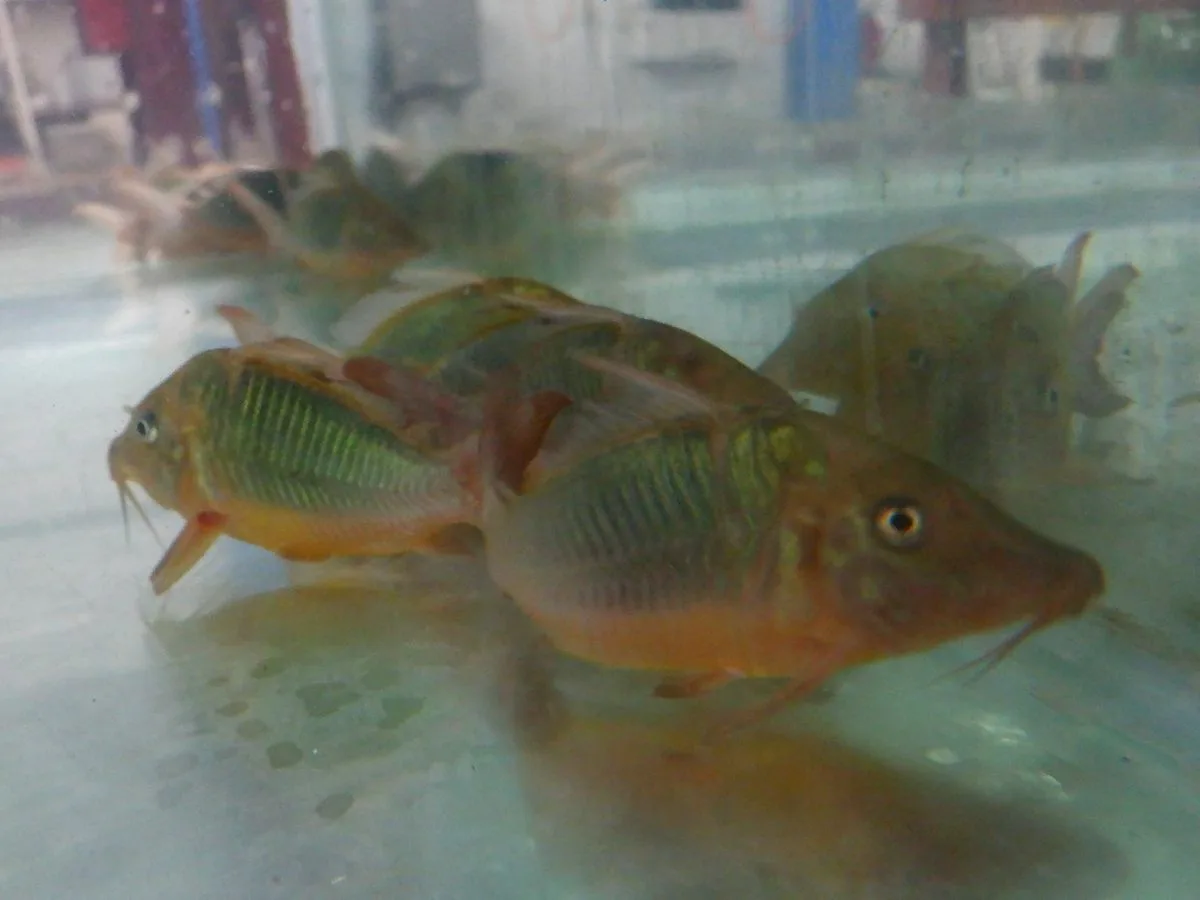
Deeper-bodied than Callichthys callichthys. Two pairs of long barbels on the upper jaw. Uniform blue-black, or darker above and dirty white below, without spots. Males with a visible genital papilla.
Systematics and features
Hancock described the species in 1828 as Callichthys littoralis. It belongs to the callichthyine catfishes (Callichthyinae) in the family Callichthyidae. There are many synonyms and regional names, for example tamatá in Brazil, atipa in French Guiana, hassa in Guyana, kwi kwi in Suriname and cascadura on Trinidad.
Above the mid-line there are 25 bony plates, below it 23. The outer caudal fin rays are thickened. Fin formula: dorsal 1/8, anal /5, pectoral 1/8–9, ventral /6. Depending on the area the upper side is blackish, blue-grey, dark grey or greenish, with somewhat lighter flanks. The fins are blue-black, light grey or colourless.
Males grow larger on average. In the breeding season they build fat deposits in the pectoral fins, and the pectoral spine becomes longer, curved upward and often reddish. Outside that season the curved spine is absent.
Origin & habitat
This describes the origin, not how to furnish the aquarium.
East of the Andes from northern and middle South America to the Río de la Plata, plus Trinidad. Only Trinidad is unambiguous as a name and stays coarse.
The range is the widest of any callichthyid: the Orinoco, Trinidad, the coastal rivers of the Guianas, the Amazon basin, the Paraguay River, the lower Paraná and coastal systems of southern Brazil. The species lives in standing waters and swamps and on the floodplains of Andean whitewater rivers. These waters are poor in oxygen and strongly shaped by the rainy season. It is absent from mineral-poor clearwater rivers and rainforest creeks of the old shields. It has been introduced into the Indian River Lagoon in Florida.
The species also breathes air through its gut. Newly hatched larvae lack this gut breathing. It develops during roughly the first 30 days of life.
Diet
Swamps and weedy waters.
In the rainy season the species eats mainly midge larvae and detritus, in the dry season various insects, small crustaceans, aquatic fly larvae and also detritus. It also takes up large amounts of anaerobic bacteria from the bottom. Juveniles eat mainly small crustaceans such as water fleas, seed shrimps and copepods.
Behavior
Outside the breeding season the fish are active mainly at night. When breeding, the male defends a territory around the nest and uses its enlarged pectoral spines.
Reproduction
The colour forms stay one profile.
Bubble nest
Reproduction starts with the rainy season, and the first fish breed at one year of age. The male builds a bubble nest with the help of the female. It is dome-shaped, on average 30 cm wide and 6 cm high, and lies in newly flooded swamps at least 10 m from the next nest. The male works plant pieces into the nest.
A nest holds 5,000 to 20,000 eggs, 1.8 mm in diameter. They are fertilised with sperm the female has taken into her mouth beforehand. A female can spawn up to 14 times in a breeding season of seven months. The male guards the nest day and night and is very aggressive at that time. The eggs develop in two to three days. The maximum lifespan is four years.
Gallery
More species in this group

Similar water needs
Species with a similar temperature, a similar pH and a comparable adult size. Whether their behaviour fits as well is what the compatibility check is for.