Threadfin rainbowfish
Iriatherina werneri
23 views
A small rainbowfish of clear, plant-rich water. In the habitat, 22 to 30 °C and pH 5.2 to 7.5 were measured.
- Temperature
- 23 – 29 °C
- pH
- 6 – 7 pH
- General hardness
- 2 – 12 °dH
- Maximum size
- 4 cm
- Minimum group size
- 6
- Minimum tank size
- 76 – 110 L
3 min read · 503 words
Fresh water
Quick facts
Place in the aquarium
Highlighted are the water layer and the spots where the species usually stays in the tank.
- Upper water Usually stays in the top third of the tank.
- Dense plants Looks for dense planting as cover, retreat or grazing ground.
Shrimp in the tank
Shrimplets at risk
- Not shrimp safe
- Dwarf shrimp at risk
- Shrimplets at risk
- Shrimp safe
- Adult dwarf shrimp
- Safe
- Shrimplets
- Get eaten
- Safe from shrimp size
- about 1 cm
The threadfin rainbowfish is a good partner for dwarf shrimp. It grows to only about 4 to 5 cm and has such a small mouth that even feeding it with fine food needs care. Adult shrimp from about 1 cm are safe. Freshly hatched young may be caught in open water.
Dense planting and moss on the bottom let many young grow up. A calm tank without hectic fish suits both. Caridina and Neocaridina suit equally well.
Home & range
Hatched countries are where the species occurs. It lives in particular waters there, not across the whole country. The points name known waters for orientation, not collection sites.
- Country of origin
- Water for orientation
Native
Overview
Threadfin rainbowfish live in larger groups. They prefer clear water in swamps, ditches, billabongs and slow, heavily planted streams. Populations in New Guinea and Cape York differ in colour and genetics from isolated stocks in the Northern Territory.
Features and name
The body is laterally compressed, slender and metallic, about 4 cm long without the long fin filaments. Males have a fan-shaped first dorsal fin, while the second dorsal, anal and tail fins carry very long filaments with delicately coloured edges. Females have short fins and clearly weaker colouring. The aquarists Werner and Frech collected the species in 1973 in a rice field near Merauke, and Hermann Meinken described it in 1974. The specific name honours the ornamental fish trader Arthur Werner. The genus name combines Irian Jaya with the silverside genus Atherina. Iriatherina is monotypic, but genetic studies suggest several species.
Origin & habitat
This describes the origin, not how to furnish the aquarium.
In New Guinea they come from coastal rivers between Merauke and the Fly, and in the Fly from swampy lagoons up to 500 km upstream. In Australia from Cape York and, separately, the Northern Territory. Habitat readings were 22 to 30 °C and pH 5.2 to 7.5. Those are field data, not an aquarium recommendation.
On New Guinea the species lives in coastal rivers between Merauke and the Fly, in the Fly up to 500 km upstream in swampy lagoons beside the main channel. In Australia it occurs on Cape York Peninsula, and isolated populations in the Northern Territory, for example near Ramingining, differ in colour and genetics. In the wild spawning takes place mainly in the warm season above 25 °C. The IUCN lists the species as least concern.
Care
The field values describe the origin, not an aquarium optimum.
Threads and quiet
The threadfin rainbowfish stays at about 4 to 5 cm. The males carry long threads on the dorsal and anal fins. 24 to 28 °C, pH 6 to 7.5, a group from eight, tanks from about 80 litres, densely planted, little current. The threads tear on coarse nets and on fin-nipping barbs.
The species is quieter than the large rainbowfish and does not tolerate hectic tankmates. A dark bottom and floating plants show the threads.
Diet
Fine food. The mouth is small. Brine shrimp, cyclops and dust-fine dry food. Coarse granules are ignored.
Behavior
They live in larger groups. No minimum number is given.
The threadfin rainbowfish is usually peaceful and is best kept in groups of six or more without fin nippers. The male courts by posturing in front of the female and raising and lowering the front dorsal fin in quick succession. Because dominant males are polygamous, a ratio of about one male to three females is recommended. Suitable are 76 litres, better 110 litres as a species tank, soft to moderately hard, slightly acidic water at pH 6.0 to 7.0 and 23 to 29 °C. The small mouth makes feeding difficult, and brine shrimp nauplii and fine larval food are suitable. In the wild the species probably eats planktonic algae, diatoms and small crustaceans. The eggs are scattered among plant leaves and hatch after 7 to 10 days.
Reproduction
In the wild they spawn in the warmer season, above 25 °C.
Gallery
More species in this group
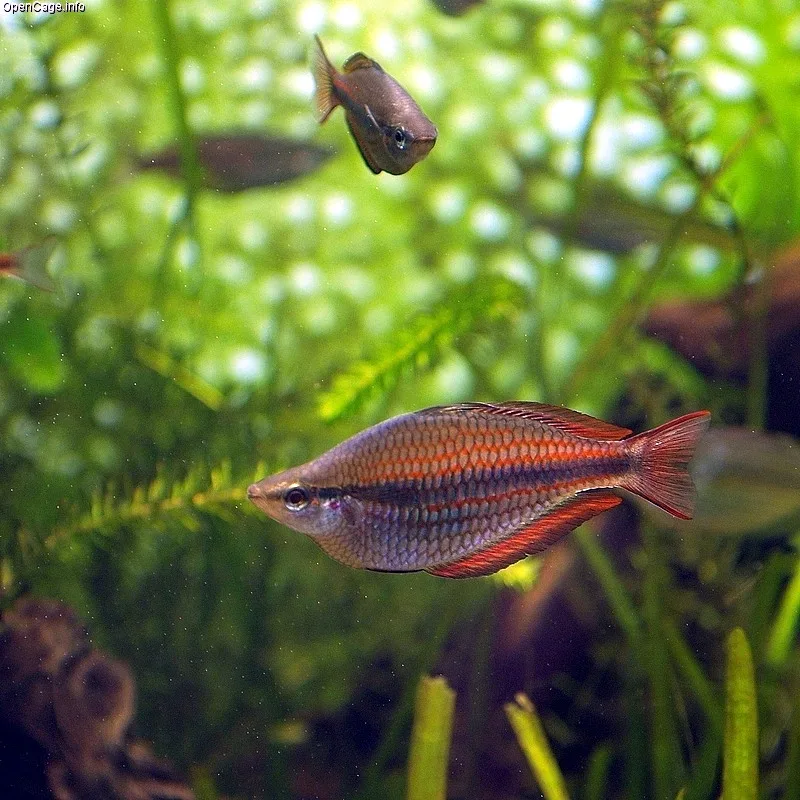
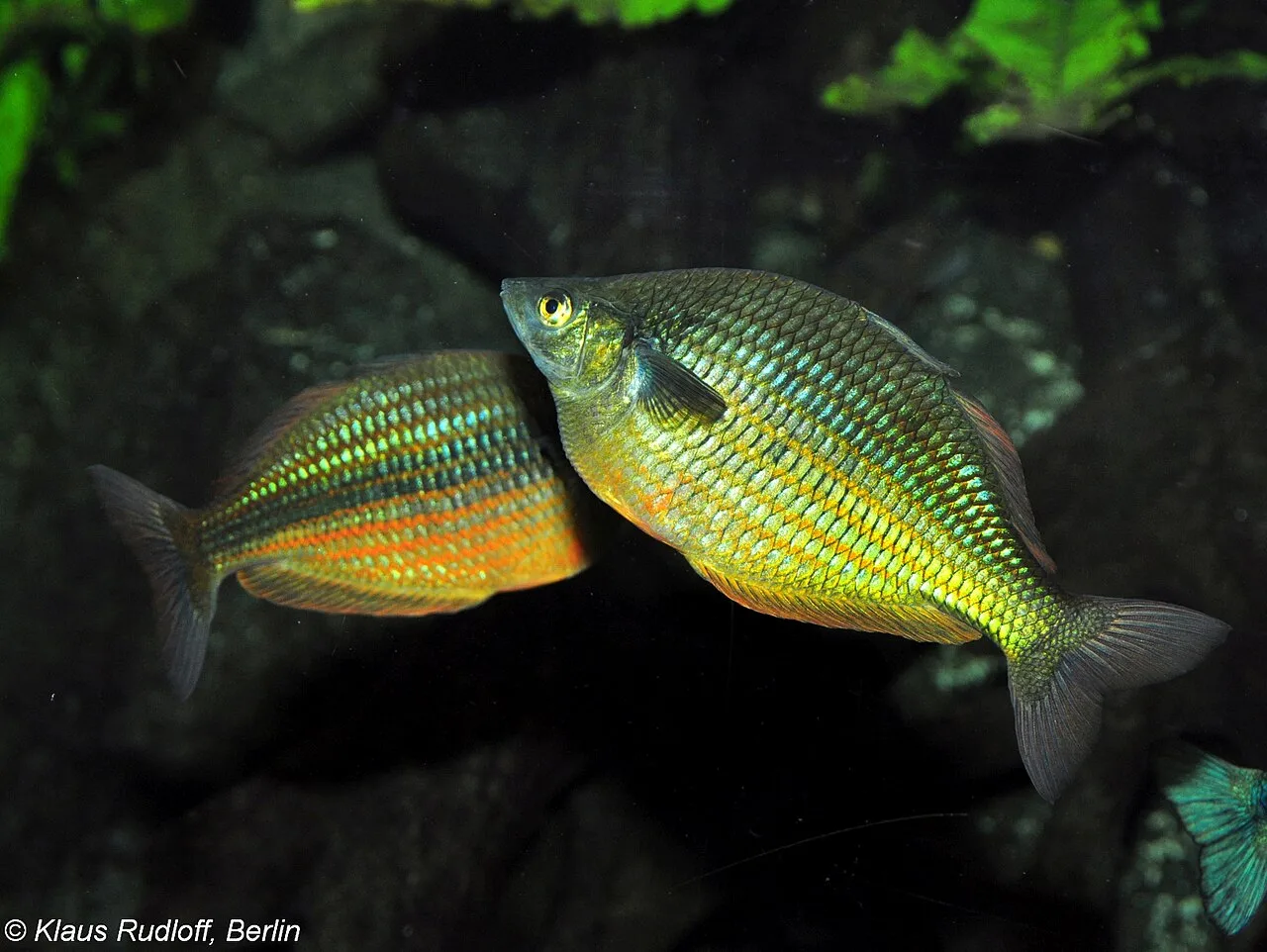
Similar water needs
Species with a similar temperature, a similar pH and a comparable adult size. Whether their behaviour fits as well is what the compatibility check is for.