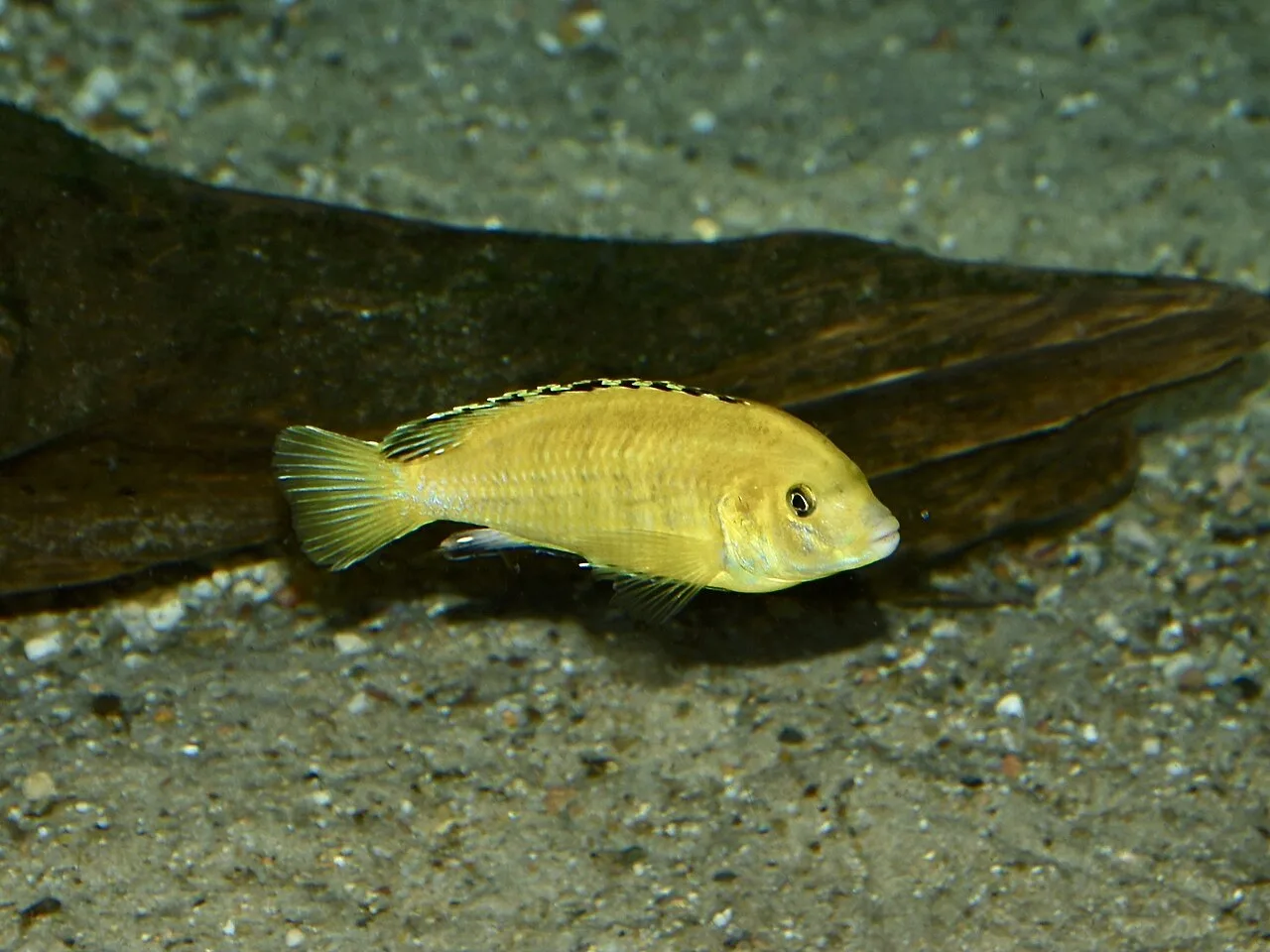
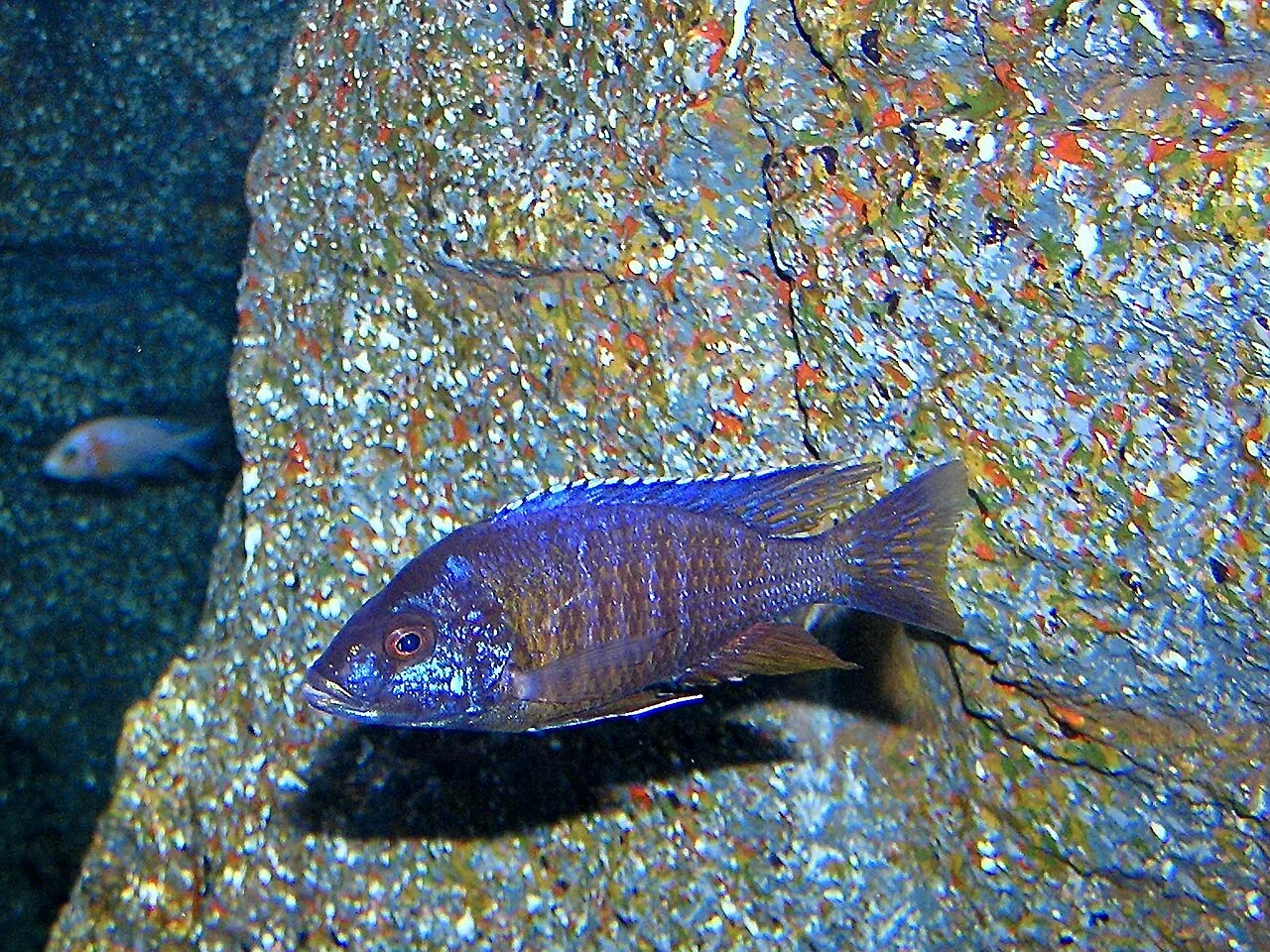
Demasoni cichlid
Chindongo demasoni
5 views
A small, strongly barred mbuna from a narrow rock habitat in Lake Malawi. The short length does not make it a beginner fish.
- Temperature
- 24 – 28 °C
- pH
- 7.5 – 8.5 pH
- General hardness
- 10 – 20 °dH
- Maximum size
- 8 cm
- Minimum tank size
- 160 L
3 min read · 460 words
Quick facts
Place in the aquarium
Highlighted are the water layer and the spots where the species usually stays in the tank.
- Middle water Usually stays in the middle of the tank, between bottom and surface.
- Near the bottom Mostly stays just above the bottom. Food has to reach the substrate.
- Rocks and caves Needs caves, crevices or rockwork as hiding place, territory or spawning site.
Home & range
Overview
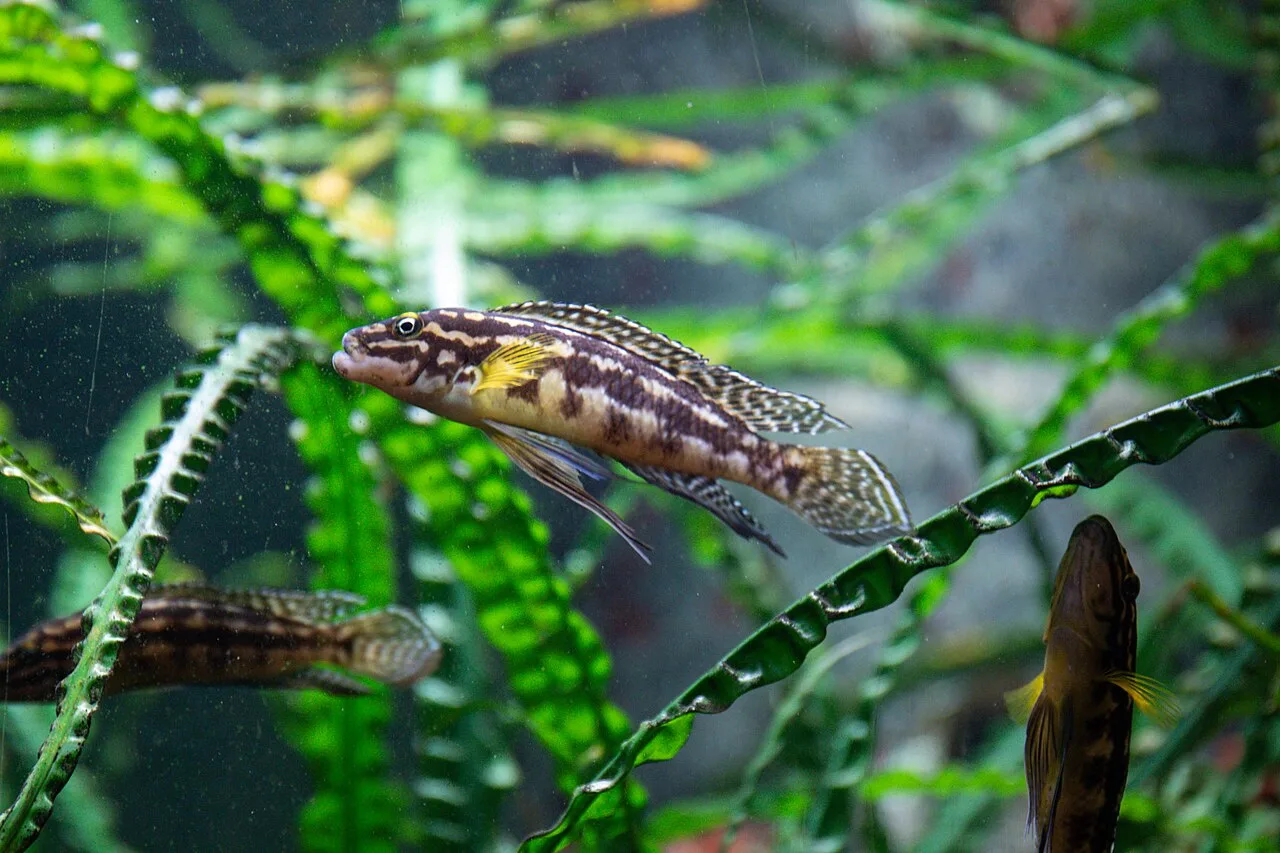
Chindongo demasoni reaches about 7 to 8 cm. Pale and dark bars run over the whole body, including the fins. Males and females look similar. The species stays small and is still one of the less tolerant mbuna, because the natural territory is tiny and does not get larger in the aquarium.
Formerly placed in Pseudotropheus. The catalogue name is Chindongo demasoni. Crosses with similarly barred species spoil the pattern and should not be sold as Demasoni.
Origin & habitat
This describes the origin, not how to furnish the aquarium.
The rock zone near Pombo in the Tanzanian part of Lake Malawi, a very small area. Clear, alkaline water, aufwuchs on rock, a high density of fish on a small surface. That density is often misunderstood in the aquarium: it works in the lake because every exit leads into the next rock. In a glass box the exit is missing.
Tanzania and Lake Malawi are the origin. The small area is a reason to keep only captive-bred fish and not to treat them as a standard filler for every Malawi tank.
Care
A stocking that spreads the fighting
24 to 28 °C, pH 7.5 to 8.5, hard. From about 160 litres, better from 120 cm, with a dense rockwork and more hiding places than fish. The group has to be large, often ten or more, so the aggression is spread. A pair in a small tank is the worst version. Surplus males are still destroyed if the layout has only one cave.
Tankmates
Other mbuna that can hold their own, clearly different in colour, in a tank that is large enough. Peaceful dither fish, tetras and planted aquariums are out. Soft plants are eaten. The Demasoni is an aufwuchs feeder and treats every green as food.
Diet
Plant-based, with the small animals in the aufwuchs. Spirulina, plant flakes, blanched courgette and little animal food. Too much protein increases irritability and loads the water, which with this stocking has to be filtered hard anyway.
Frequent small feeds and a generous weekly water change belong to the keeping. They are not optional care.
Behavior
Territorial all the time. The bars darken when a fish threatens. Subordinate fish lose the contrast, stand in an upper corner and thin out. That is the moment to catch them out, not to wait until the fins are gone.
The species is not a beginner project and not a solitary mbuna. It is a group keeping with a plan for the fish that lose the fight.
Reproduction
Mouthbrooder. The female carries for about three weeks. In a dense group the released young are often eaten. Anyone who wants young moves the carrying female in time, and calmly. The young grow fast and soon show the bars.
Uncontrolled breeding in a tank that is too small sharpens the fighting, because every new male looks for a territory that is not there.
More species in this group

Similar water needs
Species with a similar temperature, a similar pH and a comparable adult size. Whether their behaviour fits as well is what the compatibility check is for.