Moonlight gourami
Trichopodus microlepis
21 views
A silvery labyrinth fish with orange-red thread fins. It grows larger than a dwarf gourami and needs a quiet surface.
- Temperature
- 24 – 28 °C
- pH
- 6 – 7.5 pH
- General hardness
- 2 – 15 °dH
- Maximum size
- 15 cm
- Minimum tank size
- 150 L
5 min read · 847 words
Fresh water
Quick facts
Place in the aquarium
Highlighted are the water layer and the spots where the species usually stays in the tank.
- Upper water Usually stays in the top third of the tank.
- Middle water Usually stays in the middle of the tank, between bottom and surface.
- Dense plants Looks for dense planting as cover, retreat or grazing ground.
Shrimp in the tank
Dwarf shrimp at risk
- Not shrimp safe
- Dwarf shrimp at risk
- Shrimplets at risk
- Shrimp safe
- Adult dwarf shrimp
- At risk
- Shrimplets
- Get eaten
- Safe from shrimp size
- about 4 cm
The moonlight gourami is risky for dwarf shrimp. It grows to 13 to 18 cm and in nature mainly eats molluscs, small crustaceans, insects and insect larvae. With its long feelers it also detects hidden animals. Young shrimp and smaller adult dwarf shrimp are eaten. Larger shrimp from about 4 cm, such as Amano shrimp, are usually safe. Anyone who wants to keep dwarf shrimp puts them in a separate tank. Larger shrimp suit a densely planted tank with this calm gourami.
Home & range
Hatched countries are where the species occurs. It lives in particular waters there, not across the whole country. The points name known waters for orientation, not collection sites.
- Country of origin
- Water for orientation
Native
- Cambodia
- Laos, Myanmar and Vietnam are named by only one of the two versions and are therefore left out.
Overview
Trichopodus microlepis reaches about 13 to 15 cm. The body is silvery to slightly pearly, the long pelvic fins orange to red. Males have the more pointed dorsal. The species looks metallic in dim light and only grey in a glaring shop tank.
Juveniles are peaceful. With size a male holds a corner under floating plants while courting. The tank has to give up that corner and still leave room for the rest. Two adult males on a short run fight.
Features
The moonlight gourami is the only eastern gourami without body markings. Size figures range from 13 cm standard length to 18 cm total length. Between the start of the dorsal fin and the vent the body is even deeper than in the pearl gourami. Above the eye the back profile of adults rises steeply, giving a kind of saddle nose. The many small scales make the plain body shine silvery to turquoise blue depending on the light, sometimes blue-violet in males. Adults have intensely red eyes, and the tail fin is slightly notched.
The pelvic fins, modified into touch and taste organs, are especially long: they reach one and a half times the total length. In females they are light orange, in adult males bright orange-red and red during spawning. Females can also be recognised by the short, round dorsal fin, while males carry a longer, pointed one. The fin formula is dorsal III–IV/8–10 and anal X–XI/34–40.
Classification
Albert Günther described the species in 1861 from a single specimen from Cambodia as Osphromenus microlepis. Synonyms are Trichopus parvipinnis Sauvage 1876 and Deschauenseeia chryseus Fowler 1934. Trichopodus means hair foot, after the thread-like pelvic fins, and microlepis means small-scaled. Together with the pearl, three-spot and snakeskin gouramis, the species forms the eastern gouramis.
Origin & habitat
This describes the origin, not how to furnish the aquarium.
Plant-rich, slow and still waters in Thailand, Cambodia and Vietnam. Warm, often low in oxygen, with floating plants. The countries stay a coarse origin. The labyrinth is breathing at the surface, not an extra.
The species is less common in the trade than the blue gourami and is confused with it. The moonlight lacks the two black flank spots.
The homeland is assumed to be Cambodia, Laos and Myanmar. The wide distribution in Thailand is probably linked to its popularity as a food fish. The species is recorded from the Mekong and Chao Phraya in Cambodia and Vietnam, introduced in Thailand, and feral in Colombia. The fish live almost only in shallow zones of standing or slow, shaded or densely vegetated waters with usually soft, slightly acidic water, often also in the floodplain of the lower Mekong. Thanks to the labyrinth they survive very oxygen-poor water and, if kept moist, even several hours on land.
Care
Tank
24 to 28 °C, pH 6 to 7.5. From about 150 litres and 100 cm for a pair or one male with several females. Floating plants, dense edges, an open surface, little current. The air above the water stays warm. A cover holds jumps and cold draught.
Company
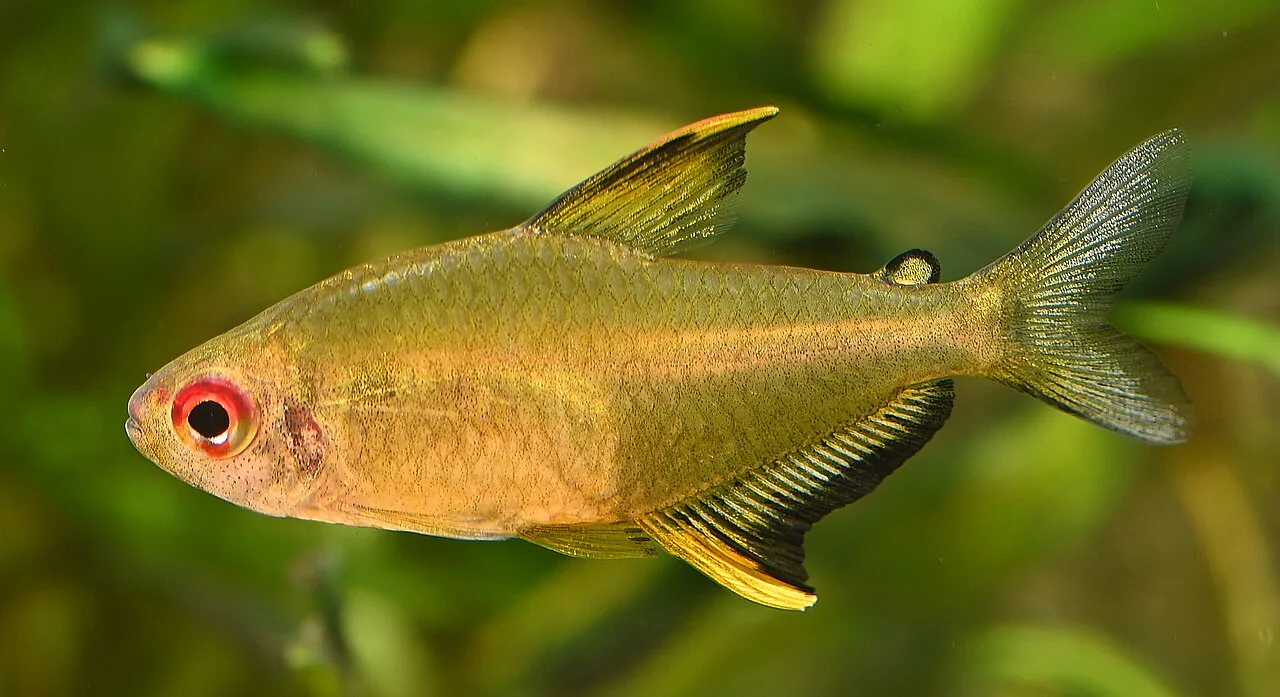
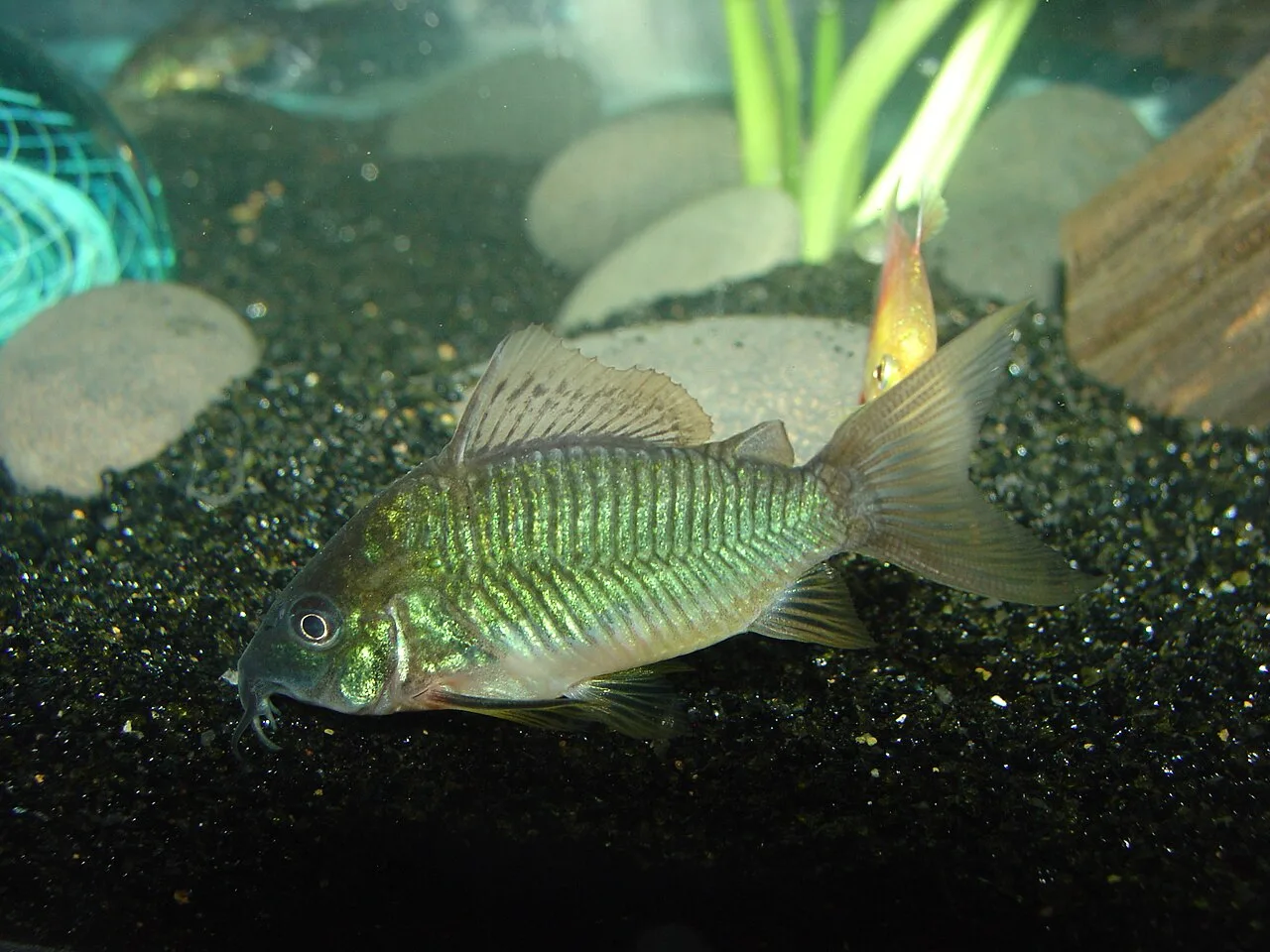
Calm fish that are not too small. Tiny tetras and shrimp are eaten. Barbs nip the red threads. Other male labyrinth fish on the same run, no. Corydoras below bother it little.
Diet
Omnivore. Flakes, granules, frozen food and a plant share, from the surface down into the middle. Several smaller feeds, so the male does not defend the portion alone at the nest.
A pure meat diet is unnecessary. The species also takes soft plant matter.
In the wild the moonlight gourami eats mainly molluscs, small crustaceans, insects and insect larvae, and also zooplankton. Only in aquariums has it repeatedly been seen eating large amounts of soft leaves of floating and aquatic plants.
Behavior
Calm outside courtship, clearly focused on the corner when breeding. The male becomes more silvery and spreads the fins. A female that is not ready needs a second zone. The red threads are used to feel. Torn threads regrow and show nippers or a coarse net.
Reproduction
Bubble nest under floating plants. The male guards the clutch and then drives the female off. The larvae are tiny and need infusoria. Little of that survives in a community tank. A breeding setup is a separate, shallow, warm tank.
A bubble nest of plants
The male claims a territory and builds a bubble nest in its centre, largely from plant pieces glued together with foam. The nests are up to 30 cm² and rise clearly above the surface. Courtship and egg laying take place beneath them. The male wraps around the female and turns her onto her back. Up to 2,000 eggs may result. The tiny eggs are lighter than water and drift under the nest on their own. Unlike related species, the male does not gather them but builds further layers of foam beneath them. The larvae hatch after a little more than 24 hours and swim freely after two to three days, which ends the male's brood care.
Importance
In its homeland the sturdy fish is a popular food fish, caught with nets and sold alive or fresh. It only reached Europe in 1952 through the Aquarium Hamburg and is still not offered regularly.
More species in this group
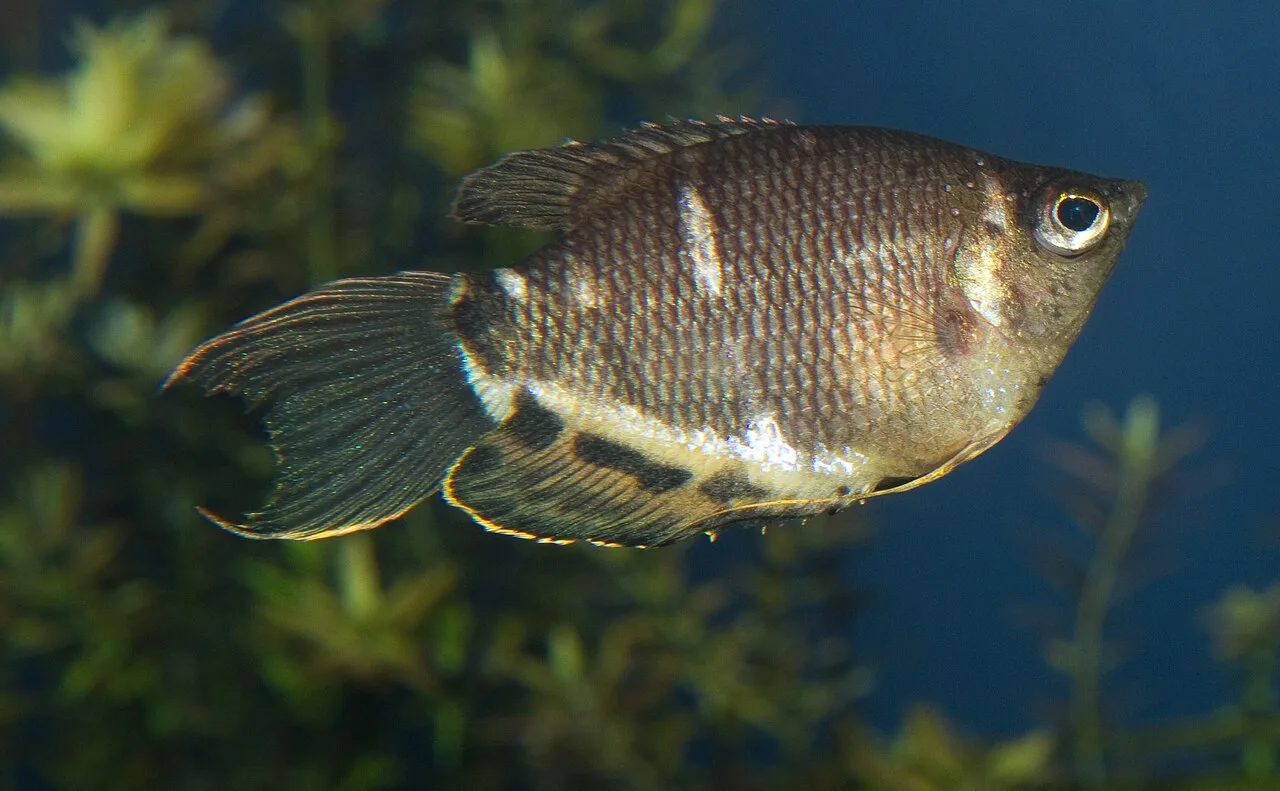
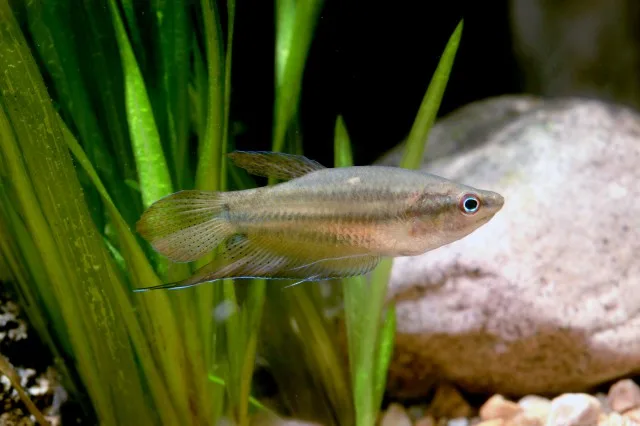
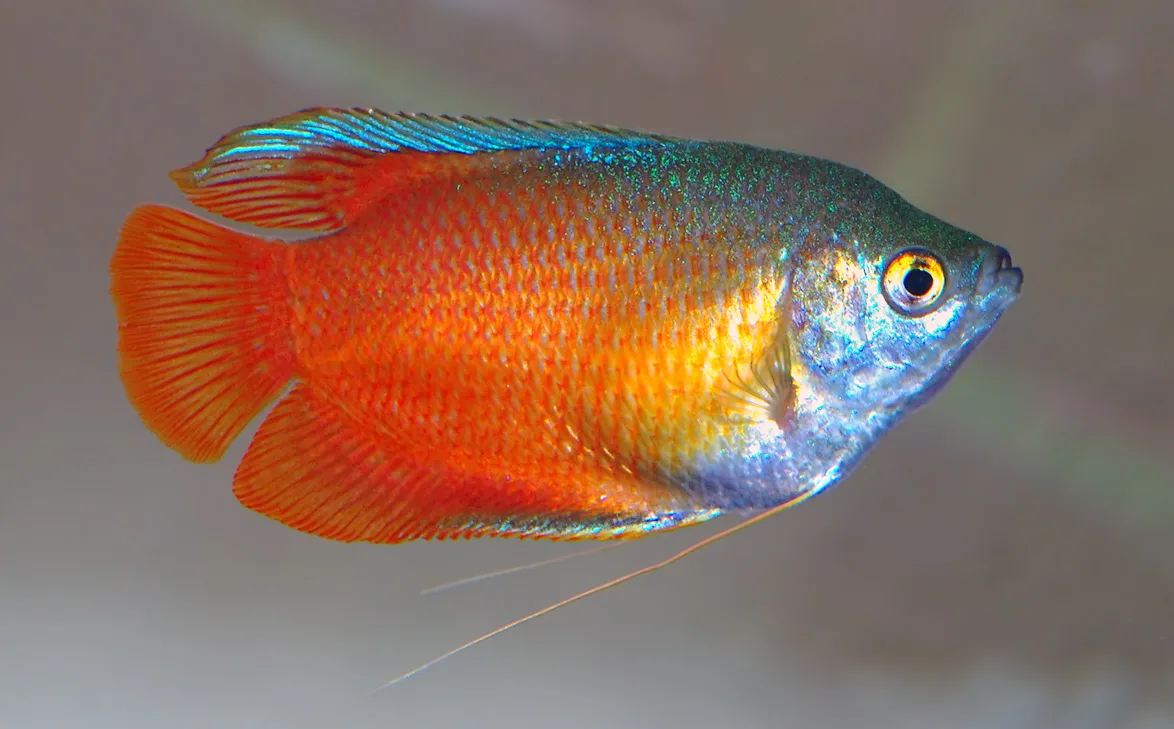

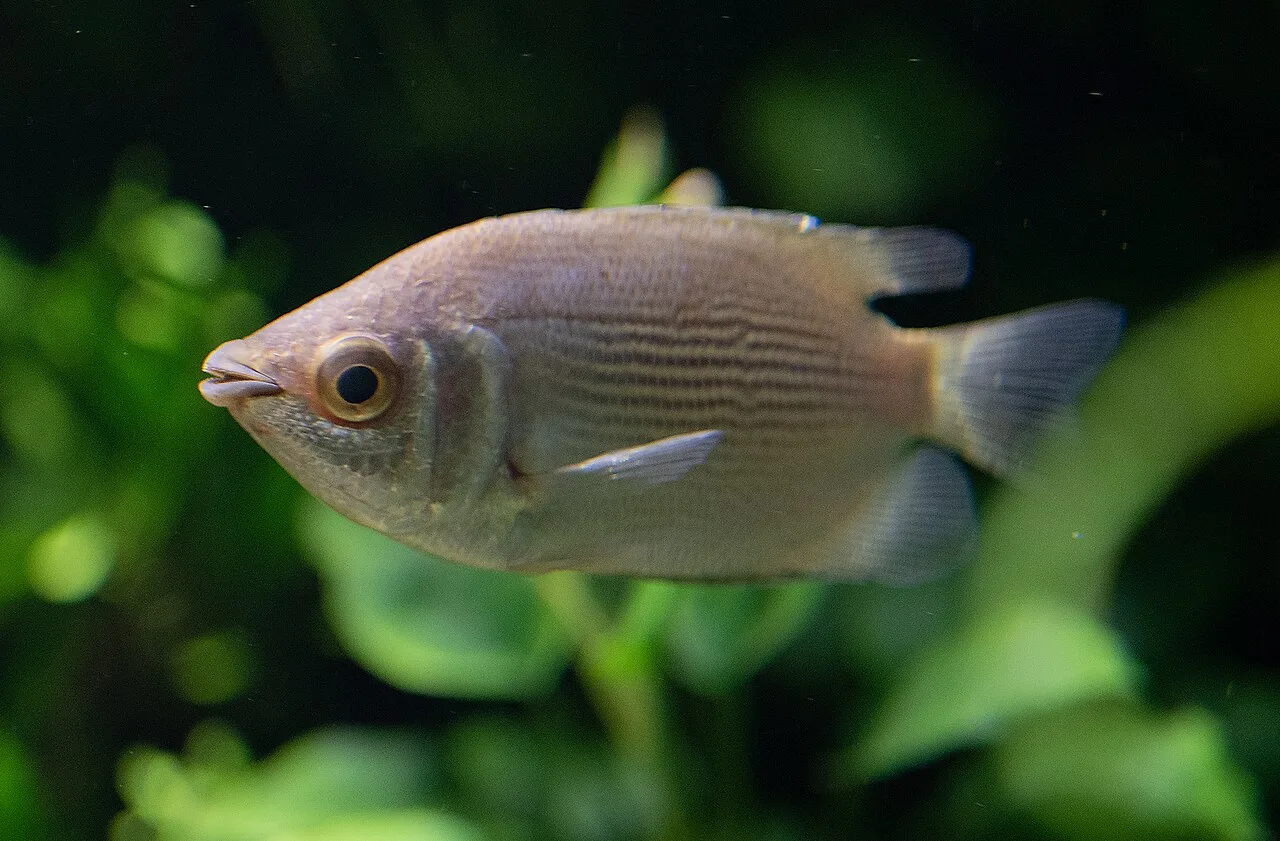
Similar water needs
Species with a similar temperature, a similar pH and a comparable adult size. Whether their behaviour fits as well is what the compatibility check is for.