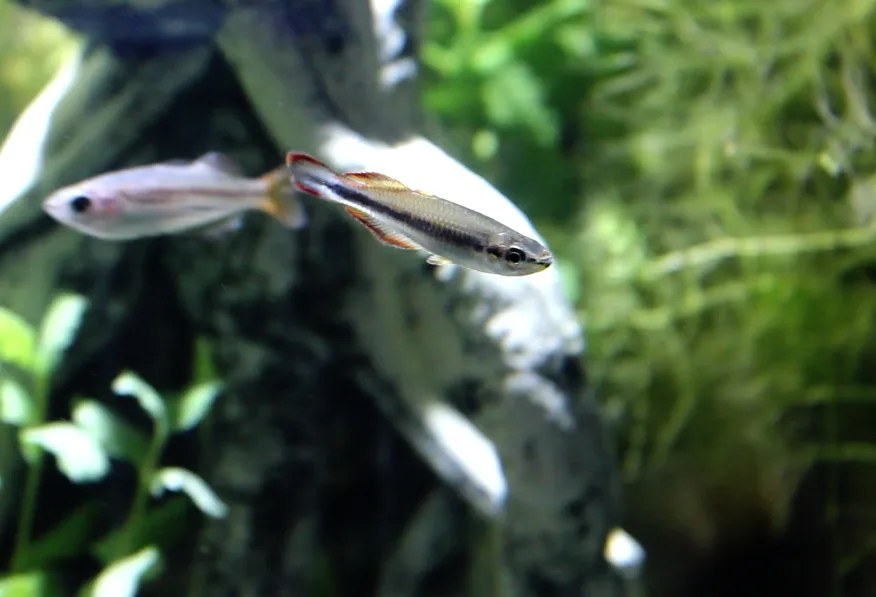
Pearl cichlid
Geophagus brasiliensis
18 views
A pearly cichlid from south-eastern South America. It grows large, digs and needs sand.
- Temperature
- 20 – 26 °C
- pH
- 6.5 – 7.5 pH
- General hardness
- 5 – 20 °dH
- Maximum size
- 20 cm
- Minimum tank size
- 300 L
4 min read · 593 words
Fresh water
Quick facts
Place in the aquarium
Highlighted are the water layer and the spots where the species usually stays in the tank.
- Near the bottom Mostly stays just above the bottom. Food has to reach the substrate.
- Substrate Sifts through the substrate or burrows into it. Fine, rounded sand without sharp edges suits it.
Shrimp in the tank
Not shrimp safe
- Not shrimp safe
- Dwarf shrimp at risk
- Shrimplets at risk
- Shrimp safe
- Adult dwarf shrimp
- At risk
- Shrimplets
- Get eaten
- Safe from shrimp size
- No size is safe
The pearl cichlid eats shrimp. It grows to 28 cm, searches the bottom as cichlids do and defends a territory as a pair. Shrimp of every size are food for it, including Amano shrimp.
There is no safe shrimp size. Anyone who wants to keep shrimp needs a separate tank for them. Even putting them together for a while, for example to clean algae, is not a good idea, because added shrimp are quickly recognised as food. A small separate tank with moss and leaf litter is the most reliable solution for a stable shrimp colony and needs little effort to run.
Home & range
Hatched countries are where the species occurs. It lives in particular waters there, not across the whole country. The points name known waters for orientation, not collection sites.
- Country of origin
- Water for orientation
Native
Overview
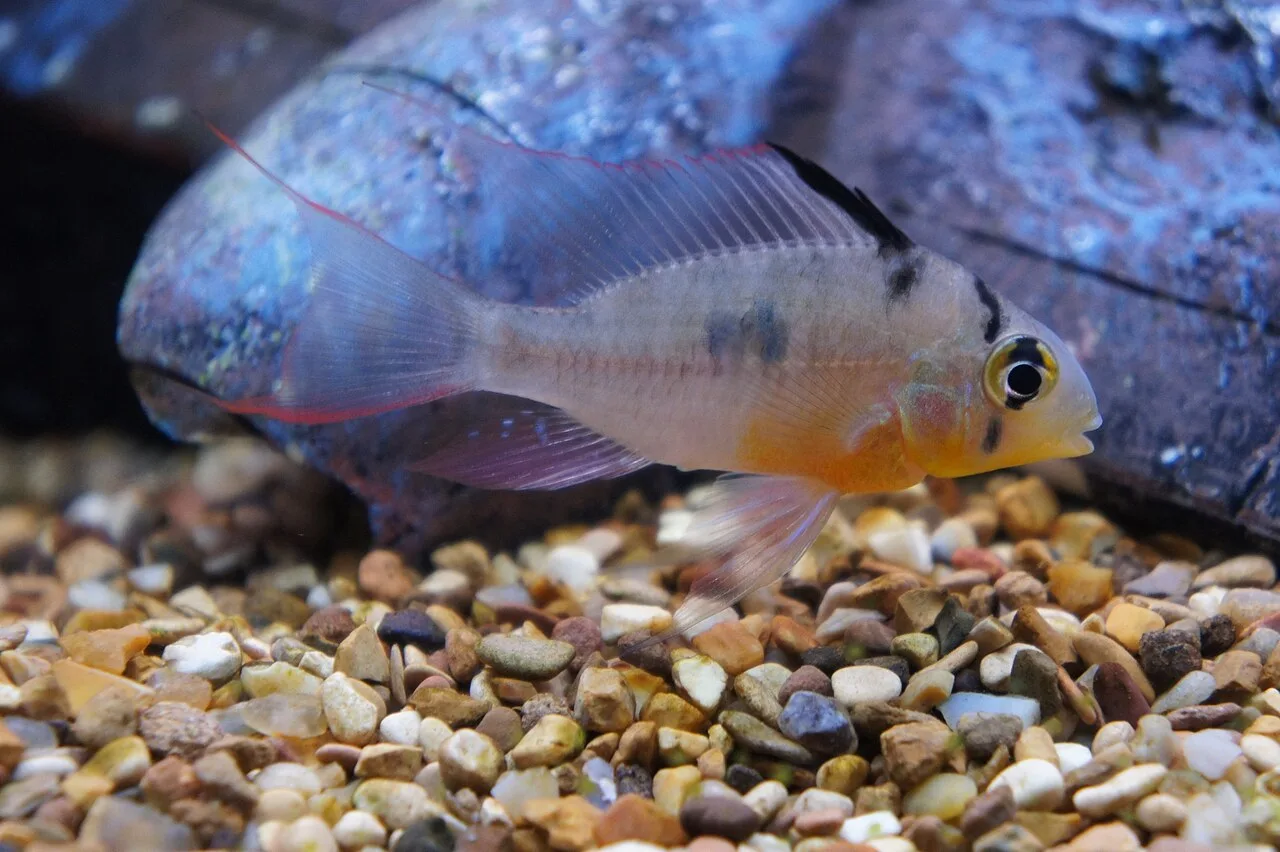
Geophagus brasiliensis reaches 20 cm and more. The body is oval, the scales carry pearly spots, the males a nuchal hump and longer fins when courting. Juveniles in the trade are often under 6 cm and do not suggest the adult size. The tank has to be planned for the adult.
The species chews through the bottom. Sand is taken up and given out again through the gills. Coarse gravel injures the gills. Plants that do not sit firm or are not tied on are uprooted.
Genus open
The pearl cichlid grows to 28 cm and matures at 8 to 10 cm. Males are more strongly coloured, have longer drawn-out fins and develop a forehead hump with age, while females stay clearly smaller. A vertical band hides the eye, and scales and unpaired fins have a pearly sheen. Sven O. Kullander removed the species from Geophagus. No new genus name exists yet, so Geophagus stays in quotation marks. The species group includes nine related species, such as G. iporangensis, G. obscurus and G. diamantinensis.
Origin & habitat
This describes the origin, not how to furnish the aquarium.
Rivers, lakes and coastal lagoons in south-eastern Brazil and in Uruguay. The water there is often harder and not extremely acidic. Both countries stay a coarse origin. The species is adaptable, and that is not a licence for a small community tank.
The species lives mainly in small clear-water rivers and streams in the uplands and coastal lowlands of eastern Brazil, north to Bahia, plus Paraguay, Uruguay and far northeastern Argentina. It also lives in lakes, ponds, ditches and brackish lagoons. There are even records from mangroves and once from sea water near Santos. It has been introduced to Australia among other places, into the Tweed River and Swan River systems.
Care
Size
20 to 26 °C, pH 6.5 to 7.5. From about 300 litres and 140 cm for a pair of adults. Fine sand, roots and stones that do not tip when the fish dig underneath. Plants only tied on or very firm. A pair. Further conspecifics need clearly more length.
Company
Robust fish that are not too small. Tetras the size of a neon are eaten. While breeding a territory on the bottom is closed. Calm fish in the upper water cope better than further bottom breeders on the same area.
Diet
Omnivore, searching the sand for small animals and taking added food. Sinking granules, frozen food, blanched vegetables. Food that only drifts at the surface misses the species. Too much fattening food makes the fish fat without replacing the search in the sand.
Behavior
A pair with a territory, often tolerable outside breeding, decided at spawning time. The digging is the normal behaviour and not a sign that the substrate is wrong. A fish that no longer feeds and stands in a corner with clamped fins is driven off or ill.
The pearly spots come with age and with good water. Juveniles are plain olive.
Reproduction
Substrate spawner with brood care. The pair digs, spawns on a stone and guards eggs and young. In a community tank this fails as soon as other fish reach the clutch. A breeding setup is the established pair in a tank of its own with sand.
The young are numerous. Without a plan for where they go, a brood becomes an overcrowded tank.
As an open spawner the pair lays up to 1000 eggs on a firm surface, usually a stone. Mainly the female guards the clutch. After three to four days the larvae hatch and lie in a pit for another four to eight days, after which both parents lead the young. Two females can pair, and their eggs then never hatch.
Gallery
More species in this group

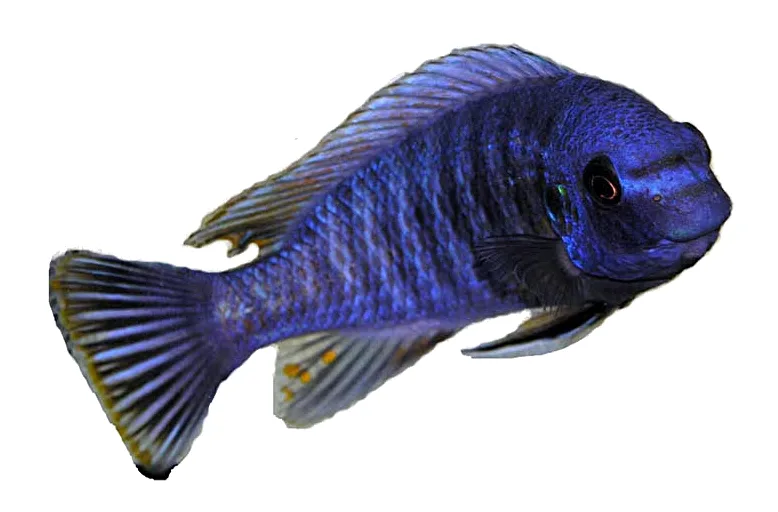
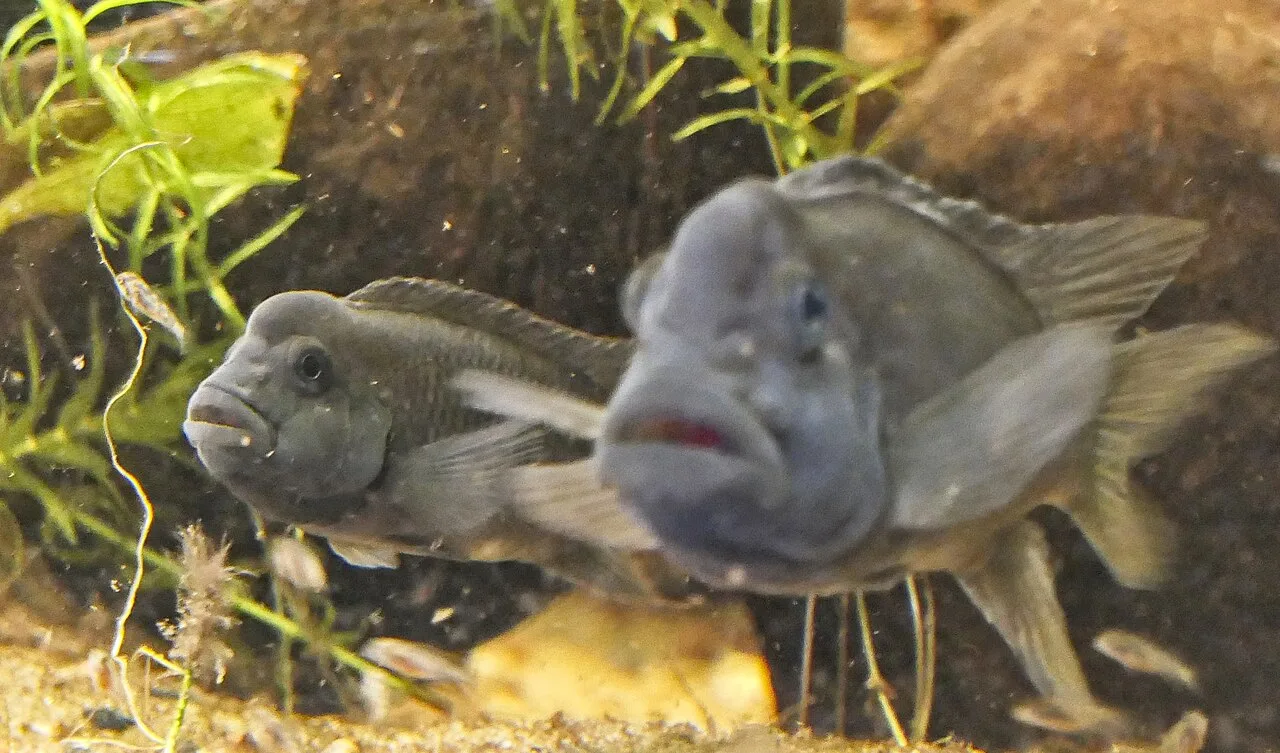
Similar water needs
Species with a similar temperature, a similar pH and a comparable adult size. Whether their behaviour fits as well is what the compatibility check is for.