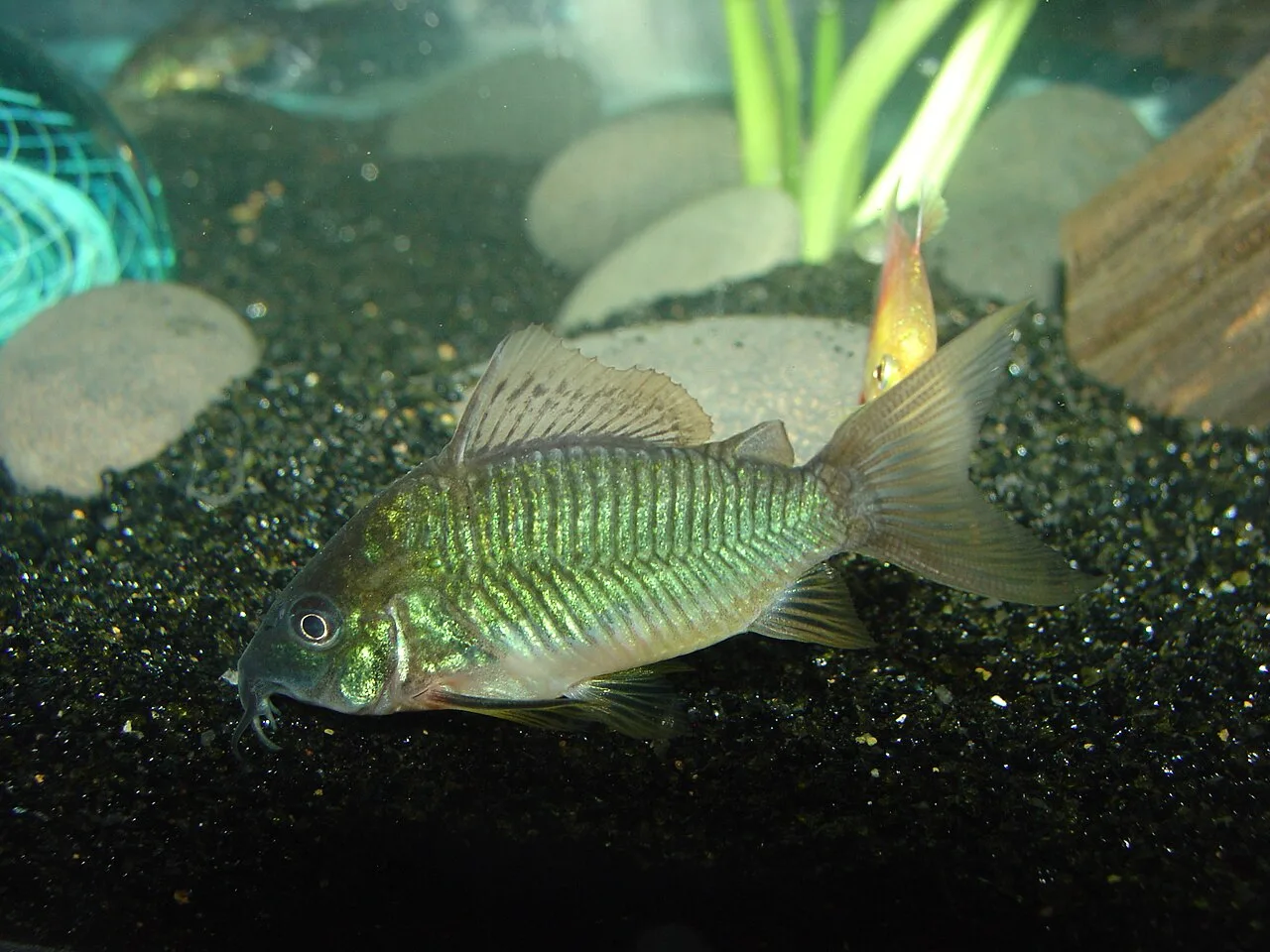
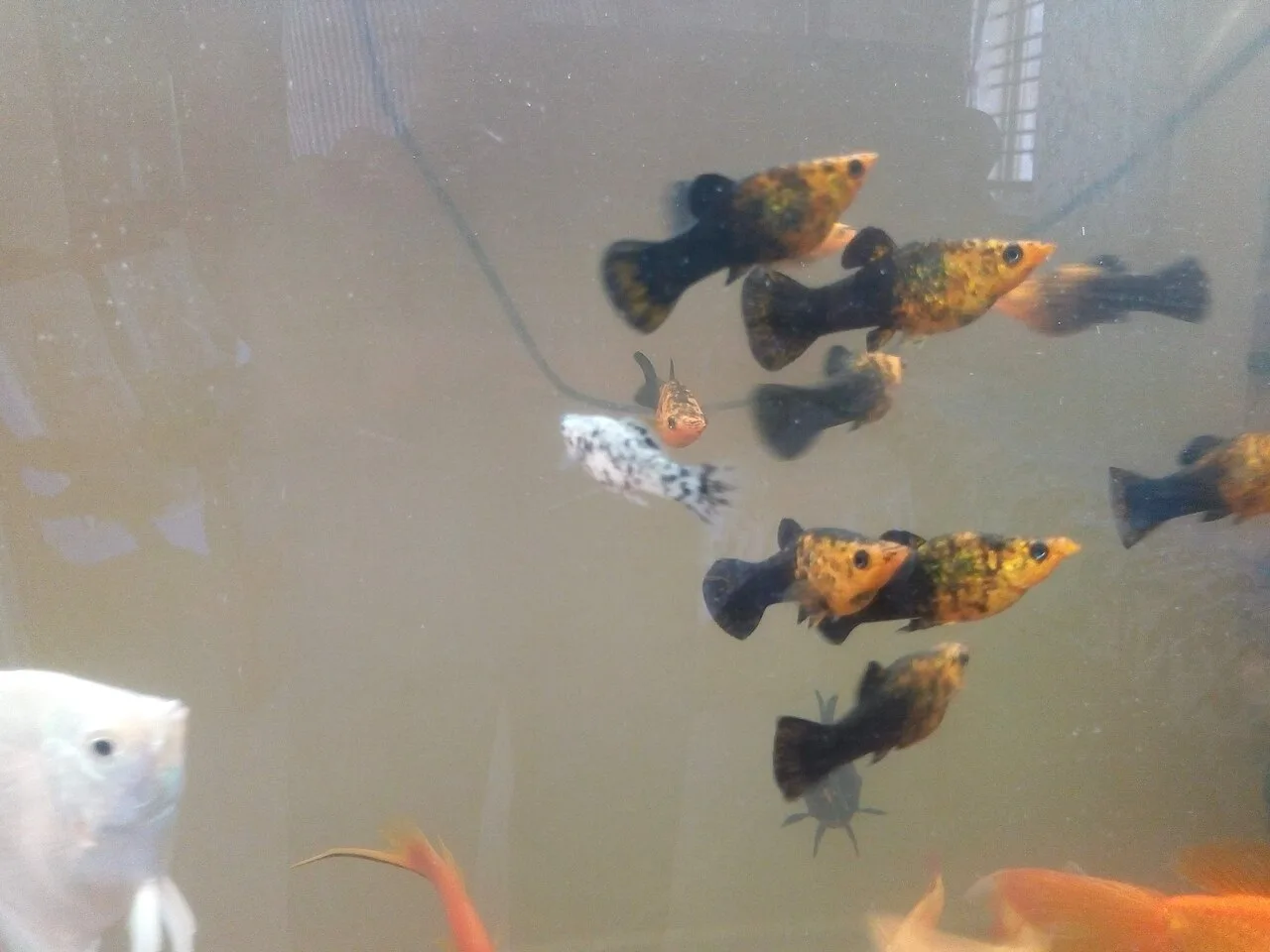
Three-spot gourami
Trichopodus trichopterus
23 views
A labyrinth fish with two dark spots and the eye as a third point. It grows larger and more decided than a dwarf gourami.
- Temperature
- 24 – 28 °C
- pH
- 6 – 8 pH
- General hardness
- 5 – 16 °dH
- Maximum size
- 15 cm
- Minimum tank size
- 150 L
5 min read · 847 words
Fresh water
Quick facts
Place in the aquarium
Highlighted are the water layer and the spots where the species usually stays in the tank.
- Upper water Usually stays in the top third of the tank.
- Middle water Usually stays in the middle of the tank, between bottom and surface.
- Dense plants Looks for dense planting as cover, retreat or grazing ground.
Shrimp in the tank
Not shrimp safe
- Not shrimp safe
- Dwarf shrimp at risk
- Shrimplets at risk
- Shrimp safe
- Adult dwarf shrimp
- At risk
- Shrimplets
- Get eaten
- Safe from shrimp size
- No size is safe
The three spot gourami is not suitable for shrimp. It grows to 15 cm, and its natural diet explicitly includes shrimp, along with molluscs, insects and their larvae. Males are also territorial and sometimes very aggressive. Dwarf shrimp and their young are eaten, and even larger species such as Amano shrimp are not safe.
Shrimp belong in a separate tank. The gourami suits calm fish of similar size in a tank with dense plants and an open surface.
Home & range
Hatched countries are where the species occurs. It lives in particular waters there, not across the whole country. The points name known waters for orientation, not collection sites.
- Country of origin
- Water for orientation
Native
- Indonesia
- Range: Java, Borneo and Sumatra in Indonesia.
- China
- Range: Yunnan as the northernmost occurrence.
Overview
Trichopodus trichopterus reaches about 12 to 15 cm. The blue form, the gold form and the marble form are cultivated colours of the same species. Two black spots on the flank and the eye make the three spots of the English name. The pelvic fins are long threads. Males have the more pointed dorsal.
Juveniles look peaceful. With maturity the males hold a corner while courting and drive off whatever swims there. The tank has to give up that corner and still leave room for the rest of the stock.
Pattern and forms
The nominate form, described from Indonesia and probably from Java, is blue-grey to ochre-brown and lighter towards the belly, with wavy vertical lines. One dark spot sits mid-body and one at the base of the tail. The spots on the tail fin are pearly, golden or bluish, those on the anal fin yellow to orange-red, and the eye is red. Fish of other origins are yellowish to blue with finer or broader bands. The spots fade with age, stress or poor water. Males have long, pointed dorsal and anal fins, females shorter, rounded ones. Blue, brown, silver, golden yellow, marbled, white and albino forms are bred.
Taxonomy
Pallas described the species in 1770 as Labrus trichopterus. The genus name refers to the thread-like pelvic fins. The species is considered too variable to be kept as one, and a revision is expected. In 2014 a form without markings except the tail spot was described as Trichopodus poptae. F. G. Umlauff brought the species to Hamburg in 1896.
Origin & habitat
This describes the origin, not how to furnish the aquarium.
Plant-rich, slow and still waters of Southeast Asia, from Myanmar through Thailand and Malaysia to the Greater Sunda Islands. The species is also widely introduced and must not be released from the aquarium into natural waters. The countries of the home range stay a coarse origin.
The habitat is warm, often low in oxygen and full of plants. The labyrinth is therefore not an extra. It is breathing at the surface.
The species has the largest range of the eastern gouramis: nearly all the Sunda islands, the Malay Peninsula, Singapore, Thailand, Vietnam, Laos, Cambodia, Myanmar and Luzon. Yunnan in China is part of the range as well. It lives in weedy, shallow, still or slow waters, rice fields, irrigation ditches and ponds, but also in rivers and canals. In the rainy season it migrates into flooded forests, for example along the Mekong. Some island populations tolerate brackish water. The IUCN lists the species as least concern. In its home range it is sold as a food fish.
Care
Tank
24 to 28 °C, pH 6 to 8. From about 150 litres and 100 cm for a pair or one male with several females. Floating plants, dense planting at the edges, an open surface, little current. The air above the water stays warm. Two adult males need a clearly longer tank with visual barriers.
Company
Calm fish that are not too small. Tiny tetras and shrimp are eaten or hunted. Other male labyrinth fish on the same run fight. Tiger barbs nip the threads. Corydoras and larger tetras fit better.
Keeping
The three spot gourami is hardy and gets along with fish of similar size and calm temperament. Males are territorial towards each other and timid around aggressive fish. Some males are very aggressive and nip fins, especially of male guppies, goldfish and bettas. Females usually keep to themselves. Several fish are only recommended if they were raised together and have enough space.
Diet
Omnivore. Flakes, granules, frozen food and a plant share. The fish feed from the surface down into the middle. A pure meat diet is unnecessary. Several smaller feeds stop the male from defending the whole portion at the nest while the rest go hungry.
In the wild the species eats molluscs, insects and their larvae, shrimp, zooplankton and insects falling onto the water, with a small share of algae and plants. In the aquarium it needs algae flakes and meaty food such as bloodworms, tubifex or brine shrimp.
Behavior
Mostly calm outside courtship, clearly territorial when breeding. The male spreads the fins, builds under floating plants and darkens in the pattern. A female that is not ready to spawn needs a second zone, or courtship becomes a chase.
The thread fins feel plants and tankmates. Torn threads regrow and show nippers or a coarse net.
Reproduction
Bubble nest at the surface. The male guards the clutch and then drives the female off. The larvae are tiny and need infusoria before they take brine shrimp. Little of that survives in a community tank. A breeding setup is a separate, shallow, warm tank with floating plants.
The gold and marble forms spawn the same way. The colour does not breed true in every brood.
The male builds the largest bubble nests of all gouramis, over 30 cm² and domed above the surface. The pair spawns underneath. Depending on the report, there are up to 800 or 1000 to 4000 tiny eggs. The larvae hatch after about one day and swim freely two to three days later. While the labyrinth organ develops, around the third week, frequent water changes are important.
Gallery
More species in this group
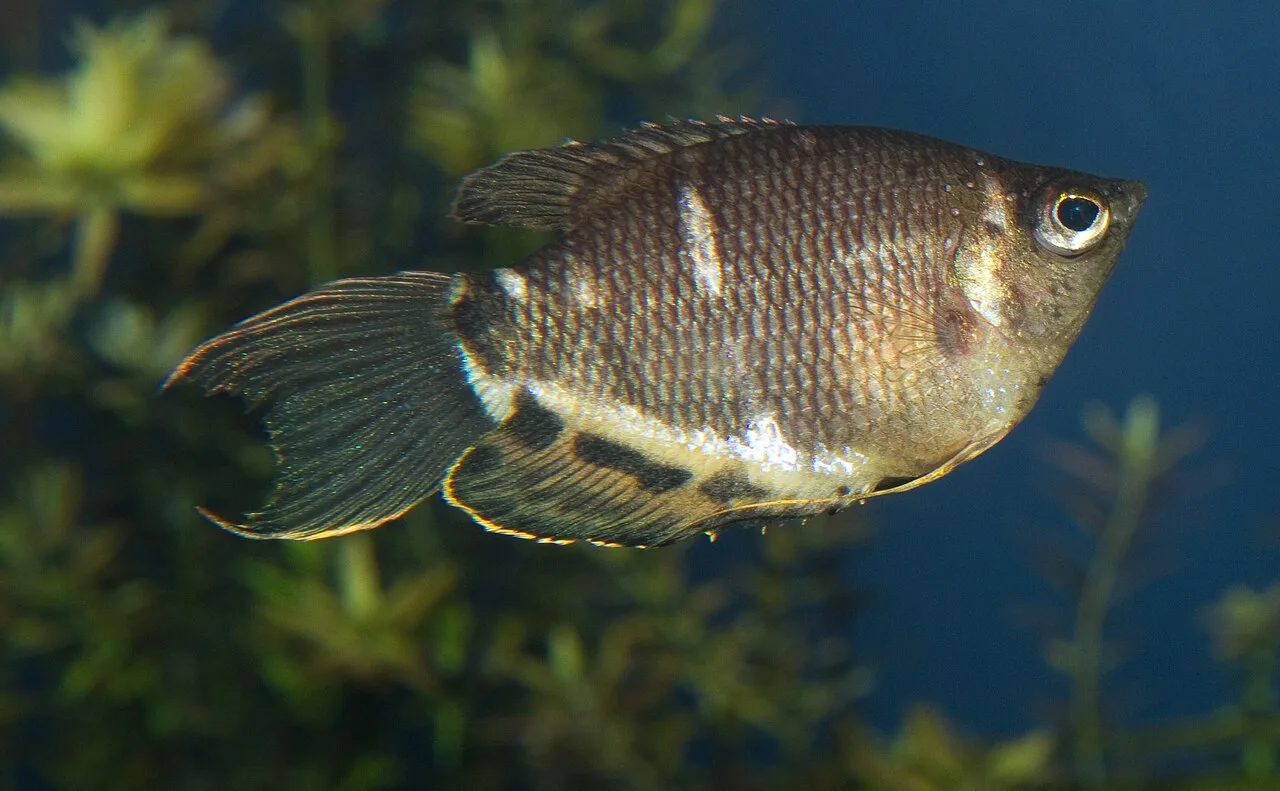
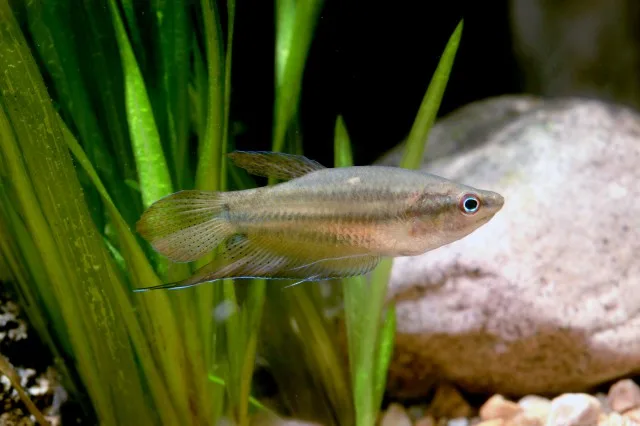

Similar water needs
Species with a similar temperature, a similar pH and a comparable adult size. Whether their behaviour fits as well is what the compatibility check is for.