Pátzcuaro dwarf crayfish
Cambarellus patzcuarensis
5 views
A small crayfish from Lake Pátzcuaro in Mexico. The orange aquarium form is a cultivated form; the wild form is considered endangered.
- Temperature
- 16 – 25 °C
- pH
- 7 – 9 pH
- General hardness
- 8 – 10 °dH
- Maximum size
- 4 cm
- Social behavior
- Territorial
- Diet
- Omnivore
4 min read · 610 words
Fresh water
Quick facts
Further published values
- Lifespan
- 1.5 a
- Minimum tank size
- 25 L
Place in the aquarium
Highlighted are the water layer and the spots where the species usually stays in the tank.
- Near the bottom Mostly stays just above the bottom. Food has to reach the substrate.
- Dense plants Looks for dense planting as cover, retreat or grazing ground.
- Rocks and caves Needs caves, crevices or rockwork as hiding place, territory or spawning site.
Home & range
Hatched countries are where the species occurs. It lives in particular waters there, not across the whole country. The points name known waters for orientation, not collection sites.
- Country of origin
- Water for orientation
Native
- Lake Pátzcuaro, Michoacán
- Endemic to Lake Pátzcuaro and nearby springs.
Overview
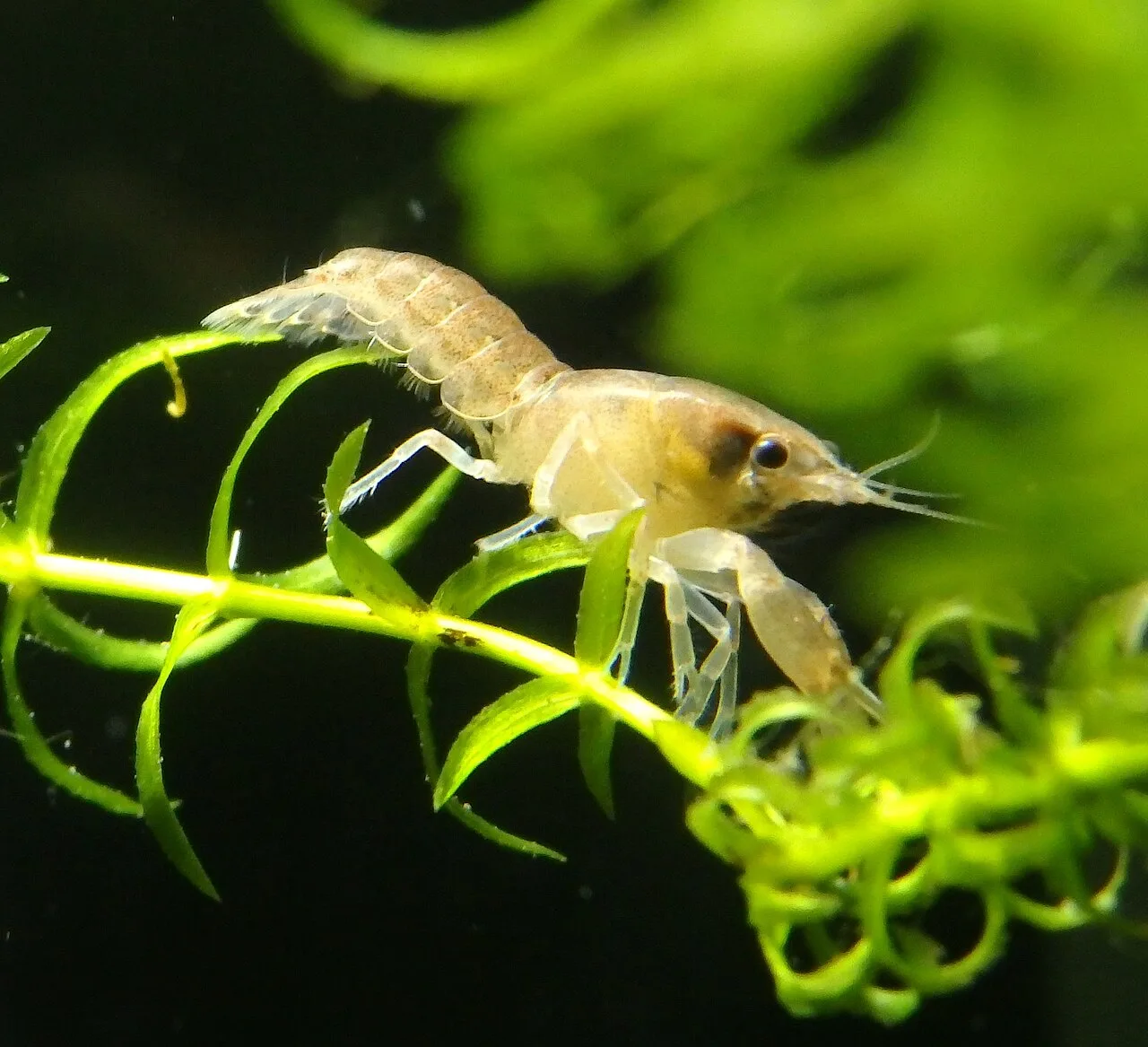
The Pátzcuaro dwarf crayfish (Cambarellus patzcuarensis) belongs to the genus of dwarf crayfish and comes from Mexico. For a long time it was regarded as a subspecies of Cambarellus montezumae. In the hobby the orange variant, CPO for short, is best known. It is a cultivated form that does not occur in nature. There is also a black to brown cultivated form.
Features
According to Baensch and Evers females grow up to 3.5 centimetres long and males about three. Schliewen gives four centimetres as the maximum; according to Pekny and Lukhaup well-kept females in the aquarium can also reach five. Males have narrower claws up to 20 percent longer, females shorter and thicker ones. Males are recognised by the gonopods on the underside. Wild animals often show dark lengthwise stripes on a brown back, stronger right after a moult. The crayfish is active by day and by night. Age figures for CPOs are usually about 18 months.
Range and habitat
This describes the origin, not how to furnish the aquarium.
The wild form is endemic to Lago de Pátzcuaro in the state of Michoacán, as well as springs near Tzurumútaro, Opopeo and Chapultepec. The lake lies in an old volcanic crater above 2000 metres, has a mean depth of 4.7 metres and shallow, marshy margins. There the crayfish lives on the muddy, densely vegetated bottom. In 2011 the lake measured 14.8 to 26.8 °C and a pH of 7.2 to 8.8, so the water is alkaline. Sewage, agrochemicals and stocked foreign fish have badly damaged the lake. The map shows Mexico as a coarse origin, not the whole country.
Keeping
For a species tank Baensch and Evers give 50 litres, Geck and Schliewen at least 25 litres. Schliewen recommends a pair or trio in small tanks, five animals for 30 litres and six to ten for 60 litres. According to Geck and Schliewen the temperature should be between 16 and 26 °C; later they added that more than 25 °C is poorly tolerated. Pekny and Lukhaup give 15 to 25 °C. At room temperature heating is usually unnecessary; in summer cooling matters more. The pH should be between seven and nine.
Set-up
Many hiding places, things to climb and dense planting, which is hardly touched, are important. After a moult the animals are vulnerable and can be eaten by others of their kind. Good aeration, some mulm, a weekly partial water change and enough minerals for the shell belong to it. Moulting problems are often caused by a lack of minerals.
Diet
The crayfish are omnivores. They take crayfish and shrimp food and ordinary fish food, and like spirulina, tubifex, white worms, grindal worms, mosquito larvae and daphnia, fresh, dried or frozen. They need more animal protein than many tank inhabitants. In community tanks their reserved nature sometimes keeps them from reaching the food.
Behaviour and moulting
In principle the animals are fairly peaceful. Males are more active and as adults sometimes become more aggressive when there is competition. Each animal has its own preferences. Geck and Schliewen advise against community tanks. With dwarf shrimp it works in densely planted tanks despite losses; according to Pekny and Lukhaup small Caridina should not be added. Macrobrachium shrimp are unsuitable because they eat freshly moulted crayfish. Fish that sleep on the bottom fit poorly, whereas Otocinclus and midwater fish fit better.
Reproduction and larvae
Males switch between a reproductive and an inactive form. Females can store sperm for up to six months. The eggs are carried under the abdomen for about 25 days, or two to three weeks, at a constant 20 to 25 °C. Females manage two to three broods in a row.
Effect of temperature
A study from 2014 compared 18, 22 and 26 °C. At 18 °C adult females lived longer and carried the most eggs; at 26 °C most young survived in the egg. According to breeders a constant 25 °C increases breeding but shortens lifespan.
Gallery
More species in this group
Similar water needs
Species with a similar temperature, a similar pH and a comparable adult size. Whether their behaviour fits as well is what the compatibility check is for.