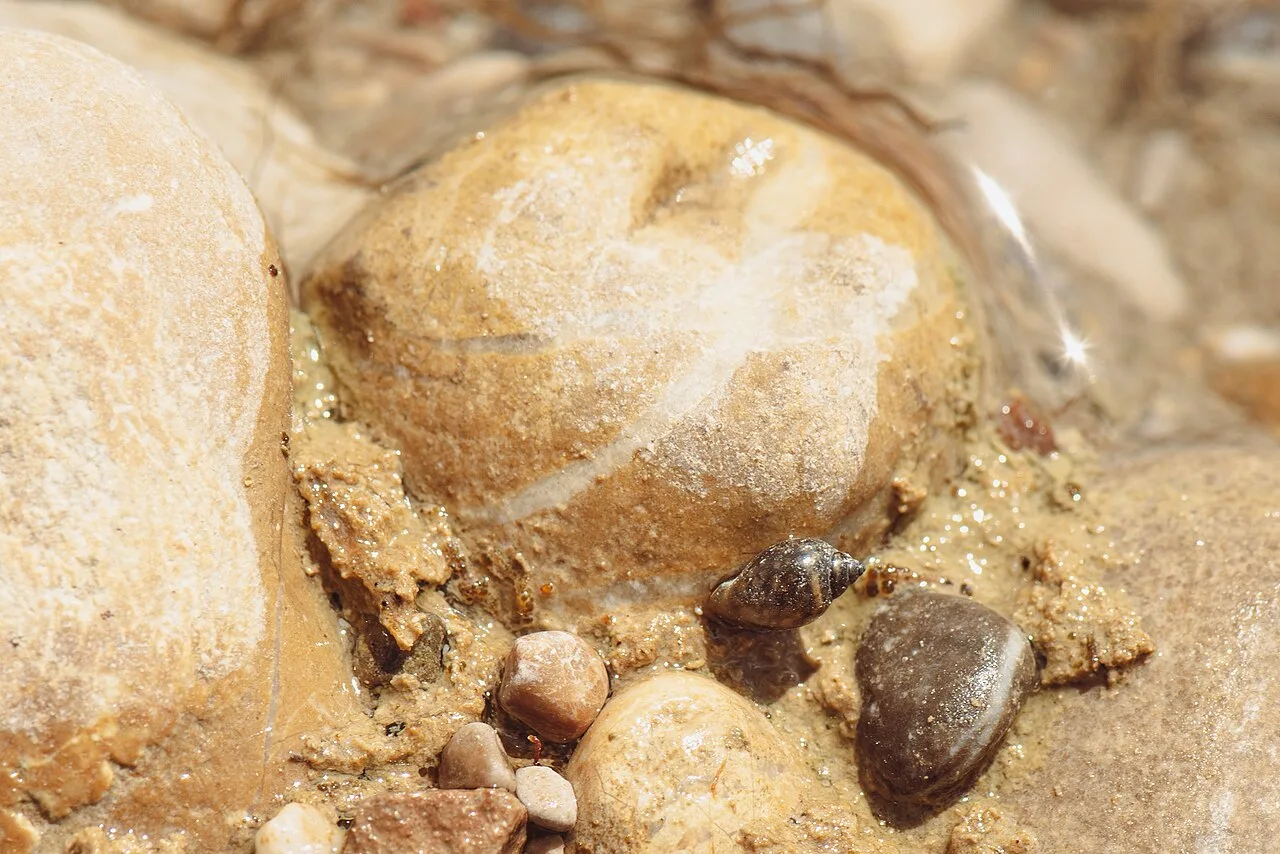
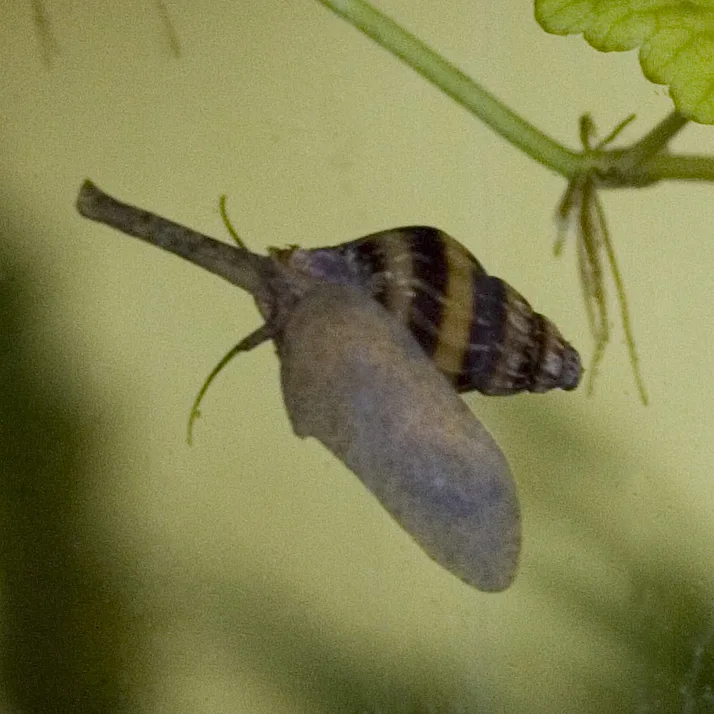
Spike-topped apple snail
Pomacea diffusa
2 views
An apple snail from the Amazon basin, known in the trade as the mystery snail. In the EU, trade in Pomacea has been prohibited since 2012.
- Temperature
- 20 – 28 °C
- pH
- 7 – 8 pH
- General hardness
- 8 – 18 °dH
- Maximum size
- 5 cm
- Social behavior
- Peaceful
- Diet
- Omnivore
3 min read · 341 words
Fresh water
Quick facts
Further published values
- Minimum tank size
- 40 L
Place in the aquarium
Highlighted are the water layer and the spots where the species usually stays in the tank.
- Near the bottom Mostly stays just above the bottom. Food has to reach the substrate.
- Dense plants Looks for dense planting as cover, retreat or grazing ground.
Home & range
Hatched countries are where the species occurs. It lives in particular waters there, not across the whole country. The points name known waters for orientation, not collection sites.
- Country of origin
- Water for orientation
Native
Overview
Pomacea diffusa has a rounded shell with a relatively high spire, hence its name. A channelled suture is absent. The shell reaches about 5 cm. Yellow, blue, purple, brown and striped trade animals are colour forms of the same species.
Name
The species was first described as a subspecies of Pomacea bridgesii. Genetic studies confirm that they are two separate species. Pomacea bridgesii is larger and has a small range; Pomacea diffusa is the common form throughout the Amazon basin. Many animals sold as bridgesii are diffusa.
Legal situation in the EU
Commission Implementing Decision 2012/697/EU prohibits introducing snails of the genus Pomacea into the EU and spreading them there. The background is damage caused by feral apple snails in rice fields and wetlands. It is therefore no longer traded in the EU. Animals must never be released.
Range and habitat
This describes the origin, not how to furnish the aquarium.
Amazon basin in Brazil, Peru and Bolivia. The type locality is near Santa Cruz de la Sierra in Bolivia. Introduced populations exist in Florida, Alabama and Cuba; they go back to the ornamental snail trade.
Keeping
Tank
From about 40 litres. A few centimetres of air remain between the water surface and the cover, because the eggs are laid above water. The cover must be tight.
Water
20 to 28 °C, pH 7 to 8, GH from about 8 °dH. In soft, acidic water the shell erodes. Warmth speeds up growth and metabolism but shortens lifespan.
Companions
With peaceful fish and shrimp. Barbs, pufferfish and loaches nip at the tentacles.
Diet
Algae, biofilm, dead plant parts, leftovers. In addition vegetables, food tablets and calcium-rich food for the shell. With enough food, healthy aquatic plants are usually nibbled only a little.
Behaviour and moulting
Peaceful and usually active by day. It breathes through a gill and also through a siphon that it stretches up to the surface.
Reproduction and larvae
Separate sexes. The clutches are glued above the waterline to the glass or the cover. They look honeycombed, are white when fresh and later light brown to salmon. Anyone who does not want offspring removes the clutches. The young snails hatch fully formed and drop into the water.
Gallery
More species in this group
Similar water needs
Species with a similar temperature, a similar pH and a comparable adult size. Whether their behaviour fits as well is what the compatibility check is for.