Rainbow cichlid
Herotilapia multispinosa
20 views
A small Central American cichlid that turns gold and black when courting. It stays as a pair and digs less than a convict.
- Temperature
- 23 – 28 °C
- pH
- 6.5 – 8 pH
- General hardness
- 9 – 20 °dH
- Maximum size
- 10 cm
- Minimum tank size
- 120 L
4 min read · 581 words
Fresh water
Quick facts
Place in the aquarium
Highlighted are the water layer and the spots where the species usually stays in the tank.
- Middle water Usually stays in the middle of the tank, between bottom and surface.
- Near the bottom Mostly stays just above the bottom. Food has to reach the substrate.
- Rocks and caves Needs caves, crevices or rockwork as hiding place, territory or spawning site.
Shrimp in the tank
Not shrimp safe
- Not shrimp safe
- Dwarf shrimp at risk
- Shrimplets at risk
- Shrimp safe
- Adult dwarf shrimp
- At risk
- Shrimplets
- Get eaten
- Safe from shrimp size
- No size is safe
The rainbow cichlid is not suitable for shrimp. It grows to 12 to 17 cm and, although it feeds mainly on detritus and algae, also hunts small fish and insects. As a pair it defends a territory around the spawning site vigorously.
Shrimp are eaten or chased away, including larger species. There is no safe shrimp size. Anyone who wants to keep shrimp needs a separate tank for them. Even putting them together for a while, for example to clean algae, is not a good idea, because added shrimp are quickly recognised as food.
Home & range
Hatched countries are where the species occurs. It lives in particular waters there, not across the whole country. The points name known waters for orientation, not collection sites.
- Country of origin
- Water for orientation
Native
Overview
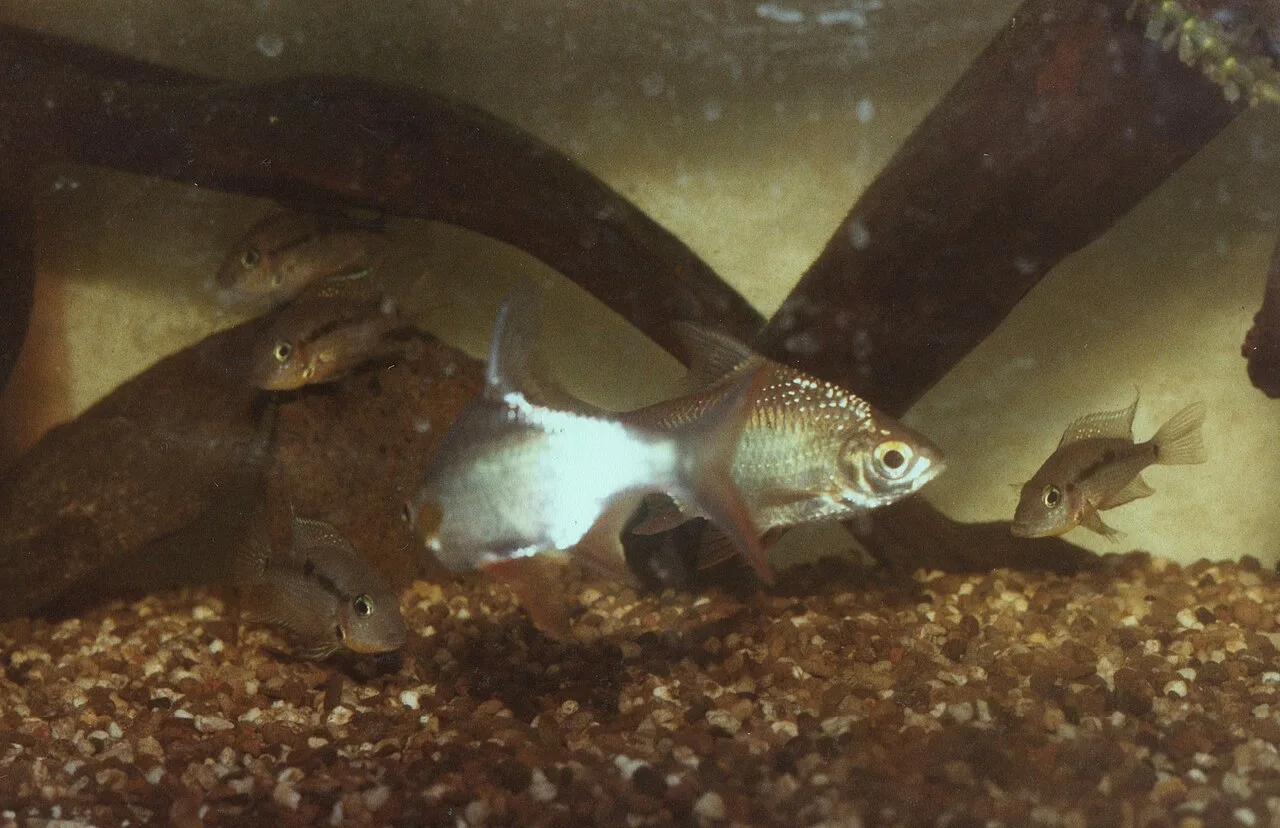
Herotilapia multispinosa reaches about 10 cm. In everyday life the body is olive with a dark longitudinal band. For breeding the fish turn gold with black patches. This colour change is breeding mood. Afterwards the plain coat returns. Males grow a little larger and have more pointed fins.
The species is not the convict and not a Malawi rainbow. It is more likely to leave plants standing if they sit firm, and it fits a larger community tank better than many other Central American cichlids. While breeding it still becomes decided.
Features
The rainbow cichlid grows to 12 to 17 cm, though most adults stay at 7 to 8 cm. The body is high oval, and the teeth are flat and tricuspid, for grazing algae. Behind mid-body below the upper lateral line lies a dark spot, from which an irregular stripe runs over the gill cover to the eye. The ground colour is usually yellow with red and brown tones and can change within seconds between dark brown and bright yellow. Günther described the species in 1867 as Heros multispinosus, and Pellegrin placed it in its own genus, Herotilapia. The name means many-spined.
Origin & habitat
This describes the origin, not how to furnish the aquarium.
Lakes and slow waters in Nicaragua, Costa Rica and Honduras. Plant-rich, often not extremely soft. The countries stay a coarse origin.
The species lives on the Caribbean side from the Rio Patuca in Honduras to the Rio Matina in Costa Rica and on the Pacific side from the Rio Guasaule in Nicaragua to the Rio Tempisque and Rio Bebedero in Costa Rica, plus the Choluteca in Honduras. It inhabits turbid shallows, weedy margins, lakes and swamps with muddy bottoms and survives the dry season in small waters. A population has persisted in the warm thermal lake of Hévíz in Hungary.
Care
Tank
23 to 28 °C, pH 6.5 to 8. From about 120 litres for a pair, with stones, a flat spawning surface, sand and plants that sit firm or are tied on. A second pair needs more length.
Company
Medium-sized, calm fish. While breeding a radius is cleared. Very small tetras can then be eaten. Shrimp as well. Outside breeding the species is reserved and also swims in midwater.
Diet
Omnivore. Granules, frozen food, blanched vegetables. The fish feed from the bottom and in midwater. A pure meat diet is unnecessary. Several feeds, so that during breeding the rest of the tank still finds food.
The diet consists mainly of flocculent detritus, filamentous algae, diatoms and biofilm, and occasionally small fish and insects. In aquaria the species takes flakes and pellets.
Behavior
A pair with a territory. A pair that fits stands together and changes colour together. A pair that chases each other is not a pair. The gold colour is not a permanent look for the shop window. Anyone who wants to see it all the time often disturbs the fish exactly when they are breeding.
Reproduction
Open substrate spawner. Both parents guard eggs and young and lead them for a while. In a community tank the brood survives only if the other fish can leave the territory. A separate tank is the safer path.
As a substrate brooder the species prefers vertical surfaces, ideally in caves. In about two hours 500 to 1500 eggs are laid in lines. Both parents fan, and mainly the female defends. After two days the larvae hatch and are moved into a pit. In the evening the parents gather the young again, and care lasts four weeks and longer. The fish make various sounds with the swim bladder during fights and before spawning.
More species in this group


Similar water needs
Species with a similar temperature, a similar pH and a comparable adult size. Whether their behaviour fits as well is what the compatibility check is for.